
Starbucks Korea Boycott: How Brands Respond to Crisis in 4 Stages
Serge Bulaev
The Starbucks Korea boycott in May 2026 shows how quickly a brand promotion can lead to protests and sales drops. The company responded in less than 48 hours by ending the promotion, apologizing, and removing the CEO, but reputational damage may have continued. The text suggests that brands should handle such crises in four stages: monitoring for early signs, escalating responses as needed, engaging with local stakeholders, and carefully measuring recovery. Early withdrawal of the product and leadership changes might help limit the damage, but full trust recovery appears to require ongoing local engagement and clear communication.

The Starbucks Korea boycott provides a crisis communications playbook for how brands should respond to localized boycotts, beginning with disciplined listening and ending with measured recovery. According to industry reports, the company's "Tank Day" backlash illustrates how quickly a promotion can incite protests, sales drops, and leadership changes. Reports suggest the company pulled the product, issued apologies, and removed its CEO, actions covered by Al Jazeera.
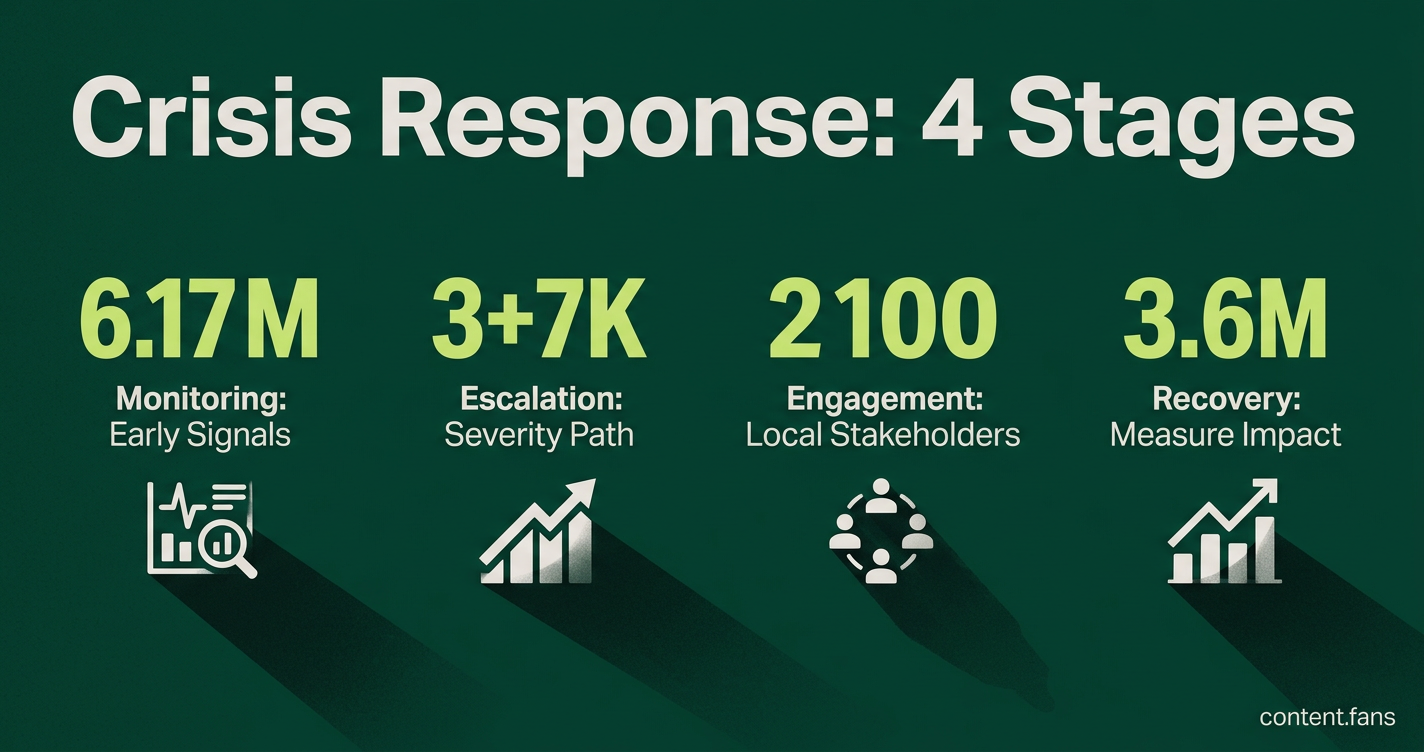
A practical guide for corporate communications and regional leaders must therefore cover four stages: monitoring, escalation, local stakeholder engagement, and recovery measurement.
Early signal detection
Brands navigate crises by monitoring early warning signs across social and traditional media, escalating responses based on severity, and engaging directly with local stakeholders. This approach, combining risk systems with clear communication channels, helps contain damage and map a path toward reputational and commercial recovery.
- Implement a regional risk system with continuous monitoring to track volume spikes, sentiment shifts, and location data across social and traditional media, as advised by CARMA research.
- Distinguish social media chatter from mainstream news coverage to identify when a boycott narrative crosses over into wider public awareness.
- Map potential triggers by adding key historical, political, and cultural anniversaries to a watchlist, as highlighted by the "Tank Day" incident.
- Set automated alerts for threshold breaches, such as a rapid increase in negative mentions. Ensure analysts flag any boycott-related foreign trade requests for legal review under U.S. Office of Antiboycott Compliance rules.
Escalation path for regional boycotts
| Level | Typical signal | Immediate action |
|---|---|---|
| 1 Monitor | Isolated complaints | Log and watch trendline |
| 2 Alert | Coordinated hashtags, local press pickup | Open incident channel, prep holding statement |
| 3 Escalate | Rapid volume growth, retailer queries | Activate crisis team, legal review, stakeholder Q&A |
| 4 Regulated | Boycott request tied to trade laws | Route to compliance, assess BIS reporting |
According to industry reports, Starbucks Korea escalated rapidly after photos of the promotion surfaced on May 18, the anniversary of the 1980 Gwangju Uprising. While a swift withdrawal and apology limited product damage, it failed to prevent reputational fallout, as reported by BBC News.
Local stakeholder engagement
- Segment key audiences - including customers, employees, civic groups, regulators, and local media. The Gwangju protests underscore the importance of targeted, city-level outreach.
- Appoint local spokespeople who are fluent in the cultural context and equip them with messaging support from headquarters.
- Establish active listening channels like town halls, surveys, and direct meetings to systematically capture and log stakeholder concerns in an issue tracker.
- Commit to providing regular, time-stamped updates, such as: "We will publish our next progress report on May 24, outlining resolved items and next steps."
Recovery measurement framework
An effective recovery dashboard should blend reputation, engagement, and commercial metrics to provide a holistic view.
| KPI | What it shows | Baseline tip |
|---|---|---|
| Brand sentiment | Public mood shift | Use pre-crisis 30-day average |
| Share of voice | Narrative control | Compare with top 3 competitors |
| Stakeholder trust | Confidence across groups | Survey every two weeks |
| Customer retention | Business impact | Track churn vs. same period last year |
| Operational recovery time | Stability of local stores | Record first day back to normal footfall |
Focus weekly reports on long-term trends rather than daily fluctuations. If sentiment metrics improve but stakeholder trust lags, the crisis team can deploy additional community briefings or CSR initiatives.
Ready-to-use message templates
-
Initial acknowledgment (≤75 words)
"We recognize the concerns raised about [issue]. We are reviewing the details and will share verified updates within 12 hours." -
Apology with corrective action
"We regret the distress caused. The promotion has been withdrawn, and we are reviewing approval processes to prevent recurrence." -
Stakeholder update
"Our team met with community representatives on [date] and committed to publish a progress report every Friday until key issues are resolved." -
Internal staff note
"Please route all external inquiries to the incident channel. Use only the approved statements below until further notice."
Putting the playbook to work
Put the playbook into practice by conducting quarterly simulation drills using known regional flashpoints. Mandate a pre-launch risk audit for campaigns near sensitive dates and have Level 2 holding statements pre-approved. As the Starbucks Korea boycott illustrates, while early product withdrawal and executive accountability can limit operational damage, long-term trust is rebuilt only through sustained local engagement and transparent measurement.
What triggered the Starbucks Korea "Tank Day" boycott and how severe was the impact?
According to industry reports, Starbucks Korea launched the "Tank Series/Tank Day" tumbler promotion. The date coincided with the anniversary of the 1980 Gwangju Uprising, and many interpreted the imagery as evoking the military crackdown that killed pro-democracy protesters. Reports suggest the promotion was withdrawn, the CEO was dismissed, and South Korean news outlets reported a significant decrease in sales. Physical protests took place outside stores, and the Interior and Safety Minister announced that Starbucks products would no longer be served at government functions.
How should brands monitor for early boycott signals?
Best practice guidance emphasizes a risk-based approach with continuous monitoring, key risk indicators, regular reviews, and controls tailored to the specific risk environment. Key steps:
- Track regional spikes in social, earned, and owned media (CARMA recommends this as the first line of defense).
- Map who is driving the boycott - look at geographic clusters and influential voices.
- Set escalation thresholds before the issue goes public - define volume, sentiment, and outlet tiers that trigger responses.
Common early-warning triggers include sudden price increases, perceived political alignment, labor controversies, and provocative influencer associations.
What does a four-level escalation framework look like?
| Level | Signal | Action |
|---|---|---|
| 1 - Monitor | Low-volume complaints, no clear boycott call | Log, tag region, assign analyst |
| 2 - Alert | Coordinated posts, local media pickup, boycott hashtags | Open incident channel, prepare holding statement, brief regional lead |
| 3 - Escalate | Rapid volume growth, major outlet coverage, retailer/customer queries | Activate crisis team, legal review, executive comms, stakeholder Q&A |
| 4 - Regulated/Reportable | Boycott-related foreign trade request or compliance issue | Route to export-control/compliance team and evaluate BIS/OAC reporting duties |
What ready-to-use templates should every recovery playbook include?
- Crisis definition and severity grid - so teams know exactly when the recovery plan starts.
- Stakeholder map - segmented list of customers, employees, local partners, media, regulators, and community groups.
- Pre-approved message bank - short (tweet), medium (website banner), and long (press release) statements ready for web, email, press, and social channels.
- Feedback loop template - one-page form to capture and triage customer, employee, and community concerns with clear owner and due date columns.
- Recovery timeline - 24-hour, 1-week, 1-month, and 1-quarter milestones with assigned leaders.
Which KPIs best measure boycott recovery?
Industry guidance suggests the most defensible dashboard combines four layers:
- Reputation - brand sentiment, media sentiment, share of voice.
- Relationship - stakeholder trust score, stakeholder satisfaction, community feedback volume.
- Engagement - response rate to recovery content, event attendance, website traffic.
- Business - customer retention rate, churn, NPS recovery, resolution time for complaints.
Broadsight's 2024 playbook recommends weekly reports that compare current metrics to pre-crisis baselines and adjust tactics accordingly.