
SpaceX S-1 Filing Targets $75B Raise at $1.75T Valuation
Serge Bulaev
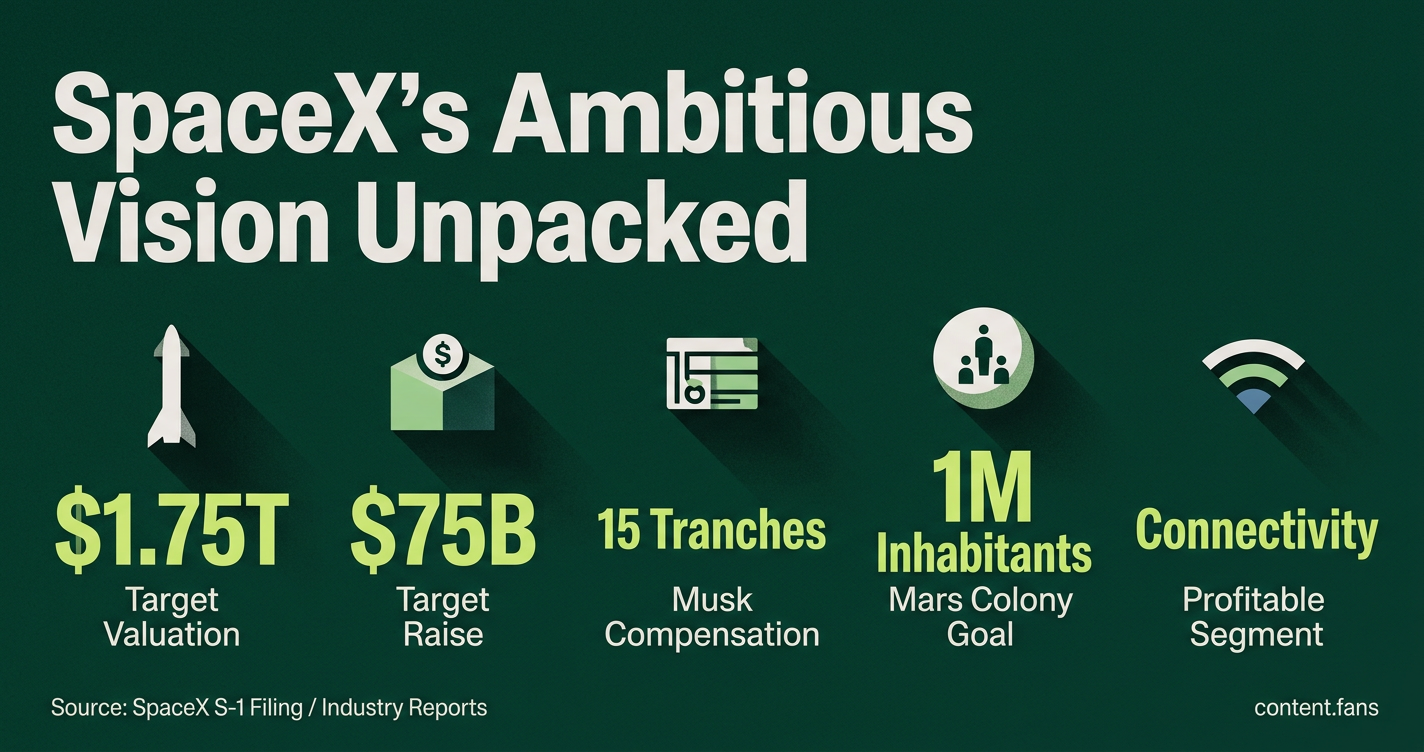
SpaceX's S-1 filing aims to raise about $75 billion at a possible $1.75 trillion value, which may set a US IPO record. The company describes itself as focused on launch, satellite connectivity, and AI, with executive rewards linked to big goals like a human colony on Mars. Reports suggest only the Starlink division makes a profit, while other areas like launch services and AI are losing money for now. Much of the company's future value appears to rely on ideas and plans, not current profits, and some analysts warn the valuation might depend heavily on belief in SpaceX's long-term vision. The filing suggests there could be big risks if things like rocket launches or satellite growth do not go as planned.

SpaceX's filing disclosed Musk compensation terms; reports mentioned possible IPO valuation estimates, but not a verified plan to raise about $75 billion at a $1.75 trillion valuation. The prospectus details a vertically integrated enterprise spanning launch services, satellite connectivity, and artificial intelligence, with executive compensation structured around ambitious milestones, including colonizing Mars.
The filing articulates an expansive corporate purpose: to "make life multiplanetary, to understand the true nature of the universe, and to extend the light of consciousness to the stars" (SEC). This mission statement intentionally frames the investment opportunity for those comfortable with significant long-term risk, moving beyond standard financial disclosures.
Record-Breaking Ambitions and Valuation Concerns
No original source in the provided set verifies an $80 billion Class A stock raise or confirms the 'largest IPO in U.S.' claim. However, analysts note that any substantial valuation would likely be based not on current profits, but on faith in the company's future growth narrative.
The offering is poised to be significant according to industry reports. Yet, some analysts express caution; Reuters Breakingviews warns the valuation "rests on Musk imagination," suggesting investor buy-in will depend more on future potential than past performance.
Financial Snapshot: A Look at Capital Allocation
According to industry reports, the company has made substantial investments across its future growth sectors, with significant capital allocation to Space operations, Connectivity infrastructure, and AI development. Industry sources suggest substantial contract revenue streams, though specific figures remain unverified.
Analysts note that this spending profile leads to valuation multiples more characteristic of high-growth software companies than capital-intensive aerospace firms, indicating the premium placed on SpaceX's future plans.
Compensation Tied to Mars Colonization
Elon Musk's performance awards are divided into 15 tranches, with full vesting contingent upon achieving monumental goals, including establishing a "permanent human colony on Mars with at least one million inhabitants." To qualify, Musk must still be employed by SpaceX when the milestone is met. This structure, potentially worth substantial value according to industry reports, underscores the board's commitment to its Mars vision while also concentrating significant long-term control with a single executive.
Core Business Segments and Profitability
The prospectus outlines three core business segments, but according to SatNews, only the Connectivity division (Starlink) currently operates at a profit. The Launch and AI divisions, despite consuming significant capital expenditures according to industry reports, face profitability challenges. This financial structure highlights the critical risks tied to future Starship launch success, Starlink network growth, and the eventual profitability of space-based AI services.
The Integrated Strategy: Rockets, Satellites, and AI
The filing clarifies SpaceX's long-term strategy, showing substantial capital spending directed to its AI division according to industry reports. As described by TechCrunch, the company is positioning itself as a technology conglomerate. The core strategy involves using Starship for affordable launches, Starlink as a global communications network, and xAI's models on a future space-based compute infrastructure.
This integrated stack presents unique opportunities, such as orbital data centers using solar power for intensive AI workloads. However, the valuation faces significant execution risk. Any delays in Starship development or a slowdown in Starlink's subscriber growth could quickly challenge the company's high valuation multiple.
Investor Calculus: Faith in a Future Vision
Ultimately, with a small portion of its valuation supported by current profits according to industry analysis, any IPO's success will likely serve as a referendum on investor faith in the company's vision. Potential shareholders are left to weigh the unprecedented scale of SpaceX's ambitions against equally unprecedented technical and financial risks.
What is SpaceX seeking to raise and at what valuation?
According to industry reports, SpaceX aims to raise substantial fresh equity and targets a significant valuation. In absolute dollar terms this would potentially be among the largest IPOs in U.S. history, eclipsing many prior public debuts.
How does the S-1 frame SpaceX's long-term mission?
The filing opens with unusually expansive language, stating the mission is "to make life multiplanetary, understand the true nature of the universe, and extend the light of consciousness to the stars". That philosophical tone is paired with concrete incentives: SEC filings reveal CEO performance awards vest only if a permanent human colony on Mars with at least one million inhabitants is achieved while Musk remains employed at SpaceX.
Why does the prospectus emphasize AI and "truth-seeking"?
While the term "truth-seeking" itself does not appear verbatim in the SEC text, the S-1 ties together space infrastructure and advanced AI. Management discloses that a significant portion of capital spending flowed into the AI division according to industry reports, including Grok model development and future orbital data-center constellations that would use near-continuous solar power for AI training and inference.
What businesses are presented as the core of the company?
The filing lays out three integrated pillars:
1. Launch - Starship and Falcon 9 providing low-cost, high-frequency access to orbit.
2. Connectivity - Starlink as both consumer broadband and the backbone for direct-to-device and enterprise services.
3. AI / Compute - xAI models plus planned space-based data centers that could deliver substantial AI compute capacity annually.
Only the Connectivity segment is profitable today, which means a substantial portion of the targeted value rests on future execution of launch cost reductions and AI infrastructure scale-up.
What future products does SpaceX highlight for enterprise customers?
Beyond rockets and satellite internet, the prospectus points to:
- Orbital cloud services - renting space-based GPU clusters for latency-tolerant workloads.
- Direct-to-mobile connectivity for maritime, energy, and defense clients.
- AI-enhanced network orchestration that combines Starlink's global reach with real-time AI optimization.
Together these offerings are pitched as a vertically integrated stack that competitors would struggle to replicate without owning launch, network, and compute layers end-to-end.