
Google updates Search with Gemini AI and Android XR glasses
Serge Bulaev
Google is updating Search with its new Gemini AI model and launching Android XR glasses, which may change how people find information. The new Search uses AI to give more conversational answers and lets users create agents to monitor information for them. Features like SynthID and C2PA may help users check if images are made by AI, adding a trust layer. XR glasses, coming soon, could make searching easier by letting people look at something and get information, but issues like battery life and privacy might slow adoption. Experts suggest these tools might move people away from traditional web searching and make AI-driven, always-on discovery more common.

Google's recent update to Search integrates its powerful Gemini AI model and previews the launch of Android XR glasses, signaling a fundamental shift in how users access information. This evolution moves beyond traditional link-based results toward a conversational, agent-driven model, complemented by ambient discovery through smart glasses. With new content provenance tools like SynthID, Google is building a framework for a more intuitive and trustworthy AI-powered future.
How Does Gemini AI Reshape the Search Experience?
Google Search is transitioning from a list of links to a conversational answer engine powered by its Gemini AI. It now provides direct, multi-step answers, supports custom AI agents for proactive information monitoring, and integrates visual search tools, fundamentally changing the user's journey from query to result.
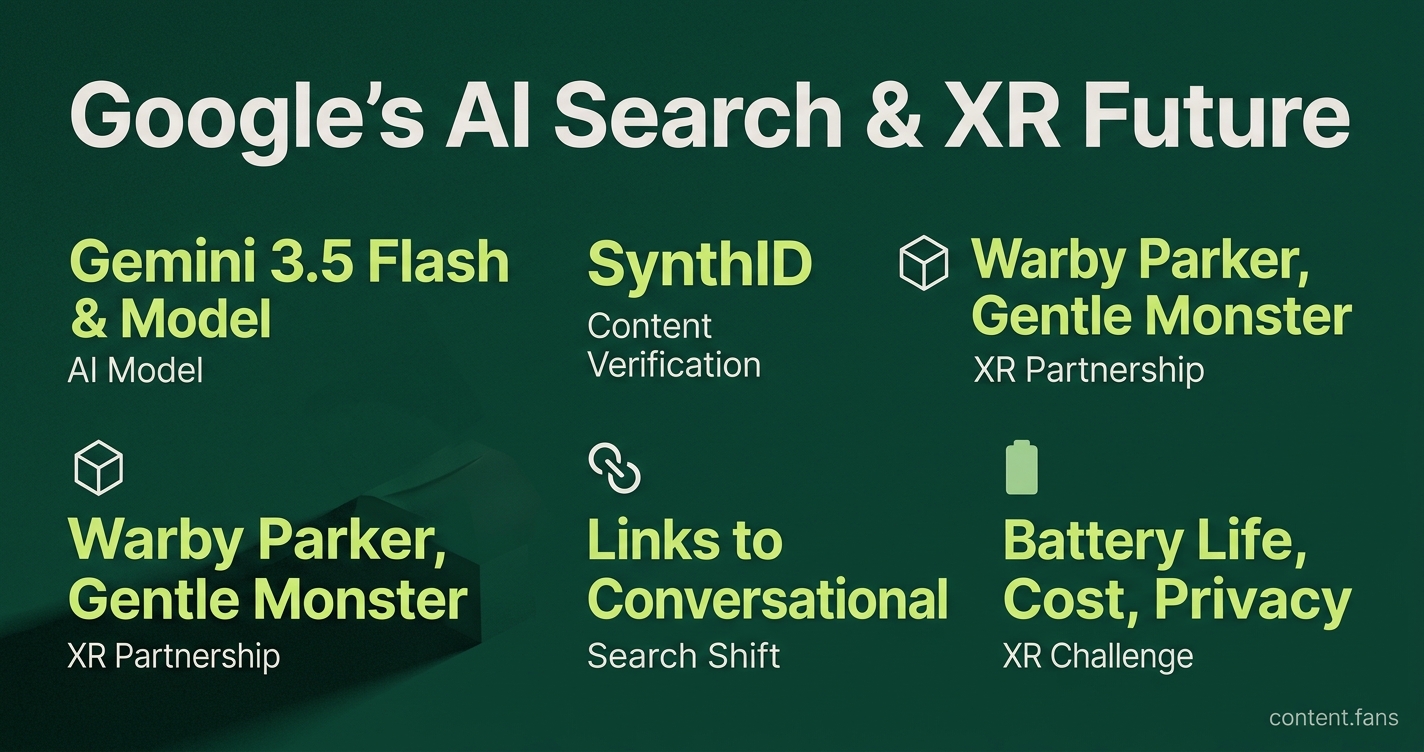
The core of this change is the Gemini 3.5 Flash model, which supports a completely redesigned interface. According to the Google Search Blog, the new search bar enables complex chat-based refinements and allows users to deploy custom agents that track information over time, reducing the need for repetitive manual searches.
How Will Google Verify AI-Generated Content?
To build trust in AI-driven results, Google is exploring content-provenance tools including SynthID. Users will be able to verify if an image is AI-generated, a feature already used millions of times in Gemini. This move aims to embed content verification into daily browsing, establishing a new standard of transparency for digital media.
What Role Do Android XR Glasses Play in the New Search?
Android XR glasses, developed in partnership with brands like Warby Parker and Gentle Monster, are designed to make search an ambient, always-on experience. By feeding visual and voice data into Gemini models, users can perform contextual queries simply by looking at an object. This technology, highlighted in a recent Android XR glasses overview, aims to shift search from a deliberate action to continuous background assistance.
What Challenges Could Slow XR Adoption?
Despite the potential, significant hurdles remain for mass adoption of XR glasses. Key barriers include limited battery life, with current models failing to last a full workday. Other major concerns are high costs, social acceptance issues related to visible cameras, and privacy regulations that could limit use in public or professional spaces.
How Should Publishers and Brands Adapt Their SEO Strategy?
For publishers and brands, the shift to AI-driven search means prioritizing entity-based SEO over traditional keyword density. As AI models like Gemini synthesize information from multiple sources to generate answers, brand authority and citation quality become more valuable than backlinks. The focus must be on clarity, consistency, and machine-readability.
To optimize for discoverability in this new ecosystem, brands should follow this checklist:
- Provide structured data that spells out people, products, and prices.
- Offer transcripts, alt text, and captions so AI can parse every asset.
- Maintain identical brand claims across site, social, and press releases.
- Secure third-party citations that reinforce expertise.
- Monitor how agents quote your content inside Search UI.
The Future of Search: An Agent-Driven Discovery Era
While a definitive timeline remains unclear, Google's latest announcements position AI agents, multimodal inputs, and wearable technology as the foundational pillars of its next discovery era. This strategic pivot suggests that the age of traditional, link-based SEO is evolving, making way for a future where search is a proactive, ambient, and conversational experience.