
Publicis' $2.2B LiveRamp acquisition raises data control, AI concerns
Serge Bulaev
Publicis' planned $2.2 billion purchase of LiveRamp has started debate about who controls important marketing data and how AI will be used. Some experts suggest this deal might change the way brands and agencies share identity data, since a big piece of shared infrastructure could now belong to one company. There are concerns from competitors and regulators about possible loss of neutrality and control, and antitrust reviews may happen. LiveRamp has promised to stay open to all partners, but some worry the industry could become more divided. Advertisers may try to protect themselves by asking for more control over their data and looking for other options.

The planned Publicis $2.2B LiveRamp acquisition is sparking industry-wide debate over data control, AI applications, and the future of identity resolution. The deal raises fundamental questions about who controls the core infrastructure of people-based marketing, as many brands and regulators have long viewed identity graphs as shared utilities. Bringing one of the largest independent graphs into a single holding company fundamentally alters this landscape.
Analysis - What Publicis' LiveRamp acquisition means for data control and AI
Publicis' acquisition brings one of the industry's largest independent identity graphs under the control of a single agency holding company. This shift challenges the long-held view of identity resolution platforms as neutral, shared infrastructure, raising immediate concerns about fair access, competitive advantage, and data privacy.
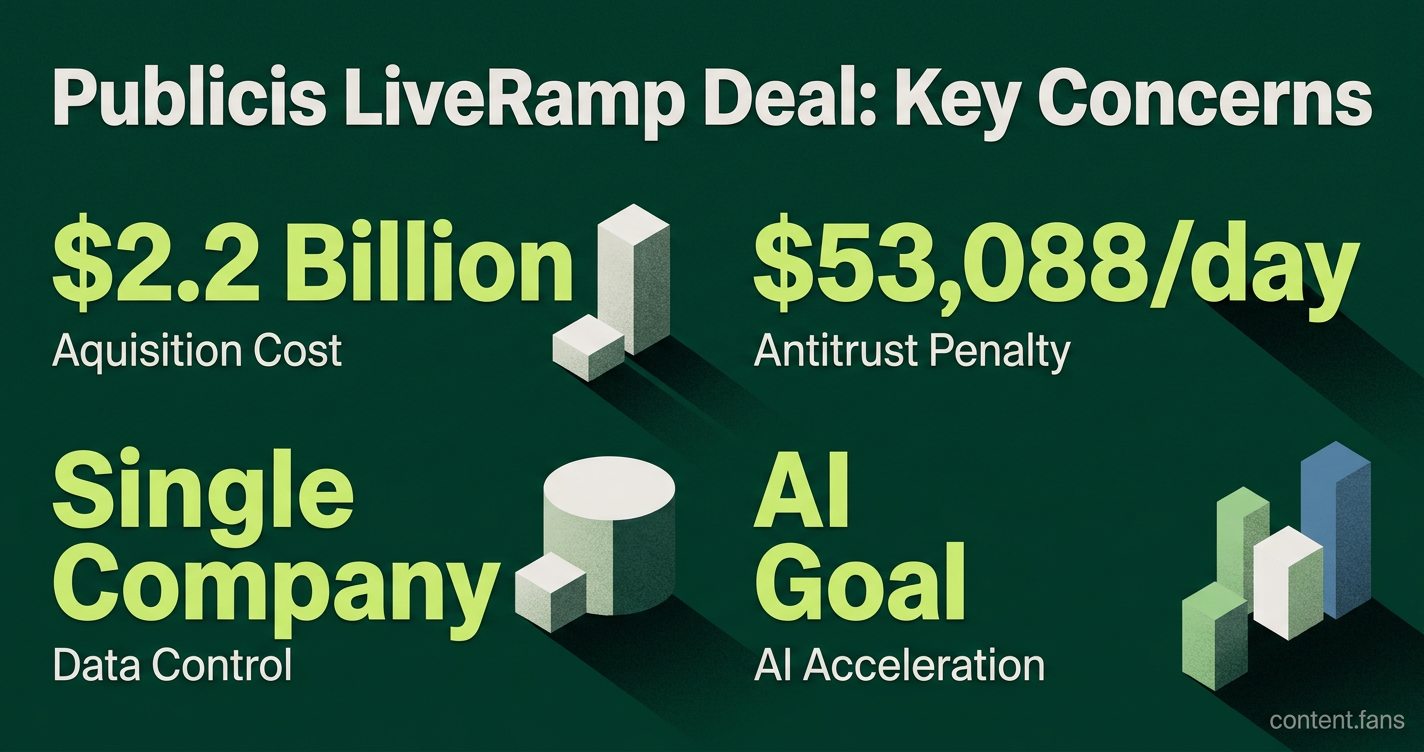
While Publicis positions the acquisition as a step toward "data co-creation" to accelerate AI-powered marketing, industry observers note its scale. The $2.2 billion cash deal represents a significant transaction in the ad-tech space (Axios). In response to concerns, LiveRamp has pledged to operate as an "open, interoperable platform" for all partners (LiveRamp News).
Neutrality worries among rivals
Skepticism from competitors emerged immediately. One retail executive described LiveRamp as the "last big piece of shared infrastructure that didn't belong to someone with a dog in the fight" (The Current). Rivals now fear that connecting client data streams - including sensitive transaction data and hashed emails - to a Publicis-owned entity creates a conflict of interest. As ID5 chief Mathieu Roche noted, Publicis's own claims of gaining a strategic advantage directly challenge its promises of neutrality, potentially driving agencies toward alternative clean rooms and in-house identity solutions.
Regulatory lens
The acquisition will undergo significant regulatory scrutiny, starting with mandatory antitrust reviews under the Hart-Scott-Rodino Act, where non-compliance can lead to penalties of $53,088 per day. Beyond antitrust, data privacy laws like GDPR and CCPA add another layer of risk, compelling firms to prioritize "privacy-centric identity resolution." Regulators are expected to closely examine the deal's impact on consent management, cross-border data transfers, and whether the combined entity gives Publicis unfair market leverage.
Mitigation playbook for advertisers
Advertisers currently dependent on LiveRamp can take proactive steps to mitigate vendor lock-in. Key strategies include both contractual and technical safeguards:
- Demand explicit data-export SLAs and documented exit paths
- Store a canonical identity copy in a neutral warehouse using exportable schemas
- Use open protocols such as OAuth 2.0 and SCIM for any new integrations (GainHQ guidance)
- Add audit rights covering merge events, consent logs, and subprocessor lists
These measures can reduce dependency if the acquisition alters service terms or pricing. In response, agencies are already exploring alternatives by benchmarking independent graphs and retailer-led clean rooms, anticipating what has been described as a "scramble for alternatives."
What exactly is Publicis acquiring and why does it matter for data neutrality?
Publicis is paying $2.2 billion in cash for LiveRamp, a data-collaboration layer that powers identity resolution for many major agencies including WPP, Omnicom, Dentsu, Havas and Stagwell. The platform handles first-party identity graphs, clean-room integrations and cookieless audience matching that most holding companies rely on to run campaigns. The moment LiveRamp is owned by one holding company, competitors worry the "last big piece of shared infrastructure that didn't belong to someone with a dog in the fight" will have a very large dog indeed (source).
Will LiveRamp stay neutral once it is inside Publicis?
Both Publicis and LiveRamp insist the platform will remain "open, interoperable and trusted" (source), but the industry reaction has been "swift and deeply skeptical". Analysts point out that Publicis has already stated the deal will give it a competitive advantage over other agencies, which "directly contradicts any notion of neutrality". Structural incentives matter: when the owner is also a competitor, data access terms, product roadmaps and pricing can shift quietly and in the owner's favor (source).
What regulatory scrutiny could the deal face?
The transaction size will trigger mandatory Hart-Scott-Rodino filing in the US, with fines of $53,088 per day for any missed step (source). On the privacy side, identity resolution platforms sit at the center of GDPR, CCPA and a growing number of new state laws, all of which demand proven consent chains and cross-border transfer safeguards (source). Regulators can delay or condition approval if they feel the combined entity could restrict rivals' access to identity tools or mishandle personal data.
How can advertisers protect themselves from lock-in?
Advertisers who depend on LiveRamp today should act under the assumption that neutrality can erode. Contractual protections are the first line: negotiate data-export SLAs (target <30 days), require transition assistance clauses that include schema mapping and cut-over support, and add annual audit rights covering consent logs and admin activity. Technically, separate the stack into modular layers: keep a vendor-neutral identity warehouse in Apache Iceberg or Delta Lake, only use identity APIs that expose standard OAuth 2.0/OpenID endpoints, and run quarterly exit drills that export profile, consent and audience data to an alternative platform (source, source).
What are realistic fallback options if neutrality disappears?
If trust collapses, expect an agency scramble for alternatives (source). Advertisers can pre-empt the rush by:
- Parallel pilots: stand up a second identity provider (e.g., ID5, UID2 operator) in a portion of media spend and measure match-rate parity.
- Identity orchestration layer: build an internal service that can route profile queries to any vendor via a standard API; this keeps downstream DSP and CDP integrations unchanged.
- Neutral clean rooms: use Snowflake or AWS clean rooms for data collaboration instead of LiveRamp's Safe Haven to avoid holdco data exposure.
- Contractual sunset: include a "neutrality trigger" that allows early termination with no penalty if Publicis changes terms, pricing or access for competing agencies.
By acting now, brands keep leverage and avoid the significant migration timelines that typically follow a surprise lock-in event.