
Publicis acquires LiveRamp for $2.2 billion, sparking ad tech debate
Serge Bulaev
Publicis is buying LiveRamp for $2.2 billion, which may change how ad tech companies work together. Experts say this deal suggests a shift toward owning the key technology behind ads, instead of just running campaigns. Some people worry that LiveRamp, once seen as a neutral platform, might not stay that way when owned by Publicis. The companies promise the platform will stay open to everyone, but some agencies are still concerned about fairness and data security. The deal is not final until 2026, and it may lead to more companies looking for other options if they feel the platform is no longer neutral.

The announcement that Publicis acquires LiveRamp in a major acquisition has sent shockwaves through the ad tech industry, igniting a fierce debate about platform neutrality and the future of data collaboration. The deal signals a strategic shift from campaign execution to owning critical infrastructure, leaving rivals questioning the future of a platform once considered the "Switzerland of the identity landscape." Industry experts doubt this neutrality can survive under the ownership of a major agency holding company.
What Publicis is buying
Publicis's acquisition of LiveRamp represents a strategic pivot toward owning foundational advertising technology. This move gives Publicis control over LiveRamp's extensive network for identity resolution - a critical component for privacy-compliant, AI-driven marketing - while raising questions about the platform's future neutrality in the industry.
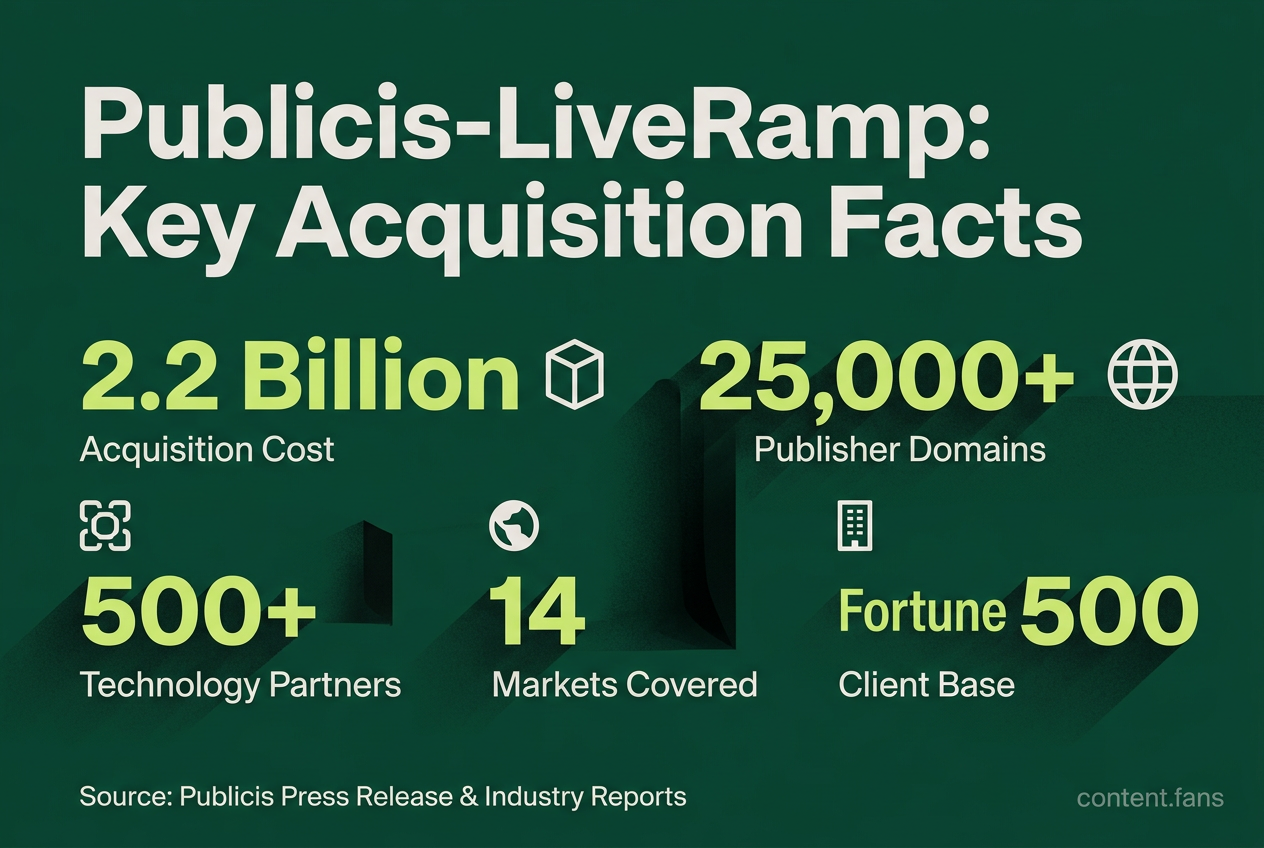
As detailed in the Publicis press release, LiveRamp provides the data collaboration backbone for a vast ecosystem, connecting over 25,000 publisher domains with more than 500 technology partners across 14 markets. Its core RampID framework allows brands to unify first-party data across channels while preserving user privacy. Publicis views this capability as essential for its agentic AI services, where accurate identity graphs are fundamental to forecasting, creative automation, and performance measurement.
According to industry reports, LiveRamp's market position includes:
- A significant client base of enterprise companies, including a substantial portion of Fortune 500 companies.
- A large team of employees focused on identity resolution, clean rooms, and partner integrations.
- Consistent growth over recent years.
Why neutrality matters
LiveRamp's historical value proposition was built on its promise of neutrality, ensuring equal access and treatment for all partners. While both companies have publicly assured the market that the platform "will continue to operate as a neutral, interoperable layer," the industry remains skeptical. As reported by AdExchanger, competing agencies are concerned about potential competitive disadvantages if Publicis gains privileged access to cross-platform data.
These concerns are crystalizing into critical procurement questions:
1. Will competing agencies receive the same service terms and support?
2. What data governance firewalls will be erected to protect client information from other Publicis entities?
3. Could platform pricing and feature development be prioritized for Publicis clients?
Early market reactions
Initial market reactions reflect widespread concern. MediaPost notes that the acquisition threatens the "neutral middle" that publishers and retailers have long relied on. In response, many industry observers predict a surge in demand for alternative identity providers and independent clean rooms. While some point to contractual clauses promising open access as a mitigating factor, the long-term outlook remains uncertain.
According to industry reports, the deal creates a period of scrutiny. Key metrics to watch will be customer churn, pricing fairness, and the results of data governance audits, which will serve as indicators of whether industry skepticism leads to a mass migration to competing platforms.
Strategic backdrop
The acquisition aligns with a powerful strategic trend: the growing pressure to own "data plumbing" as AI automates core advertising functions. From this perspective, Publicis is vertically integrating its technology stack. LiveRamp's collaboration layer complements Publicis's existing assets, including Epsilon's first-party data and Lotame's audience tools, creating an end-to-end solution for data sharing and closed-loop measurement.
This move is indicative of a larger industry shift where major holding companies are evolving from service providers to owners of proprietary platforms. The goal is to deliver measurable, identity-grounded outcomes in an increasingly automated advertising landscape.
What does Publicis Groupe get for this major acquisition?
LiveRamp - a data collaboration platform that already links 25,000 publisher domains and 500-plus technology partners in 14 countries.
Publicis says LiveRamp will let it accelerate data co-creation for smarter agents, positioning identity governance as the gateway to AI-driven campaigns.
Will LiveRamp stay neutral now that an agency holding company owns it?
Publicis promises yes; the industry answers probably not.
- Publicis statement: "LiveRamp will continue to operate as a neutral, interoperable platform and provide open access across the ecosystem."
- Industry reaction: most outside agencies doubt the "Switzerland of the identity landscape" can stay Swiss when it sits inside one of the world's three largest holding companies.
Expect rival shops to request **enses or hard-governed contracts before sharing first-party data.
How are competitors reacting?
An immediate scramble for alternative identity and clean-room vendors.
AdExchanger reports that independent agencies are actively evaluating ID5, InfoSum, and Habu to reduce reliance on a platform now controlled by a direct competitor.
Expect procurement teams to run side-by-side pilots and demand data-ring-fence clauses in new master-service agreements.
Why is identity ownership suddenly central to agency valuations?
Because whoever controls the ID layer controls the AI outcome layer.
- According to industry reports, identity infrastructure is considered a key valuation driver and a top focus for M&A activity, alongside CTV and retail-media tooling.
- Buyers now reward recurring-revenue, tech-enabled agencies with premium multiples, while project-based firms face discounts.
What should brands and publishers do next?
Audit contracts and test neutrality in live campaigns.
1. Review Master Service Agreements for clauses that let you port audiences out if neutrality erodes.
2. Run multi-vendor experiments with at least one independent identity provider to benchmark match rates and cost.
3. Include AI-governance language that limits how any holding-company owner can use shared data for model training.