
Sen. Warner's AI Bill Integrates EU AI Act Rules For US Businesses
Serge Bulaev
Sen. Warner's AI Bill may add rules similar to the EU AI Act for U.S. businesses, focusing on transparency and audits for high-risk AI systems. Companies might need to get user consent, minimize unnecessary data, and keep secure logs for at least 180 days. Security experts suggest building clear systems for tracking AI actions and making sure logs are easy to review if regulators ask. Choosing vendors may require checking if they meet security and documentation rules. Experts believe preparing early could help businesses avoid bigger problems or costs later.

Enterprises tracking Senator Warner's AI bill are realizing its potential to integrate core rules from the EU AI Act into U.S. law. As high-risk obligations in the EU Act activate, this proposed legislation would layer comparable transparency and audit duties on American businesses. For product and compliance teams, the urgent question is how to translate these clauses - covering consent, data minimization, and logging - into daily engineering work.
This article provides a practical analysis, mapping regulatory clauses to concrete actions so companies can proactively adjust their roadmaps, procurement, and staffing.
Regulatory Triggers That Matter
The EU AI Act mandates strict compliance for high-risk AI systems, while the proposed U.S. legislation seeks to establish similar frameworks. The specific U.S. obligations for user consent, data minimization, and maintaining tamper-evident audit logs are not current federal law, though they mirror the stringent requirements already established by the EU AI Act.
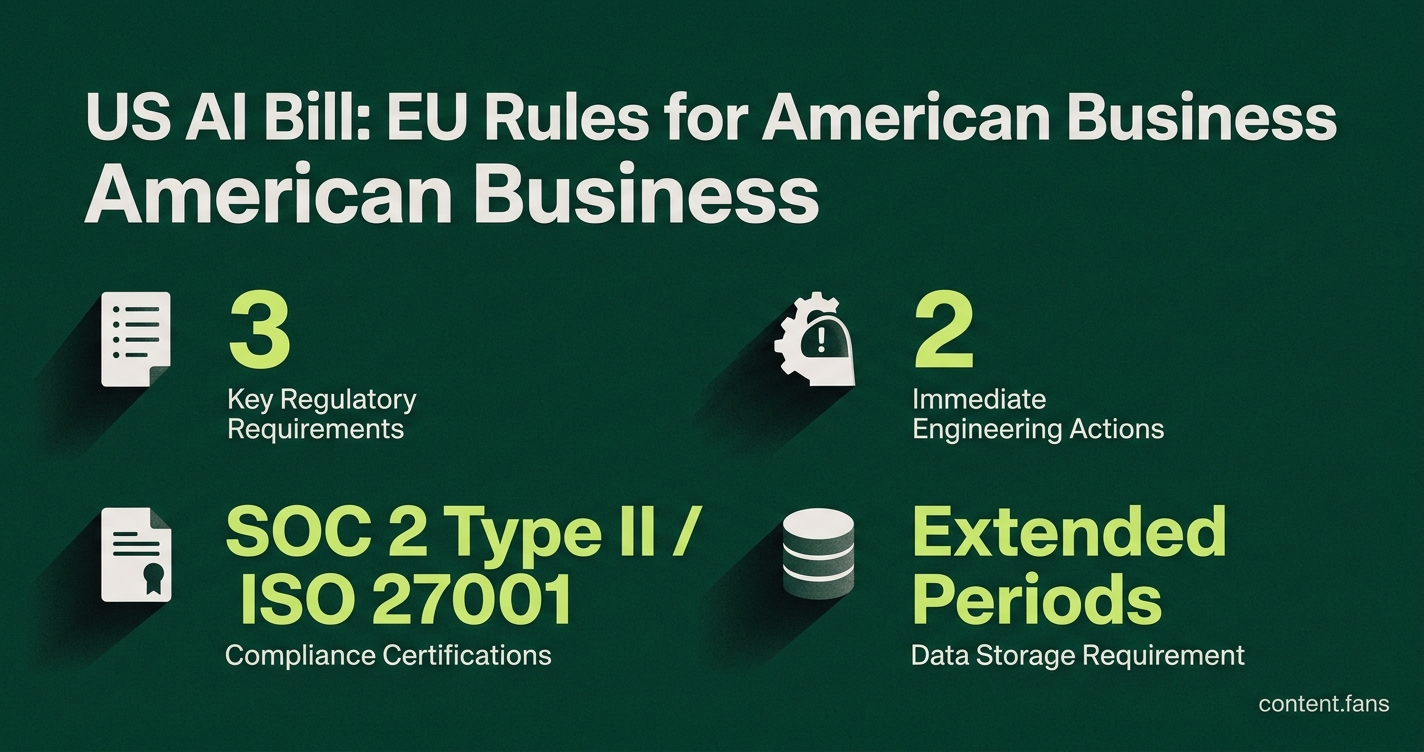
Legal analysts highlight three universal requirements emerging from regulatory discussions:
- Consent flows that record data subject agreement before an agent ingests personal information.
- Data minimization proofs showing that prompts and context windows exclude extraneous attributes.
- Tamper-evident audit logs stored for extended periods, searchable by regulators on request.
Product Roadmap Shifts: Inventory, Guardrails, and Documentation
AI governance tooling is increasingly being treated as a contract prerequisite in security reviews, a trend supported by industry reports from Globenewswire and Spendflo. This shift necessitates two immediate engineering actions:
- Build or acquire an agent registry that details the purpose, data scope, and human escalation points for every AI workflow.
- Integrate logging hooks at the context delivery, tool invocation, and outbound action layers to ensure every decision is fully replayable.
For the medium-term, product leads should prioritize explainability features. Industry analysis from Observer and Spendflo indicates that regulators will expect deployers to provide comprehensive documentation that pairs an agent's output with the specific data it used. This requires saving final prompt stacks and storing feature attributions where supported by the model.
Vendor Selection and Contracting Implications
Procurement teams must now filter vendors based on governance and compliance, not just model accuracy. Consistent with NIST's AI Risk Management Framework, security questionnaires are already flagging vendors lacking SOC 2 Type II or ISO 27001 certifications. Key screening questions include:
- Does the platform generate immutable JSON logs for every agent step?
- Are role-based permissions enforced at the tool layer, or only at the API gateway?
- Can the vendor export technical documentation meeting regulatory requirements?
A failure to secure clear, affirmative answers may signal significant compliance gaps.
Operational Playbook: What to Do This Quarter and Next
Short-term (Next 90 Days):
1. Conduct a risk inventory of all existing AI agents against the EU AI Act's high-risk categories.
2. Update privacy notices to disclose autonomous processing and specify log retention periods.
3. Deploy circuit breakers that automatically halt agent actions when anomaly detectors are triggered.
Medium-term (Next 6-12 Months):
1. Complete Fundamental Rights Impact Assessments for all high-risk use cases.
2. Migrate logs to a tamper-evident storage solution with extended retention and indexed search capability.
3. Formalize an incident escalation path that routes severe events to legal and the CISO within one hour.
Proactive alignment with these anticipated rules is critical for reducing future compliance costs and preventing disruptive product freezes.
What does Sen. Warner's AI bill change for US companies already eyeing the EU AI Act?
The short answer: it folds the EU's risk-based rules straight into US commerce law. If your roadmap already assumes EU compliance, you'll recognise the same high-risk list, extended log mandate, and pre-market conformity checks. What shifts is the venue and the penalty math - Washington can impose criminal liability on officers and claw back federal contracts, so C-suites that only "noted" Brussels deadlines now own a US-grade liability.
Which internal systems fall under "agent" rules?
Any software that ingests data, takes action, and keeps running without a human pressing "enter". Classic examples are recruiting screeners, credit-scorers, network-security bots, and customer-service chatbots that can trigger refunds or account closures. The Bill pulls the EU trigger list verbatim, so if a process was labelled high-risk in Brussels it is high-risk in Virginia as well.
What concrete engineering steps reduce exposure?
- Inventory first: tag every agent with its data sources, privilege level, and business function - no exemptions.
- Drop privileges to least-access; convert standing service accounts to scoped, time-bound tokens.
- Turn on tamper-evident logs (WORM storage or LTO) covering prompt, API call, response, and final action.
- Insert circuit-breakers: hard stop if credential use, spend, or outbound data transfer spikes above rolling mean.
- Wrap agents in sandbox containers; forbid direct kernel or DB super-user access.
How should product roadmaps change?
Build "compliance in" rather than retrofit. Schedule Weeks 1-2 to map EU/US high-risk flows, Weeks 3-4 to design guardrails and escalation paths, then code features. Start with a single narrow use-case (one high-volume ticket queue or report run) so you can validate bias, explainability, and kill-switch efficacy before you scale sideways. Multi-agent orchestration should wait; regulators want proof-of-control on one agent before you network dozens.
What belongs in updated vendor contracts?
Add mandatory clauses on (a) SOC 2 Type II + ISO 27001 certificates, (b) GDPR/HIPAA technical safeguards for data handling, (c) right-to-audit with reasonable inspection notice, and (d) indemnity clauses with appropriate caps for non-conforming models. Require vendor support for adversarial testing logs and red-team findings for every model change. If the supplier can't produce those artefacts, procurement teams are advised to disqualify.