
Salesforce launches Agentforce Commerce, unifies AI agents for retail
Serge Bulaev
Salesforce launched Agentforce Commerce in June 2026, bringing its Shopper, Buyer, and Merchant AI agents together on one platform for retailers. Early reports from Salesforce suggest that retailers using Agentforce saw big increases in site visits and sales, though results may differ. The system connects to popular AI services like ChatGPT and Google Gemini, with more features and payment options planned soon. Analysts say these tools might help stores reach more interested shoppers and improve customer experiences. Over 6,000 companies have reportedly signed up, but some features may still be catching up for headless storefronts.

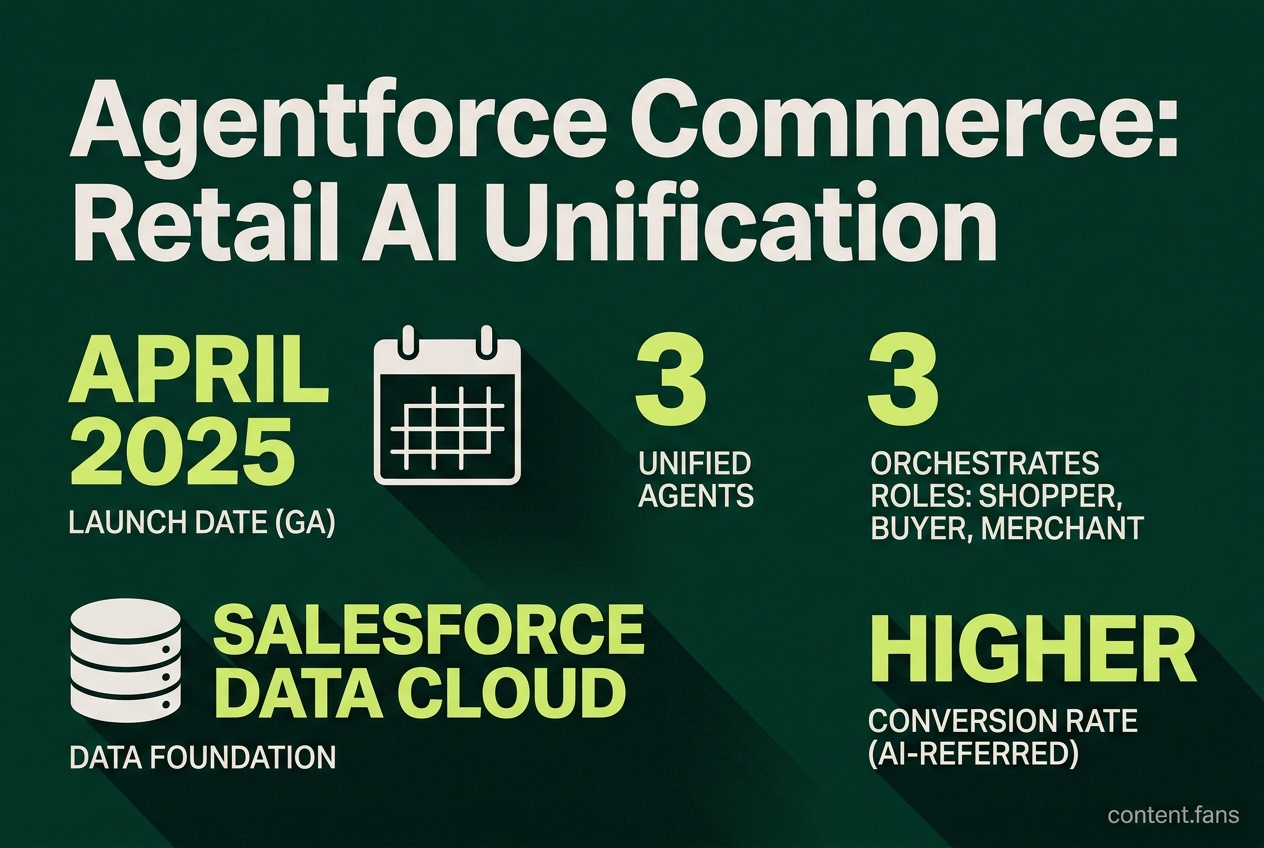
Agentforce for Guided Shopping (B2B & D2C) launched for GA in April 2025, with additional commerce features added in the Summer '26 release on June 15, 2026. The enhanced multi-agent suite unifies Salesforce's Shopper, Buyer, and Merchant Agents into a single orchestration layer, designed to translate AI capabilities into measurable retail outcomes.
Early results indicate significant impact, with AI assistants in Agentforce showing substantial improvements in retail engagement according to industry reports.
Three agents, one playbook
Agentforce Commerce is a unified retail platform that orchestrates three distinct AI agents: Shopper, Buyer, and Merchant. It integrates Salesforce's commerce, B2B, order management, and payments functionalities with Data Cloud to create a single, cohesive system for driving sales and improving customer experiences.
The new orchestration coordinates three discrete roles without custom code:
1. Shopper Agent acts as a personal stylist and product finder.
2. Buyer Agent focuses on procurement scenarios.
3. Merchant Agent helps staff manage catalog and promotions.
The platform's architecture connects to external AI services through Salesforce's own LLM gateway and Flex Credits system. Future roadmap items include enhanced integration capabilities for conversational commerce experiences.
Outcomes retailers can track
Industry reports suggest that retailers using AI-powered shopping agents are experiencing significant growth compared to their peers. Case studies provide further context, with companies like Pandora reporting improvements in customer satisfaction metrics after automating high-volume product questions.
Analysts believe these results show how agentic shopping can capture high-intent traffic before a customer visits a brand's website. During recent holiday seasons, shoppers referred by AI have shown higher conversion rates compared to other sources, highlighting a shift toward conversational discovery.
A unified data foundation
Agentforce Commerce unifies the former Commerce Cloud, B2B, order management, and payment platforms, all connected through Data Cloud. Salesforce highlights this unified stack as a key differentiator from competitors that use bolt-on AI widgets. Enhanced search capabilities help eliminate zero-result pages through natural language interpretation.
To gauge readiness, retailers can use the following checklist:
- Confirm catalog meets schema for commerce protocols.
- Map payment methods ahead of channel launches.
- Train service teams on Merchant Agent dashboards.
- Benchmark current search exit rates before enabling intent-aware search.
- Monitor AI-referred traffic share weekly after go-live.
According to market analysts, competitors like Shopify and Adobe provide AI features but often rely on third-party plug-ins for external channel integration. By ensuring the retailer remains the merchant of record, Agentforce eliminates the reconciliation challenges that occur when orders are processed in external marketplaces.
By Q2 2026 (April-June), cumulative Agentforce deals reached 12,500 total, with approximately 6,000 paid deals, signaling strong market interest. While headless storefronts can adopt the suite, engineers point to a feature lag compared to managed sites, a gap expected to close with upcoming API releases later this year.
FAQ - Salesforce Agentforce Commerce
What is Agentforce Commerce and when did it officially launch?
Agentforce Commerce is Salesforce's re-branded, unified B2C, D2C, B2B, Order Management and Payments platform that now coordinates three purpose-built AI agents: Shopper, Buyer and Merchant. Agentforce for Guided Shopping launched for GA in April 2025, with enhanced commerce features added in subsequent releases.
Agentforce was initially launched in October 2024, and by Q2 2026 (April-June), cumulative Agentforce deals reached 12,500 total, with approximately 6,000 paid deals.
How do the three agents work together?
- Shopper Agent - acts like an always-on Personal Shopper, answering questions and surfacing products via natural-language, intent-aware search.
- Buyer Agent - executes routine procurement workflows for B2B customers (e.g., re-ordering safety-stock).
- Merchant Agent - autonomous merchandiser that updates pricing, promotions and inventory across every channel.
All three agents run on the same Data Cloud instance, so the moment one agent learns something new the other two can act on it instantly.
Are the performance claims real or just hype?
Early adopters have provided measurable results:
- Retailers that deployed shopper agents are experiencing significant growth compared to those that didn't.
- Case studies show companies like Pandora reporting improvements in customer satisfaction metrics and service efficiency.
- Across recent holiday seasons, AI-assisted traffic has shown higher conversion rates compared to traditional traffic sources.
Which AI channels are natively integrated and why does it matter?
Agentforce Commerce provides native integration capabilities for publishing product catalogs to various AI channels without hand-off pages or manual redirects. The platform uses Salesforce's own LLM gateway and Flex Credits system for AI integrations.
Because retailers remain the merchant of record, every transaction lands in the same system that runs loyalty, service and marketing.
What technical guardrails exist for implementation?
- Managed storefronts receive new Agentforce features first, usually within 4-6 weeks after GA.
- Headless implementations via SCAPI or LWR are supported but still require a dedicated engineering sprint to reach feature parity.
- All integrations use open protocols for future AI channel compatibility without re-architecting the middleware.
Retailers who want to pilot quickly should start on the managed storefront and migrate to headless once ROI is proven.