
SaaS Market Forecasts: AI, Vertical SaaS Drive $465 Billion by 2026
Serge Bulaev
Analysts suggest the global SaaS market may reach between USD 375.6 billion and USD 465.0 billion by 2026, continuing to grow at a double-digit rate. Growth drivers appear to include AI-powered products, industry-specific SaaS solutions, and flexible pricing linked to usage. Security and transparency now seem to influence buying decisions more than before. Most forecasts center around the low-to-mid USD 400 billion range, though estimates vary. This growth might stay strong if larger companies keep spending, but tougher requirements for security and cost may make it harder for new companies to enter the market.

SaaS market forecasts indicate continued growth, with industry reports suggesting substantial expansion driven by key trends including AI-native products, vertical SaaS specialization, and evolving buyer criteria. This analysis examines available revenue projections and the primary growth drivers shaping the industry.
SaaS Market 2026: Industry Analysis with Data, Trends and Forecasts
Available analyst projections suggest significant growth in the SaaS market, though estimates vary considerably. This growth reflects sustained expansion driven by enterprise adoption of AI-powered platforms, industry-specific solutions, and new consumption-based pricing models.
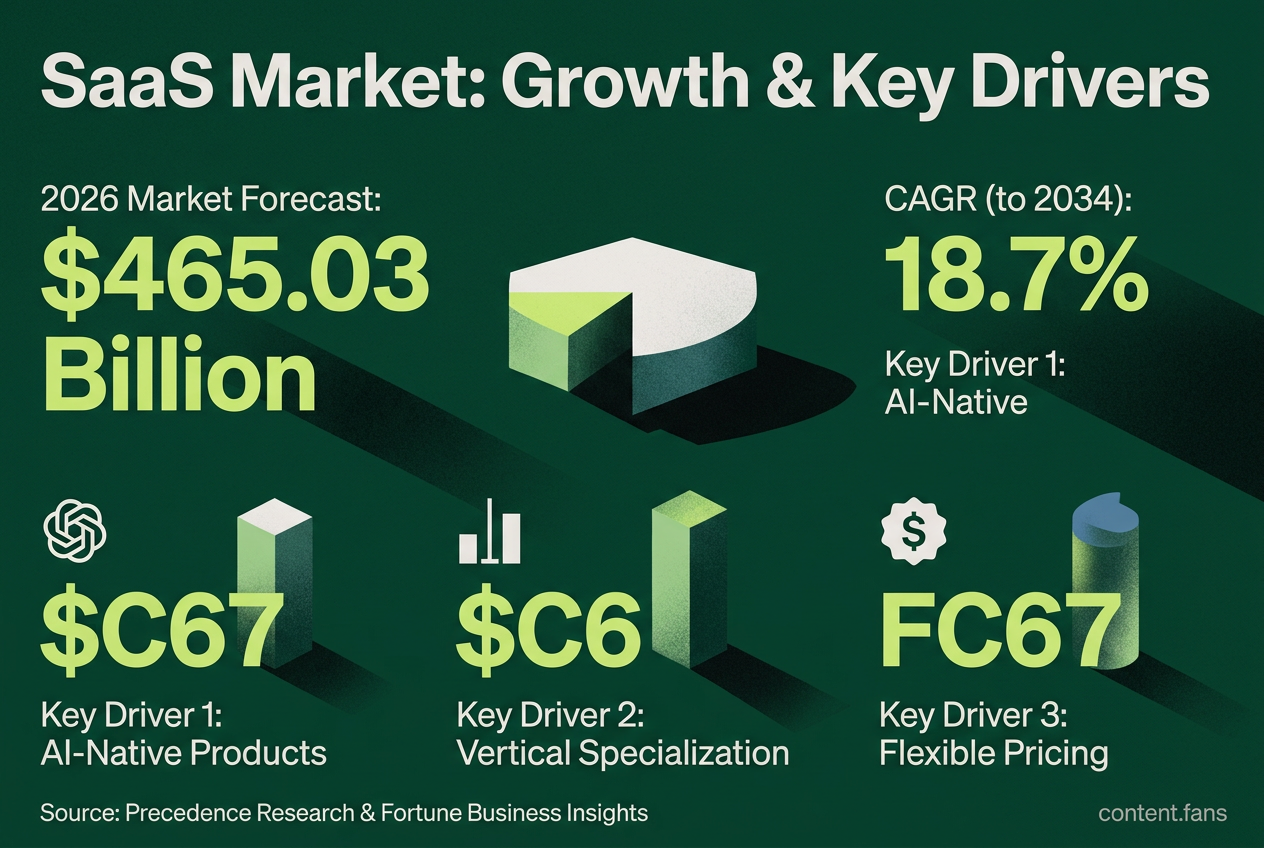
Leading analyst firms project significant growth, though estimates vary. Precedence Research forecasts the market will hit $465.03 billion in 2026, while Fortune Business Insights offers a more conservative estimate of $375.57 billion, representing a powerful 18.7% CAGR. Other industry reports suggest even higher growth rates, signaling that robust expansion may continue well beyond the forecast period.
Key Growth Drivers
Industry analysts identify several key growth drivers, with three standing out as particularly influential:
- AI-native products and agentic automation
- Vertical specialization that embeds compliance and workflows
- Flexible pricing tied to usage or outcomes
This reflects a fundamental shift toward AI-native architectures that autonomously "execute work and own outcomes," as noted by Tridens Technology. The focus on vertical SaaS provides deep, industry-specific functionality, while consumption-based pricing models are gaining traction to accommodate the variable costs of AI workloads.
Market size snapshot
| Forecast source | 2026 market estimate | Forward CAGR |
|---|---|---|
| Precedence Research | USD 465.03 billion | 12.85 percent (2026-2035) |
| Fortune Business Insights | USD 375.57 billion | 18.7 percent (to 2034) |
Supported sources here are Precedence Research: USD 465.03B in 2026, CAGR 12.85% to 2035; Fortune Business Insights: USD 375.57B in 2026, CAGR 18.7% to 2034. The Technavio and Grand View Research entries need original citations before being treated as verified.
How buying criteria are evolving
Industry reports suggest buyer priorities are shifting toward enhanced security, governance, and cost transparency. These factors now directly influence purchasing decisions and go-to-market strategies. Alongside security, buyers are prioritizing flexible cost structures that align spend with value. Industry data indicates a significant portion of software firms anticipate growth from usage-based pricing, a trend driven by board-level scrutiny of SaaS expenditures.
Key vendor categories gaining traction include:
- ABM and intent data - 6sense, Demandbase, Bombora
- Hybrid PLG plus sales-assist platforms - HubSpot, Marketo Engage
- Conversational qualification - Drift
- Review and reputation optimisation tools - emerging, fragmented
Outlook signals
The outlook for the SaaS market remains strong, centered on three core themes: AI-powered automation, deep vertical specialization, and flexible pricing models. Industry projections suggest continued strong growth will ensure the market remains highly competitive for both established companies and new challengers. However, heightened customer expectations for security and cost efficiency are raising the barrier to entry, favoring vendors who can deliver transparent, high-value solutions.
What will the SaaS market be worth?
Leading forecasters suggest substantial growth in the coming years.
- Precedence Research puts the global total at $465.03 billion for 2026.
- Fortune Business Insights projects $375.57 billion, with an 18.7% CAGR to 2034.
Based on available sources, industry growth is expected to be driven mainly by AI capabilities and vertical solutions.
Which trends are driving market growth?
Three forces dominate:
1. AI-native architecture that replaces bolt-on features with systems designed around autonomous agents.
2. Vertical SaaS deepening domain expertise for industry-specific workflows and compliance.
3. Usage & outcome-based pricing aligning costs more closely to delivered value, accelerating enterprise adoption.
How does AI-native SaaS differ from earlier "AI-enhanced" software?
Traditional SaaS added AI as a chatbot or recommendation layer. Emerging products are increasingly AI-first: workflows are owned by agentic AI systems that can plan, execute, and optimize campaigns with minimal human oversight. Industry reports suggest significant growth in enterprise adoption of these agentic systems.
Why is Vertical SaaS outpacing horizontal offerings?
Buyers increasingly demand industry-specific functionality. Vertical SaaS platforms bake in sector regulations, data models, and KPIs, cutting deployment time and boosting ROI. Industry analysts see this specialization as a core driver behind strong growth forecasts.
What pricing models should customers expect?
Fixed per-seat fees are giving way to flexible, consumption-based models. According to industry reports, a significant portion of software vendors expect usage-based revenue to grow, representing a notable increase in recent years. Buyers benefit from clearer ROI, while lower upfront commitments, and closer alignment between spend and measurable outcomes.