
Google Unveils Gemini 3.5 Flash, Its Fastest Agentic AI Model
Serge Bulaev
Google has introduced Gemini 3.5 Flash, which is its fastest AI system designed for autonomous tasks, not just chat. The model may run complex tasks for hours and can pause when it needs human approval. Google says it is faster and may be more cost-effective than previous models, but the real-world benefit depends on reliability and proper safety controls. Some companies are testing it for tasks like document reviews and coding, and it supports several different input types. It is available now, but its wider use may depend on how well it can handle long, complex jobs on its own.

Google has unveiled Gemini 3.5 Flash, its fastest agentic AI model, engineered for complex autonomous execution rather than conversational replies. As a mid-tier offering between the Flash and Pro lines, it demonstrated its power at Google I/O by building coding pipelines and an entire operating system from simple prompts. According to Google Cloud, Gemini 3.5 Flash delivers frontier-level accuracy on key agent benchmarks while generating output up to four times faster than previous models.
What the new "agentic" label actually covers
The 'agentic' capabilities of Gemini 3.5 Flash enable it to operate autonomously for extended periods, executing complex, multi-step tasks. It can orchestrate sub-agents and only pauses for human approval at predefined permission boundaries, moving beyond single-turn conversational replies to handle long-running, stateful operations.
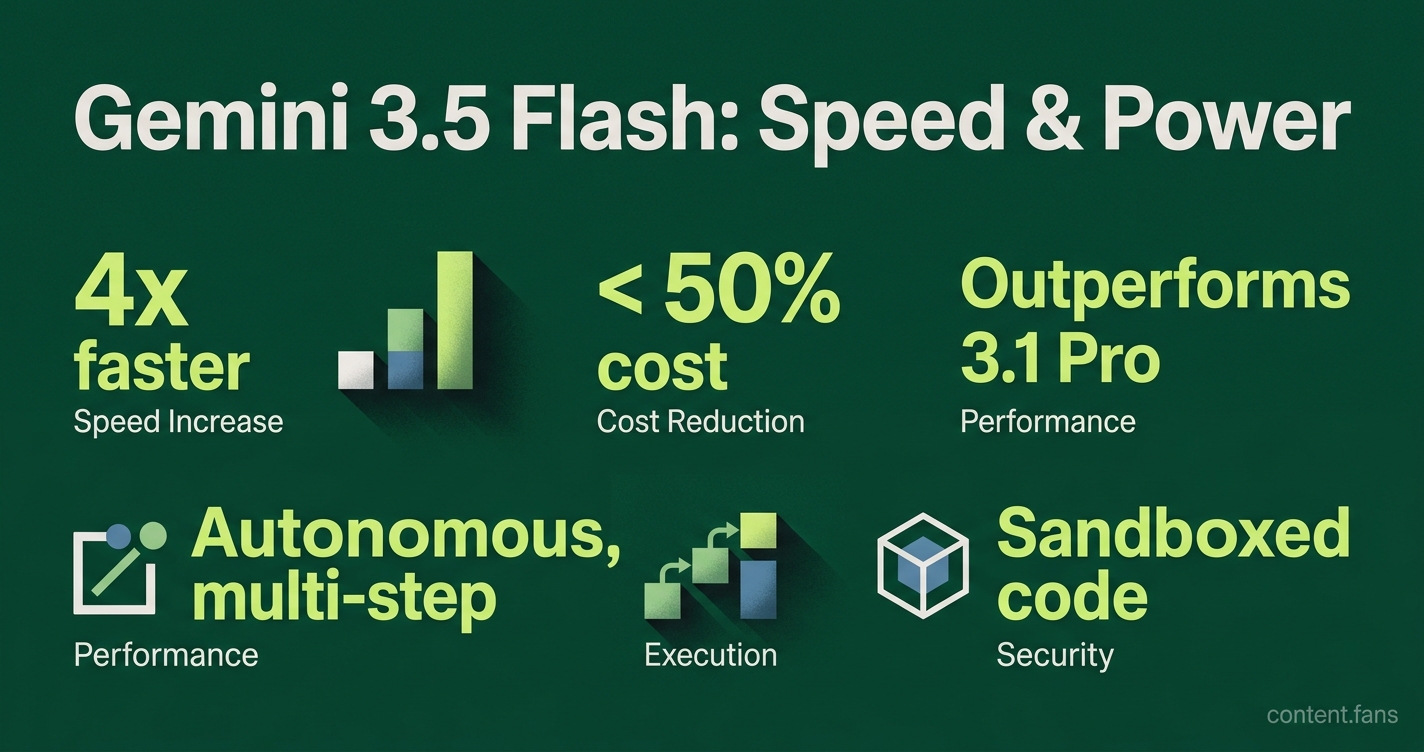
This new model can run autonomously for extended periods, pausing only for human sign-off at critical permission points. This allows it to function as a primary orchestrator, delegating tasks to multiple sub-agents. Key capabilities highlighted by Google include:
- Stateful, long-running task execution for extended periods
- Native parallel processing via multi-agent delegation from a single API call
- Secure, sandboxed code execution within the Managed Agents environment
- Low-latency performance ideal for rapid, iterative development cycles
- Strong performance on agentic benchmarks according to industry reports
Implications for coding and enterprise workflows
Gemini 3.5 Flash is the default model in Antigravity, Google's new agent-first IDE. Its high throughput makes it suitable for real-time use in CI/CD pipelines that require numerous hourly test runs. DeepMind CTO Koray Kavukcuoglu confirmed it "outperforms our latest frontier model, 3.1 Pro, on nearly all the benchmarks." For enterprise workflows, according to industry reports, many firms are testing Flash for multi-step document reviews and customer onboarding, tasks previously hindered by high latency. While Google claims it delivers this speed at "often at less than half the cost of comparable models," analysts cited by InfoWorld advise that its real-world value hinges on reliability and robust safety guardrails. To address this, the Managed Agents preview provides a secure, Google-hosted Linux container for safe tool and code execution with explicit permission gates.
Availability and next steps for builders
Gemini 3.5 Flash is becoming available through the Gemini API. It supports multilingual text and image inputs, with audio support in early testing. Developers can deploy an agent with a secure sandbox via a single API call. Early partners are reportedly using Flash to condense multi-week research tasks into overnight jobs. However, its widespread adoption will ultimately depend on the model's consistency in planning, executing, and self-auditing during extended, complex operations.
What makes Gemini 3.5 Flash different from earlier Gemini models?
Speed and agency are the headline upgrades. Google says the new model is up to 4× faster than other frontier-class models and is the first in the family explicitly tuned for long-horizon, multi-step autonomy rather than single-turn chat. According to industry reports, it demonstrates strong performance on agentic benchmarks while delivering significantly higher token throughput than comparable models.
How does Google let developers deploy autonomous agents with Flash?
The Gemini API now ships Managed Agents (public preview). One API call spins up a stateful agent inside a Google-hosted Linux sandbox, giving the model a controlled place to write, test and run code, install packages, or call external tools. Early customers report running numerous parallel tests by spawning Flash-based sub-agents that work on separate modules and merge results automatically.
Which real-world tasks is Flash already handling?
Inside Google's pilot program the model has been used to:
- build an operating system from scratch with minimal human guidance
- automate multi-week bank back-office workflows (document checks, OCR, approvals)
- handle iterative research projects that pause only when a human decision gate is reached
Google Cloud lists software development, customer onboarding, tax workflows and data-diagnostics as prime enterprise use cases.
How does performance compare with rival agentic models?
According to industry reports, Flash demonstrates competitive performance against other frontier agentic models on key benchmarks. The key differentiator is speed: Google and independent testers indicate Flash delivers significantly higher tokens-per-second than many comparable models, making it among the fastest frontier models available.
What does it cost and where can I try it today?
Gemini 3.5 Flash is available through:
- Gemini API
- Gemini app
- AI Studio
- Antigravity IDE
- new AI Mode in Google Search
Industry analysis suggests pricing is higher than previous Flash models but "often less than half the cost of comparable frontier models", according to Google Cloud. A free tier is available in AI Studio, while enterprise usage is metered per 1k tokens with volume discounts for committed use.