
Google updates Search with AI agent features, impacting traffic
Serge Bulaev
Google has updated its Search with an AI-powered "intelligent search box" that takes longer prompts and can answer follow-up questions or launch small tools. Analysts suggest this change may lead to fewer clicks to websites, as answers are shown directly in Search, though Google reports query volume and revenue are up. Some data shows paid and organic click-through rates might be lower on pages with AI Overviews, and being cited in these answers appears to help brands get more clicks. Observers recommend creating content that is easy for AI to use and focusing on being cited, not just ranked. There may also be new tools for developers to add mini-apps inside Search.

Google's latest update to Search introduces powerful AI agent features, a change set to significantly impact website traffic. Now, an "intelligent search box" accepts longer prompts and opens an AI workspace for follow-up questions or to launch small tools, directly altering the traditional user journey.
What exactly is Google's new "intelligent search box" and how does it work?
Google's intelligent search box is an AI-powered interface that accepts longer, conversational prompts. It opens an interactive workspace to provide summarized AI Overviews and launch mini-apps directly within search results, often reducing the need for users to click through to external websites.
Google is expanding Search with AI Mode and agentic features; it is not documented as fully replacing the traditional search bar. After a user types a longer, conversational query, the box expands to accommodate multi-part questions. Google's AI Mode can maintain an ongoing conversation, use live web information, and in some cases perform agentic tasks. This experience is driven by Google's Gemini AI models announced at I/O.
Demo of the new search box in the Google I/O keynote
How will traffic and advertising revenue shift for publishers?
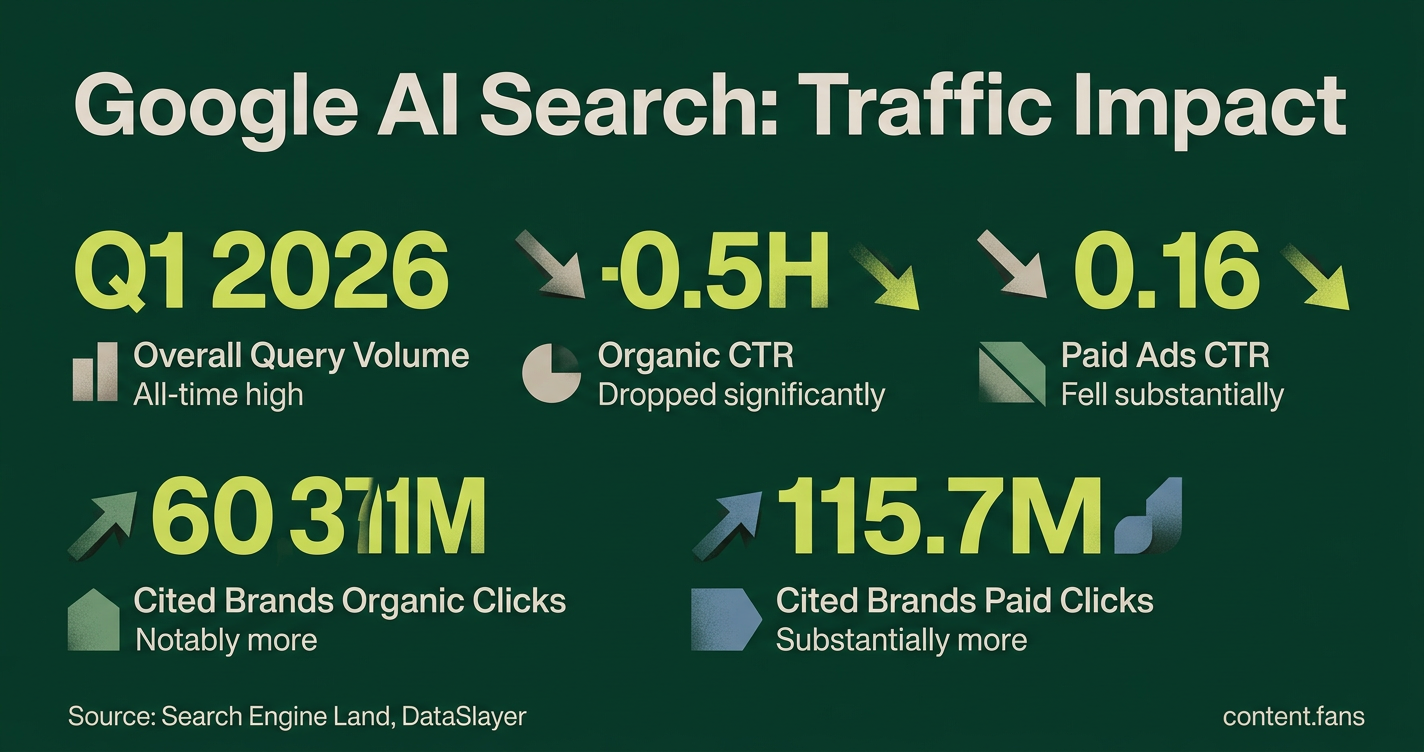
While Google's executives report that overall search demand is growing - Alphabet told investors that query volume hit an "all time high" in Q1 2026 (The Verge) - the click pattern is shifting dramatically. Early studies from sources like Search Engine Land and DataSlayer show a significant drop in click-through rates (CTR) when AI Overviews are present:
- CTR dropped significantly for organic results according to industry reports.
- CTR fell substantially for paid ads according to industry reports.
- Brands cited inside the AI answer saw notably more organic clicks and substantially more paid clicks than non-cited peers according to industry reports.
The takeaway is that information-heavy content (like how-to guides and definitions) is most at risk of losing traffic, as Google can now answer these queries inline. Publishers who optimize to be named inside the AI summary may preserve visibility, but as Search Engine Land notes, total pageviews are likely to fall.
Which types of businesses stand to gain from the new search experience?
Early analyses and case studies point to four clear winners in this new ecosystem:
- Strong brands that become cited sources: Citation-based visibility is emerging as a key metric for brand lift, even when click volume falls.
- Multi-format creators: Video creators can keep discovery on-platform. For example, YouTube reported that a significant number of users tried its new "Ask" tool according to industry reports.
- Developers building mini-apps: Any service that can surface data through Google Workspace, Calendar, or Gmail has a direct path into the new on-the-fly experiences like custom planners and dashboards.
- Local and transactional businesses: Navigational and commercial queries still tend to trigger traditional links, so the drop in CTR is much smaller for these search intents.
What practical steps can content creators take right now?
Based on recommendations from marketing and SEO agencies like McKinsey and Go Fish Digital, the 2026 playbook for content visibility focuses on Generative Engine Optimization (GEO):
- Structure for extraction: Use clear H2/H3 headings, bulleted lists, and schema markup so AI can easily lift and cite your content.
- Map sub-questions: Build topic clusters around every potential follow-up question a user might ask to increase the odds of being featured in an AI Overview.
- Brand yourself in every paragraph: Include your brand name or domain in your answers, ensuring that even a short citation carries brand recall.
- Diversify traffic sources: The brands seeing the smallest negative impact all run email, YouTube, and community funnels that are not dependent on Google clicks.
- Track new metrics: Shift focus from classic rankings to metrics like AI citation share, mention frequency inside AI answers, and zero-click brand lift.
What developer tools are available for building personalized mini-apps inside Search?
At I/O 2026, Google showcased a full stack of tools that allow developers to create agentic experiences for Search:
- WebMCP: An open protocol for exposing JavaScript functions and forms so an agent can call them securely.
- Chrome DevTools for Agents: A toolset for letting an AI validate, debug, and fix generated UIs in real time.
- Prompt API: A stable API (in Chrome 148) that returns structured JSON, making generated mini-apps behave predictably.
- Agent Development Kit (ADK): Connects agents to Google services (Gmail, Calendar, Drive) and third-party platforms like GitHub or Notion.
- Developer Knowledge API & MCP Server: Provides AI assistants with canonical documentation for Google products to improve the reliability of generated code.
These tools allow the Search interface to consume the same agentic capabilities already shipping with Chrome and the ADK without requiring a separate SDK.