
Rivian Spinout ALSO Raises $150M Series D for Autonomous Delivery Push
Serge Bulaev
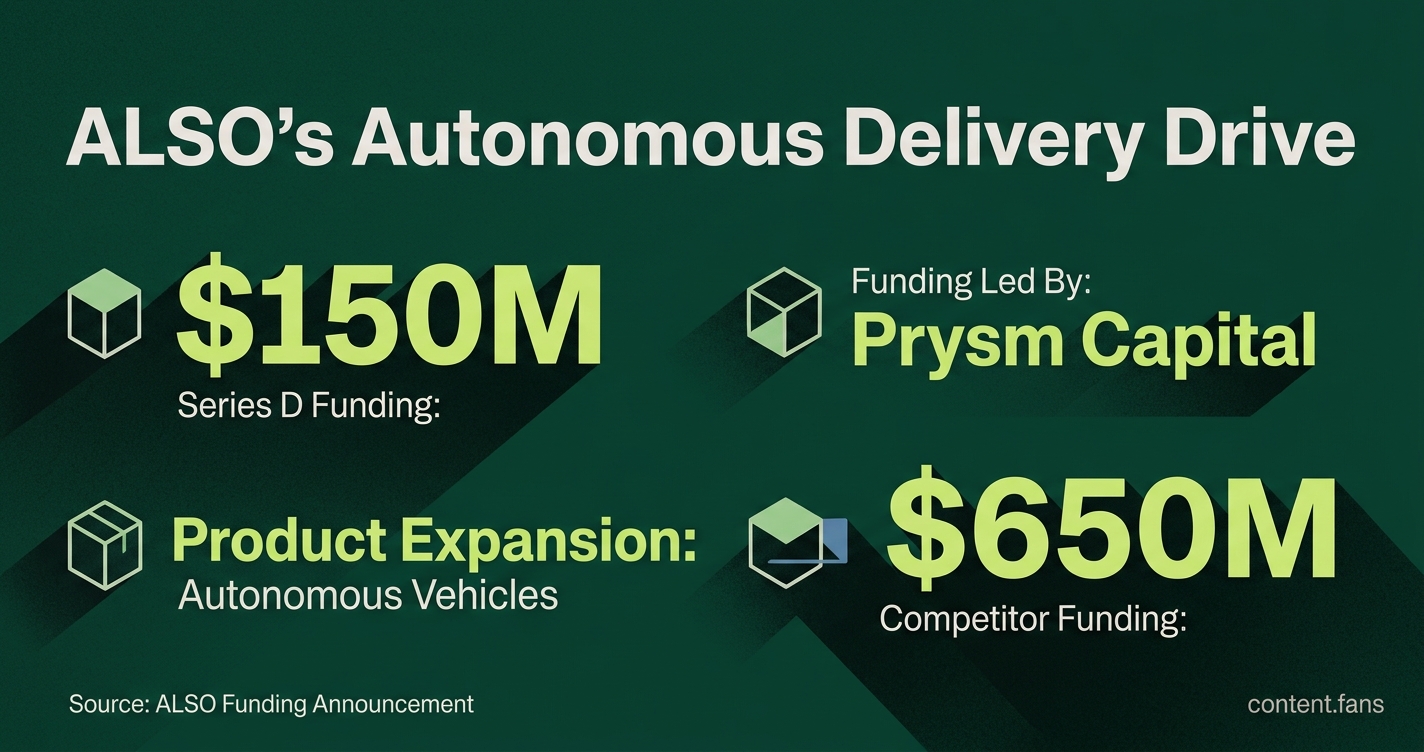
ALSO, a Rivian spinout, has raised $150 million in Series D funding led by Prysm Capital, with plans to expand into autonomous delivery vehicles. The company appears to be following a common late-stage growth pattern and may use the funds for scaling operations, expanding geographically, or preparing for public company requirements. There have been no public announcements of acquisitions or major hires since the funding, which suggests management may still be finalizing plans. Entering the autonomous delivery market puts ALSO among competitors raising larger sums, and this funding might go toward testing automation in cities before wider rollout. It is not yet clear when or if ALSO will pursue an IPO or other major steps, as future milestones have not been announced.

ALSO, a Rivian spinout focused on last-mile logistics, has secured $150 million in a Series D funding round to accelerate its push into autonomous delivery vehicles. The financing, which surfaced in an August 19, 2026 filing, was led by Prysm Capital with participation from Eclipse, Greenoaks, and MVP Ventures. A TechCrunch report confirms the company is expanding its product line from e-bikes and cargo quads to fully autonomous delivery vehicles.
Analysts view the investment as a textbook Series D move, providing growth capital to a company with proven market demand that is opting to remain private longer. Guidance from DealRoom suggests that funding at this stage often aligns with substantial post-money valuations, according to industry reports.
How Late-Stage Funding Fuels Growth
This $150 million injection will primarily fuel ALSO's strategic shift toward autonomous delivery. The capital is expected to scale operations, build out fleet infrastructure, fund geographic expansion, and support the technology and compliance upgrades required for commercial deployment of its autonomous vehicle platform.
Late-stage capital is typically allocated toward scaling operations rather than foundational R&D. Common applications include:
- Geographic Expansion: Entering new regions, often outside the company's home market.
- Operational Scale: Building out warehouses, service centers, and fleet infrastructure.
- Strategic Acquisitions: Acquiring companies to gain market access or intellectual property.
- Corporate Readiness: Upgrading finance and compliance systems in preparation for public-company reporting.
Since the financing was announced, no major acquisitions or senior hires have been disclosed, suggesting that management is still finalizing its capital deployment strategy.
Navigating the Path to an IPO
Achieving Series D status does not guarantee an immediate IPO. Companies at this stage typically begin preparing for the public markets by initiating audits, forming board committees, and organizing their cap table. If ALSO pursues this path, future indicators would likely include a confidential S-1 filing or the appointment of independent directors. However, with market windows for public offerings shifting rapidly, disciplined private growth remains a common strategy.
Competing in the Autonomous Delivery Market
By targeting autonomous delivery, ALSO enters a capital-intensive arena where competitors are raising significantly larger funds. For instance, Wonder reportedly secured $650 million in 2026 to expand its physical footprint and robotics. This competitive landscape highlights the substantial upfront investment required for hardware, software, and regulatory navigation. According to industry reports, significant capital may be strategically earmarked for pilot programs to validate automation technology in dense urban environments before a broader rollout.
Investor Expectations and Future Milestones
Late-stage investors will expect to see measurable returns on this capital, including recurring revenue growth, improving unit economics, and a repeatable sales model in new markets. Strong performance could accelerate a dual-track process where ALSO simultaneously weighs an IPO against strategic acquisition offers from larger logistics firms. Failure to convert the capital into growth could delay public listing ambitions.
For now, the record shows a verifiable set of facts: $150 million raised from a syndicate of growth investors and a clear roadmap toward autonomous vehicles. Every further milestone - be it overseas expansion, a major acquisition, or an S-1 draft - remains to be documented as it is announced.
Who is ALSO and what is its connection to Rivian?
ALSO is a Rivian spinout focused on autonomous delivery vehicles. The company originated from the electric vehicle maker Rivian and has since operated as an independent entity developing last-mile delivery solutions. Its roots in Rivian's technology and engineering expertise have positioned it to advance in the competitive autonomous delivery space.
What does the $150 million Series D funding signify for ALSO's stage of growth?
This late-stage growth capital round indicates ALSO has moved well beyond early startup phases. Series D is generally a late-stage round for companies with proven product-market fit and substantial revenue; a cited 2026 source describes typical Series D rounds as $50M to $300M. For ALSO, this funding signals investor confidence in its autonomous delivery technology and operational scalability as it competes in a capital-intensive market.
How will ALSO use this funding to advance its autonomous delivery capabilities?
The capital will accelerate ALSO's push into autonomous delivery vehicles - expanding beyond its earlier pedal-assist e-bikes and cargo quads. The company plans to scale production, enhance autonomous driving systems, and deploy vehicles commercially. Strategic priorities include technology investment for platform upgrades, operational scaling through larger teams and infrastructure, and potential geographic expansion into new markets where last-mile delivery demand is growing rapidly.
Who led the Series D round and what does the investor mix reveal?
Prysm Capital led the $150 million round, with participation from Eclipse, Greenoaks, and MVP Ventures. This investor composition is notable: Prysm's leadership suggests growth-equity expertise, while repeat participation from firms like Eclipse indicates continued confidence from existing backers. The syndicate's profile - combining specialized growth investors with deep-tech and sustainability-focused firms - aligns with ALSO's dual challenge of scaling hardware production while advancing autonomous software.
What does this funding mean for ALSO's future path - IPO or continued private growth?
The Series D extends ALSO's private-market runway without committing to near-term public listing. While late-stage funding often precedes IPO preparation, sources indicate companies at this stage typically spend many months to years on readiness work before filing. ALSO will likely prioritize scaling operations, achieving profitability milestones, and strengthening governance structures before considering public markets. According to industry reports, many companies demonstrate predictable growth and clear paths to profitability - benchmarks ALSO can now pursue with strengthened capital reserves.