
Gusto, Airwallex CFOs use Claude AI to boost financial workflows, revenue
Serge Bulaev
Gusto and Airwallex CFOs say using Claude AI may help them improve their finance work by making reports and summaries faster. Both companies reported strong revenue growth, with Gusto passing $1 billion and Airwallex reaching about $1.4 billion in annualized revenue. Surveys suggest that over half of finance teams already use AI tools, and Claude appears to be a popular choice. McKinsey research suggests AI tools might help with faster financial reporting, but some limits remain. Experts point out that adoption rates can vary, and company-reported numbers may not always be fully verified.

CFOs at fintech leaders Gusto and Airwallex are using Claude AI to boost financial workflows, moving generative AI from test dashboards to the core finance suite. Gusto CFO Mike Taylor uses Claude for AI-drafted morning summaries, while Airwallex CFO Pranav Sood leverages it for faster variance reports, enabling both to focus more on strategy. This AI adoption coincides with major financial milestones. Gusto has surpassed $1 billion in trailing revenue while maintaining profitability, and Airwallex reported its annualized revenue has reached approximately $1.4 billion amid global expansion.
Gusto and Airwallex CFOs: Claude transformed CFO workflows; company metrics shared
CFOs at Gusto and Airwallex use Claude AI to automate key financial workflows, including generating daily summaries and variance reports. This allows finance leaders to delegate routine data processing, freeing them to focus on strategic analysis, performance anomalies, and higher-value business questions instead of manual spreadsheet reviews.
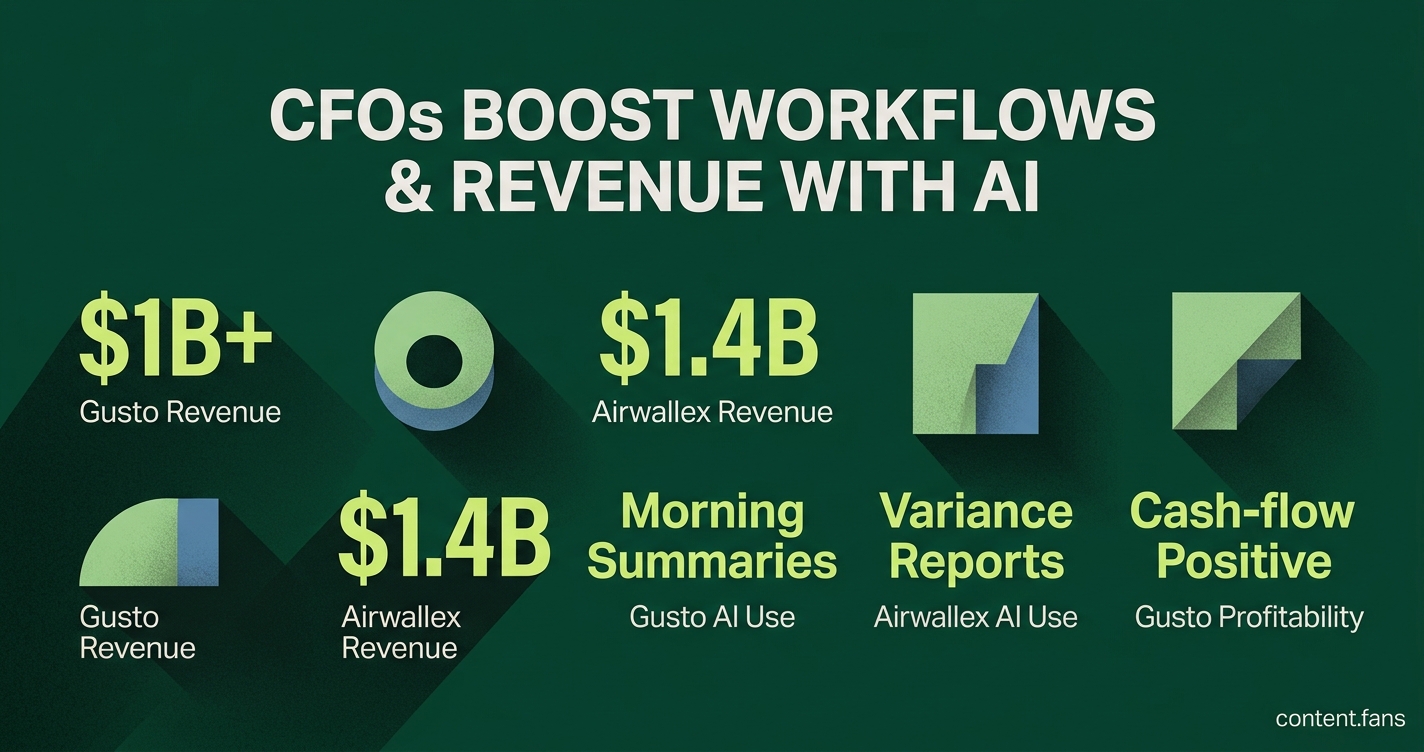
Gusto's revenue growth is on a clear trajectory, rising from earlier estimates of $750 million in 2024 to over $1 billion by 2026, with Taylor confirming the company has been cash-flow positive for "several years." Airwallex detailed its rapid international growth, highlighting significant revenue increases in the Americas and strong year-over-year gains in EMEA, with its annualized revenue crossing the $1.4 billion mark.
CFO-level AI usage enters mainstream finance
The experiences at Gusto and Airwallex reflect a broader trend. Recent surveys show that a growing number of finance teams now use AI, with many applying it to productivity tasks and budgeting. The primary benefit is automated narrative generation - from flash results to self-explaining vendor reports. While adoption rates vary and most metrics remain self-reported, the use of Claude for core reporting at two billion-dollar revenue companies signals a significant shift. These cases offer a clear look at how generative AI delivers operating leverage and drives real revenue growth, even as many firms are still moving beyond pilot stages.
How is Claude AI changing day-to-day work for CFOs like Gusto's Mike Taylor?
Gusto CFO Mike Taylor reports that Claude has "completely changed" his role by shifting his work from reviewing raw spreadsheets to analyzing AI-generated summaries and reports. This workflow transformation allows financial leaders to delegate data processing and focus on strategic interpretation. This trend is backed by research showing that a significant number of finance teams now use AI, with Claude seeing growing adoption. The technology is highly valued for shortening financial reporting cycles via automated data extraction.
What financial milestones has Gusto achieved alongside its AI adoption?
Alongside its AI adoption, Gusto has achieved sustained profitability and strong revenue growth. The company surpassed $1 billion in 12-month trailing revenue and has been cash flow positive for several years. This performance is marked by revenue growth accelerating over recent quarters, building on a climb from $750 million in 2024. Gusto maintains a valuation of roughly $9.3 billion, indicating a focus on disciplined growth.
How does Airwallex's global scale compare to Gusto's?
Airwallex operates at a comparable revenue scale to Gusto but with broader geographic diversification. The company achieved $1.4 billion in annualized revenue and operates in more than 20 countries. Its growth is especially strong outside of Asia, with Americas revenue showing significant year-over-year growth and EMEA revenue growing substantially. This global expansion strategy highlights the company's international infrastructure and positions it against China-centric scrutiny.
What specific finance workflows are being transformed by generative AI beyond basic reporting?
Generative AI is transforming multiple high-value finance functions beyond basic reporting. Recent surveys show that many CFOs apply AI to operational productivity and financial planning. Further reports indicate that Claude is used for forecasting, month-end close, underwriting, and tax preparation. Despite this progress, most advanced capabilities are still at an early scale, indicating significant room for future growth.
How representative is CFO-level AI adoption across the broader market?
These examples represent leading-edge but increasingly mainstream adoption. Although many finance teams use AI tools, research reveals that only a small percentage of CFOs have fully scaled AI within core finance functions. This highlights a gap between general tool use and deep strategic integration. The experience of CFOs like Mike Taylor remains more advanced than the norm, but the path forward is clear. Industry guidance points to a period of rapid operational integration, moving AI from experiment to essential tool.