
Rippling, OpenAI, Sakana AI launch new agentic AI products
Serge Bulaev
Rippling, OpenAI, and Sakana AI have each launched new AI products that may change how companies handle data, security, and AI models. Rippling's system appears to improve sales data and reduce overlapping software by using autonomous agents and real-time data cleanup. OpenAI's Daybreak program, available to selected partners, automates cybersecurity tasks and uses tiered access, which may help prevent misuse. Sakana AI's Fugu seems to help companies use several AI models together and lets them choose where their data is processed, which might lower regulatory risks. These tools suggest a shift where more control and safety is placed outside the main AI models, rather than inside them.

Several technology companies are developing agentic AI products that could transform enterprise operations. These emerging frameworks address critical layers of the developing agentic stack - including data architecture, cybersecurity, and multi-model AI orchestration - and signal a potential shift in business technology.
This report analyzes the technical approaches and early developments in enterprise AI automation based on available public information.
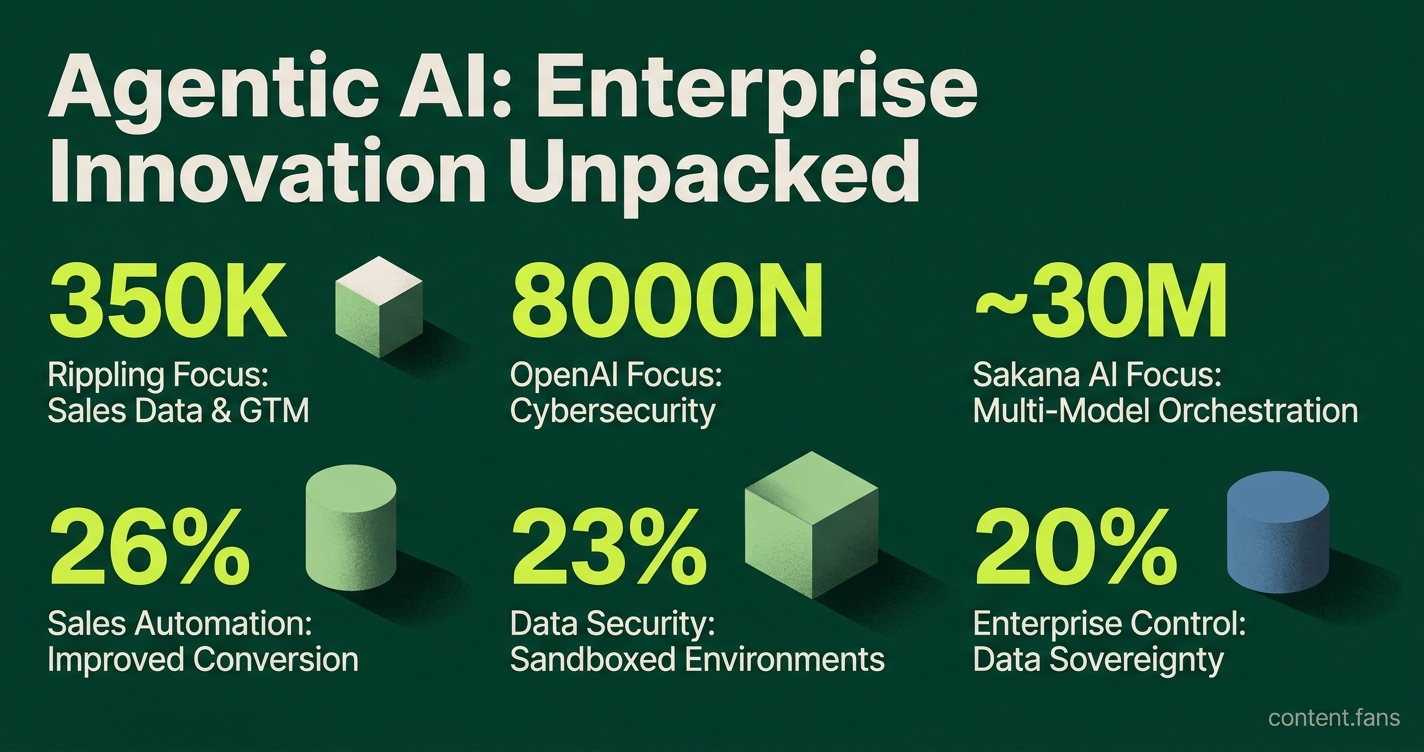
Rippling: AI-Enhanced Data Architecture for Sales Operations
Companies across the enterprise software space are experimenting with AI agents to refine sales data and automate go-to-market processes. Some organizations are building data foundations designed to support autonomous agents using modern data architecture patterns.
Advanced data systems are increasingly using architectures that transform raw data into clean, business-ready formats through structured pipelines. Natural language interfaces are being developed to provide sales teams with conversational access to governed data tables. Early implementations of AI-powered sales automation have shown promising results, with some case studies reporting significant improvements in conversion rates and opportunity generation.
Modern AI systems use sophisticated middleware approaches where agents use semantic search to find correct context before executing code in sandboxed environments, ensuring reasoning models never directly alter production data. Industry reports suggest that a growing number of B2B revenue teams are experimenting with AI agents and exploring potential cost savings in their tool spending.
OpenAI: Exploring AI Applications in Cybersecurity
OpenAI continues to research applications of AI in cybersecurity, though no specific "Daybreak" platform has been publicly announced. The company has expressed interest in developing AI systems that could assist with secure code review, threat modeling, and security validation within controlled environments.
The approach to AI security tools typically involves tiered access models with different capability levels for different use cases. Such systems would likely be rolled out cautiously to trusted partners before any broader availability, reflecting the sensitive nature of cybersecurity applications.
Sakana AI: Research into Multi-Model Orchestration
Sakana AI, based in Tokyo, is conducting research into AI systems that could orchestrate tasks across multiple models. The concept involves "conductor" models that could potentially decompose prompts, delegate subtasks to specialized models, verify outputs, and synthesize final answers.
Such multi-model approaches aim to combine the strengths of different AI systems while maintaining performance across various tasks. Enterprise features being explored include data sovereignty controls that would allow users to restrict processing to specific geographic regions or exclude certain models to address regulatory requirements.
Emerging Trends in Enterprise AI
- Data Integration: Companies are building AI-native data architectures that allow agents to work with real-time, governed data
- Security Focus: AI applications in cybersecurity are being developed with careful attention to access controls and capability partitioning
- Vendor Flexibility: Multi-model architectures are being explored to help companies avoid vendor lock-in by enabling model swapping without changing endpoints
These developments demonstrate growing interest in moving autonomous agents from experimental demos to production-ready tools for sales, security, and reasoning. The emerging pattern emphasizes the importance of safety and governance layers built alongside AI capabilities.
What are companies building in "Agentic GTM Data Architecture"?
Organizations are moving beyond traditional rules-based sales automation toward more sophisticated AI-powered go-to-market systems. The foundation typically involves modern data architectures that enable AI agents to query live customer data efficiently without compromising data integrity.
Data is commonly organized in structured layers (often called Bronze → Silver → Gold patterns), ensuring agents work with clean, governed data rather than raw, disconnected feeds. Natural language interfaces are being developed to expose data through conversational endpoints, allowing sales teams to ask real-time questions about customer behavior and opportunities.
Advanced implementations use middleware that scopes each agent to specific domains and employs sandboxed code execution to prevent direct data manipulation by language models, maintaining security and compliance standards.
What results are companies seeing from AI sales automation?
Early implementations of AI-powered sales automation are showing varied results across different organizations. Some companies report improvements in demo booking rates and opportunity creation, though specific metrics vary significantly by implementation and industry.
The total addressable market identification has improved for organizations using AI to analyze their customer data more effectively. Industry adoption of AI agents in sales processes is growing, with many B2B teams exploring at least basic automation capabilities.
What is the current state of AI in cybersecurity?
AI applications in cybersecurity are being actively researched and developed by major AI companies, though most remain in experimental or limited pilot phases. The focus areas typically include automated code review, threat modeling, and security validation.
These systems generally employ layered access models with different capability tiers for different security functions and user types. Most cybersecurity AI tools are being developed through partnerships with established security companies rather than direct public releases, reflecting the sensitive nature of these applications.
How do multi-model AI orchestration systems work?
Multi-model orchestration represents an emerging approach where a coordinating system manages tasks across multiple AI models rather than relying on a single large model.
The typical process involves:
1. Decomposing complex prompts into subtasks
2. Routing each subtask to the most appropriate specialized model
3. Validating intermediate outputs for consistency
4. Synthesizing results into coherent final responses
This approach aims to leverage the specific strengths of different models while maintaining high performance across diverse tasks. Enterprise implementations often include geographic and regulatory controls to address data sovereignty requirements.
Why are enterprises interested in multi-agent architectures now?
The growing interest in multi-agent architectures stems from several factors: the potential for operational cost savings, the ability to avoid vendor lock-in, and the promise of more sophisticated automation capabilities.
Organizations are particularly interested in systems that provide direct, governed access to real-time data rather than working with static data exports between separate tools. This approach could potentially reduce the complexity and cost of managing multiple specialized software systems.
The compound benefits of integrated AI systems - combining data processing, analysis, and action in unified workflows - represent a significant opportunity for operational efficiency improvements across enterprise functions.