
Retail BI adopts agentic AI for real-time customer action in 2026
Serge Bulaev
By 2026, retail business intelligence may shift from simply showing past data to taking real-time actions for customers, such as sending coupons and restocking items automatically. This change appears to be powered by agentic AI, which can predict customer preferences and act without human help. However, experts warn that poor data quality might slow progress, with many AI projects possibly failing if the data is not ready. Where data is reliable, AI may help retailers keep more customers and increase revenue. The market for these retail analytics tools seems to be growing, as cloud platforms make them more accessible to mid-sized businesses.

By 2026, retail BI is evolving toward more autonomous AI systems for enhanced customer experiences, shifting from passive data reporting to proactive, automated decision-making. This evolution, powered by AI agents that predict customer needs, enables automated restocking and personalized coupon delivery with reduced human intervention. While poor data quality remains a significant hurdle, successful implementation promises higher customer retention and revenue growth, driving expansion in the retail analytics market.
From Descriptive Charts to Autonomous Action
The evolution of retail business intelligence marks a transition from descriptive analytics, which report past events, to autonomous AI systems that take proactive action. These systems use predictive and generative capabilities to anticipate customer needs and execute tasks like inventory management and personalized marketing in real-time.
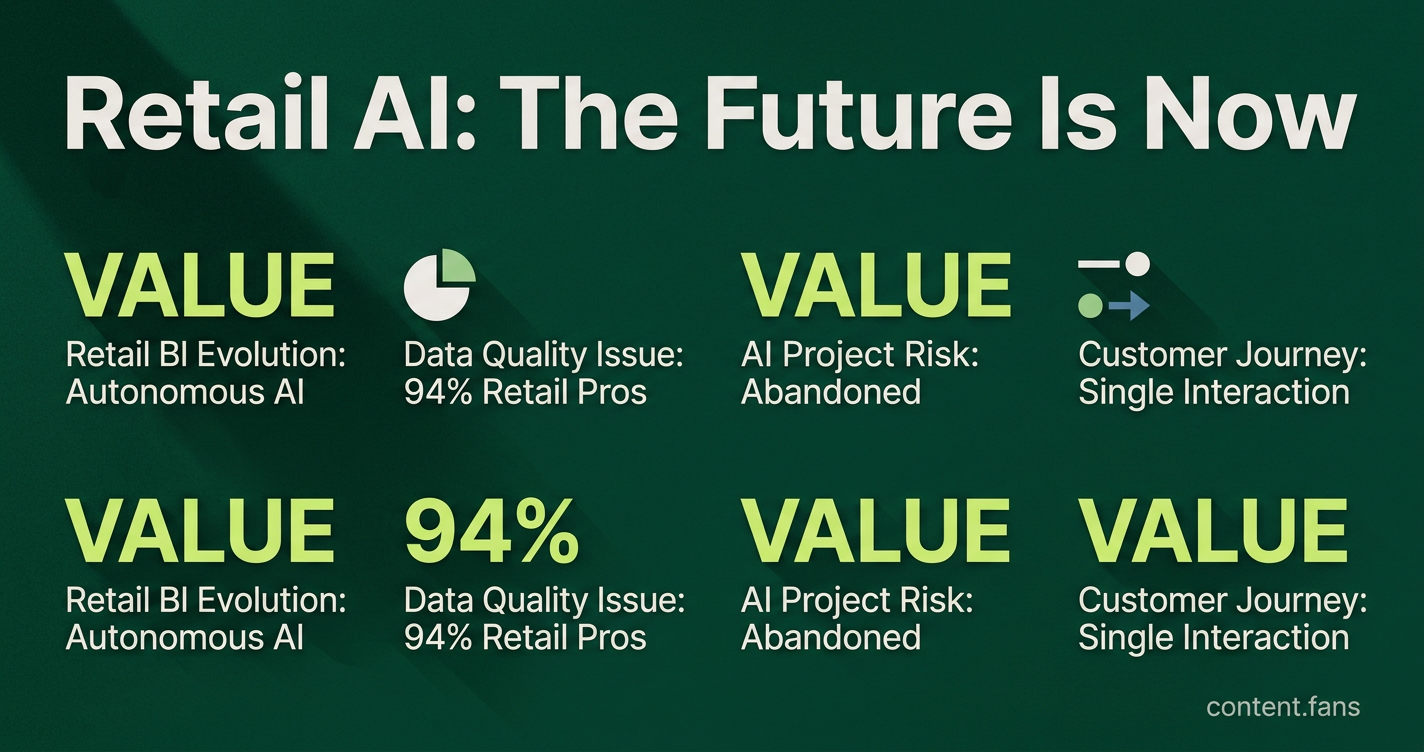
Modern business intelligence now moves beyond describing past events to recommending future actions, a shift powered by predictive, prescriptive, and generative AI (How AI Is Transforming Retail Analytics). This trend points toward a future where the multi-step shopping journey may collapse into a single, AI-directed interaction, with industry reports suggesting growing executive interest in this transformation. Autonomous AI systems - agents that can reason, plan, and execute - are increasingly powering retail enterprise applications, with these agents autonomously managing inventory based on live demand and deploying personalized offers.
Data quality: the hidden speed bump
Despite high ambitions, AI roadmaps often stall due to poor data quality. Industry analysts warn that a significant portion of AI projects may be abandoned if they lack "AI-ready" data. The retail sector is particularly vulnerable, with MindBridge data showing that 94 percent of retail professionals face operational delays from poor data. Inaccurate records not only skew dashboards but also amplify bias and cause model drift, leading to flawed forecasts. Industry surveys highlight that many businesses see data quality as their primary integrity challenge, while a significant portion lack adequate automated quality tools. To succeed, practitioners must focus on three core areas:
- Continuous monitoring to detect schema changes before they impact production models.
- Strong governance frameworks that ensure data lineage for audits and compliance.
- Real-time data pipelines to provide AI systems with fresh, consistent inputs.
Personalisation that lifts retention
When data foundations are solid, retailers see significant and measurable returns. Industry reports indicate that retailers using predictive models to identify at-risk customers can achieve substantial churn reduction. AI-enhanced loyalty programs show improved performance compared to static reward systems, with studies reporting meaningful retention improvements. Furthermore, omnichannel retailers with integrated data systems demonstrate higher revenue and increased customer lifetime value. Careertrainer.ai reports that engaged employees are 87% less likely to leave and companies with engaged workforces see 21% higher profitability, highlighting the importance of unified analytics approaches.
Market accessibility widens
The retail analytics market size in 2026 is estimated at USD 6.88 billion according to Mordor Intelligence, as cloud platforms make these powerful tools more accessible to mid-market businesses. Key trends shaping the future of BI, including generative AI in conversational commerce and robotic warehouse automation, all rely on a foundation of unified, trustworthy data powering autonomous systems. This collective shift indicates that retail BI has evolved beyond monthly reviews; it now involves algorithms that monitor live customer signals, determine the next best action, and execute it with greater autonomy.
What exactly is autonomous AI in the context of retail BI and how will it change customer journeys?
Autonomous AI refers to systems that sense, decide and act on behalf of the retailer with reduced human approval for each step. These agents are increasingly powering retail enterprise applications, up from small pilots only a few years ago. Instead of merely describing what happened on yesterday's journey, the AI continuously maps where each shopper is heading and re-orders inventory, issues an offer or triggers a personalized message in real time. The traditional multi-step shopping funnel is evolving toward more streamlined AI-curated interactions, raising retention rates for retailers that have moved beyond descriptive dashboards.
Which data-quality challenges could still derail AI deployment?
Retailers currently face significant data-quality challenges; industry surveys show that many companies call poor data their top integrity challenge. Fragmented or incomplete customer records affect a substantial portion of retailers, while industry analysts warn that AI projects lacking AI-ready data face abandonment risks. The result is project delays, biased recommendations and lost revenue - with 94 percent of retail professionals reporting workflow delays tied directly to bad data according to MindBridge. To avoid the pilot trap, teams must automate validation, improve governance and unify omnichannel sources before autonomous agents can reliably act on their own.
How large is the business upside for retailers that achieve mature AI-driven BI?
Industry case studies show measurable retention gains. Retailers using predictive-churn models have achieved substantial churn reduction and lifted customer lifetime value significantly. AI-enhanced loyalty programs demonstrate improved performance compared to static schemes. Across segments, retailers with fully integrated data estates report higher revenue alongside increased customer lifetime value. In practical terms, this translates to meaningful improvements in retention rates for retailers that move from fragmented data to an autonomous, real-time stack.
Which new KPIs replace traditional BI metrics in an autonomous environment?
Speed-to-insight has overtaken simple data visibility as the key metric. Retailers now track time-to-action - how quickly the system turns a signal into an inventory move or a personalized offer - as the primary indicator of BI maturity. Complementary KPIs include conversion uplift per autonomous campaign, cross-sell lift after streamlined journeys and inventory days-of-cover saved by real-time rebalancing. Loyalty teams monitor retention-rate improvements within 30 days of AI-triggered outreach, demonstrating a direct line between autonomous decisions and customer stickiness.
What practical steps should teams take to prepare for advanced autonomous AI?
Start by building an AI-ready data layer: automate quality checks, resolve identity fragmentation and certify all feeds for real-time latency under 150 ms. Next, run controlled pilots that assign one autonomous agent to a narrow use case - for example, predicting next best action for loyalty members - and measure retention impact versus control groups. Finally, adopt cloud-based platforms accessible to mid-market chains; these services help smaller retailers catch up to leaders in the evolving retail landscape.