
Report Maps How AI Changes Investor Jobs, Skills, and Governance by 2026
Serge Bulaev
The report suggests that AI may change investor jobs by automating routine tasks, but key decisions and judgment are still led by humans. Investors might need new skills like using AI tools safely, checking for bias, and clear communication with clients. Regulations are expected to tighten, and firms may need better oversight and training for safe AI use. Pilot programs appear to keep humans involved in important decisions, and logs may be needed to track how AI is used. Overall, AI integration seems to mean shifting tasks rather than completely replacing investor jobs.

Industry reports outlining how AI changes investor jobs have sparked anxiety, but the reality is more nuanced than simple replacement. Instead of eliminating roles, artificial intelligence is reshaping finance work by automating specific tasks. This analysis offers a view of this transformation, mapping near-term automation, emerging skills, and a governance checklist for firms preparing for the future.
AI is coming for the investor's job: task-level view
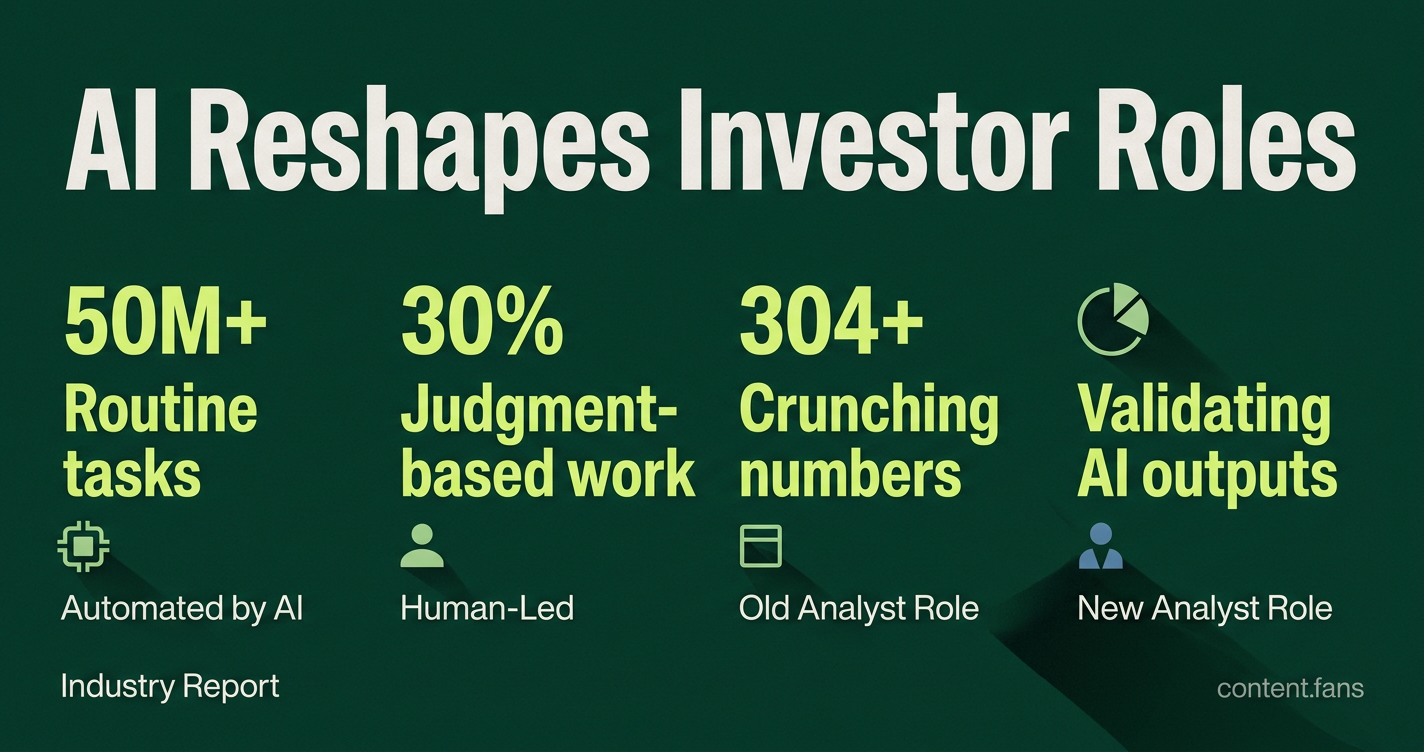
Artificial intelligence will change investor jobs by automating routine, data-intensive tasks like first-draft summaries and anomaly screening. This shifts the focus of human professionals toward judgment-based work, such as narrative framing, client communication, holistic risk assessment, and final decision-making, where context and accountability are paramount.
| Function | Automatable today | Still human-led |
|---|---|---|
| Equity research | Data ingestion, first-draft earnings summaries, screening for anomalies (GenRpt Finance) | Narrative framing, client-specific insights, regulatory sign-off |
| Trading | Intraday pattern recognition, risk alerts | Final order sizing, best-execution judgment, exception handling |
| Portfolio construction | Mean-variance optimization, allocation scenarios (Matt Britton) | Holistic risk appetite calls, stakeholder communication |
According to industry observations, routine data synthesis is becoming machine-assisted, while responsibilities requiring judgment, strategic context, and ultimate accountability remain firmly in human hands.
Essential Skills for Investors in the AI Era
As the Brookings Institution notes, the analyst's role is evolving from "crunching numbers" to "validating AI-generated outputs." To remain valuable, professionals must cultivate new competencies. Industry reports suggest the most sought-after skills will include:
- AI Tool Fluency: Mastering safe and effective prompting techniques for various AI platforms.
- Advanced Data Literacy: The ability to critically assess data, identify potential biases in AI outputs, and spot anomalies.
- Model Validation: Applying critical thinking to understand and validate the logic and results of AI models.
- Strategic Communication: Translating complex AI-driven insights into clear, actionable advice for clients.
- Regulatory Awareness: Staying current with emerging compliance duties related to AI, such as model risk management.
A significant talent gap is expected to emerge for professionals who can bridge the gap between AI models and practical investment strategies, effectively supervising algorithms and translating their outputs into actionable intelligence.
A Governance Roadmap for Safe AI Adoption
The regulatory landscape for AI in finance is evolving, with authorities implementing new rules on a piecemeal basis. Colorado originally set an AI Act to take effect February 1, 2026, but later legislation delayed the effective date to January 1, 2027 and narrowed the framework to disclosure/transparency obligations for certain automated decision-making technologies. Similarly, the EU AI Act phases in obligations over time; high-risk system obligations do not simply begin in August 2026 as a blanket rule. Investment firms operating globally must navigate these divergent compliance timelines.
Drawing on insights from industry leaders like Aon and Databricks, a best-practice framework for safe AI integration is emerging. Investment managers should embed the following five governance pillars:
- Risk-Based Inventory: Catalogue all AI use cases and classify them according to their potential business impact and regulatory risk level.
- Establish Oversight: Form a cross-functional governance committee with representatives from compliance, risk, data science, and investment teams.
- Develop a Formal Policy: Create a comprehensive AI policy that specifies approved tools, data governance controls, mandatory human review checkpoints, and clear criteria for model rollbacks.
- Rigorous Model Testing: Implement a testing protocol to evaluate models for accuracy, bias, and performance drift both before and after deployment. Document all metrics.
- Conduct Annual Training: Mandate annual training for all relevant staff on safe AI usage, data handling protocols, and procedures for escalating issues.
Structuring an Effective AI Pilot Program
According to Aon, successful AI pilot programs in investment management typically run for 90-120 days. These pilots operate in parallel with existing workflows and crucially, maintain a 'human-in-the-loop' for all material decisions. Key success metrics include analyst time saved, reduction in error rates, and client feedback on the explainability of AI-driven recommendations. Models that meet predefined targets can then advance to a limited production environment, governed by stringent audit trail requirements.
To ensure compliance with emerging transparency laws, internal data governance is critical. Firms must maintain detailed logs that capture all AI inputs, user prompts, model outputs, and any human overrides. This creates a reconstructible audit trail for regulatory scrutiny.
Ultimately, the evidence indicates that AI integration in finance is a story of task reallocation, not wholesale job elimination. The investors who will thrive in this new landscape are those who develop the skills to supervise and challenge algorithmic outputs, navigate new forms of risk, and clearly articulate investment strategy to clients within a complex, evolving regulatory framework.
Frequently Asked Questions
Q1: What tasks are being handed to AI first, and which stay with analysts?
According to industry trends, the data-heavy but low-judgment chores go first: scraping filings, flagging earnings surprises, cleaning comps tables, drafting first-pass screeners, and tagging sentiment in call transcripts.
Tasks that remain stubbornly human: turning numbers into a thesis, deciding what "material" means, picking valuation stories that pass a sniff test, and explaining a downgrade to a client board.
In short, routine pattern recognition is now machine-speed; narrative synthesis, regulatory nuance, and relationship risk still move at human cadence.
Q2: Will headcount fall, or just shift?
Many buy-side desks expect net headcount to remain relatively stable, but the FTE mix changes.
Junior seats may shrink significantly because AI does the grunt work; specialist and client-facing roles expand slightly.
Think smaller analyst cohorts, larger validation, prompt-design, and client-explanation layers.
The firms that grow are the ones that re-allocate headcount to AI oversight, **not the ones that freeze hiring.
Q3: What does "safe adoption" look like on a trading floor?
Start with four guardrails:
1. Approved-use list - spell out which models, data sources, and prompts are cleared.
2. Human-in-the-loop release gate - every AI output that feeds an order ticket or research note needs a named sign-off.
3. Model-risk log - keep a version-controlled audit trail of prompts, weights, and override decisions for 30 months.
4. Kill-switch test - run a quarterly simulation where the model misfires; can staff still price the book manually in under fifteen minutes?
These steps significantly reduce hallucination risk based on early-bird programs at regional broker-dealers.
Q4: Which skills should a mid-career analyst add now to stay employable?
Pick three micro-credentials and one macro habit:
- Prompt-engineering boot-camp - learn to chain context windows so the model cites line numbers, not guesswork.
- Python-for-finance refresher - enough to read model cards and spot leaky features.
- Reg-tech survey - map ESMA, SEC, and Colorado rules that touch your asset class.
Then book a weekly "model hour" where you manually replicate last Friday's AI screens; if you can't, you've over-outsourced.
Q5: How are regulators treating AI-generated research?
Patchwork, but three themes dominate:
- EU AI Act phases in various obligations over time with different requirements for different risk categories.
- Colorado's original AI law (SB 24-205) required disclosure to consumers interacting with AI systems and was originally set to take effect February 1, 2026, but it was later repealed and replaced by SB 189, which delays the effective date to January 1, 2027 and narrows the rule to ADMT and consequential decisions.
- FINRA 2210 continues to regulate retail communications; firms should consider how AI-generated content fits within existing compliance frameworks.
Bottom line: keep hard-copy prompts, log reviewer initials, and archive for appropriate audit cycles; that approach helps maintain regulatory compliance across jurisdictions.
Sources
- Brookings Institution, Hybrid jobs: How AI is rewriting work in finance
- Aon, The AI Governance Frontier in Investment Management
- EU AI Act phased rollout schedule