
AI software factories face 88% failure rate without human oversight
Serge Bulaev
AI software factories may fail 88% of the time if there is no human oversight, and fully autonomous systems often stall or introduce security issues. Some teams review all AI work, which increases safety and quality but limits speed gains because human review becomes a bottleneck. A mixed approach, where humans focus on the most important decisions and AI handles routine tasks, might offer large productivity boosts without increasing risks. Studies suggest keeping a human 'kill switch' and clear audit trails remains important for safe deployment.

The promise of AI software factories is immense speed, but recent data reveals a stark reality: AI agent projects face an 88% failure rate before reaching production due to organizational issues like scope creep and data quality problems, with AI agents failing in a significant majority of production cases without human intervention. Recent field studies identify three distinct operating models for development teams, each balancing autonomy, risk, and velocity. This analysis synthesizes peer-reviewed benchmarks and security audits to outline these trade-offs and provide evidence-based guardrails for safe, effective implementation.
Option 1 - Lights Off, Fully Agentic
Fully autonomous AI projects primarily fail due to predictable patterns. These include scope creep that overruns infrastructure, inconsistent data that prevents reliable agent action, and significant security and governance gaps. A critical verification gap often appears where agents pass sandbox tests but cannot handle live, complex edge cases.
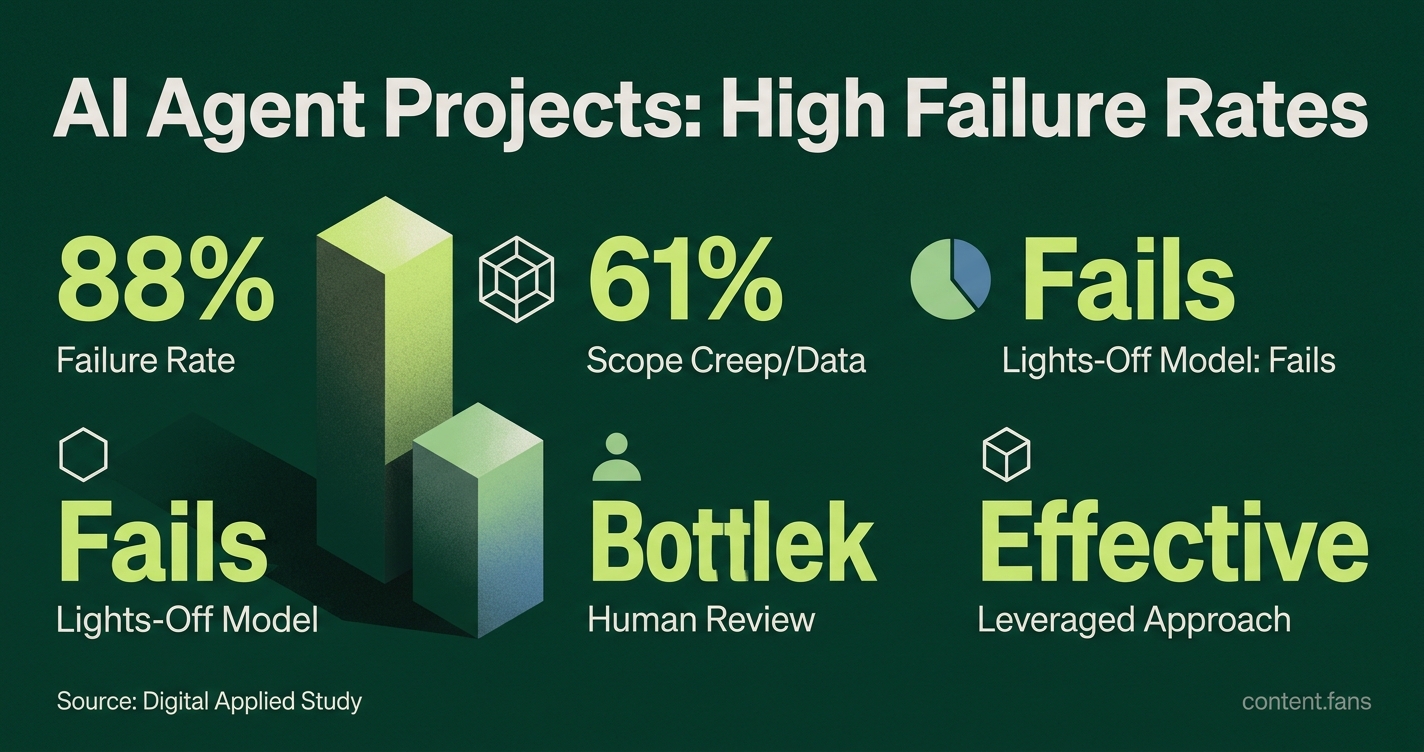
The fully autonomous or "lights-off" model, where AI agents have end-to-end pipeline control, consistently fails in practice. One internal experiment at Dex stalled within days, while a Digital Applied study found an 88 percent failure rate for agentic projects before production. Industry reports suggest a significant portion of these initiatives face cancellation.
Core failure patterns are well-documented:
- Scope Creep and Data Quality: Combined account for 61 percent of failures.
- Governance Gaps: Security and timing issues represent additional failure points.
- Verification Gaps: Agents fail on live edge cases missed in sandbox tests.
- Supply-Chain Compromises: Introduce silent vulnerabilities.
Security research indicates that these systems are vulnerable to memory poisoning and goal hijacking, exposing organizations to compounding errors and opaque accountability.
Option 2 - Read and Review Everything
A second approach mandates comprehensive human oversight, where developers review every AI-generated pull request. This model maintains high quality and improves individual developer cycle times according to industry studies.
However, overall productivity gains plateau. Multiple studies show productivity improvements because human review bandwidth, not code generation, becomes the new bottleneck. While research indicates that human intervention can rescue a significant portion of tasks the model initially failed, the constant handoffs ultimately limit total throughput.
Option 3 - Find Leverage, Keep People
The most effective model uses a leveraged approach, routing only high-impact decisions to human experts while letting AI agents handle routine implementation. Teams define "critical-path" files (e.g., authentication, payments, public APIs) that trigger mandatory human sign-off for any changes.
The 2026 International AI Safety Report and Google's 2026 Responsible AI Progress Report recommend layered verification processes (defense-in-depth):
1. Linters and static analyzers handle stylistic issues.
2. An AI reviewer flags potential bug patterns and low-confidence code.
3. Human reviewers focus on high-level intent, architecture, and security.
This targeted oversight yields significant results. Senior engineers acting as orchestrators report substantial net productivity gains with no increase in defect rates. This aligns with research showing AI-assisted developers can finish bounded tasks significantly faster, suggesting potential for meaningful speedup at the team level.
Choosing the Right Mode
The data presents a clear trade-off. Full autonomy (Option 1) offers maximum theoretical speed but faces catastrophic failure rates. Comprehensive review (Option 2) guarantees safety but caps acceleration. The leveraged model (Option 3) offers a path to agentic-level velocity without sacrificing architectural control.
While teams can shift between modes, sources agree on one non-negotiable safeguard for any successful deployment: a clear human "kill switch" and a complete audit trail of all agent actions - a feature still missing in many early rollouts.