
DeepMind CEO proposes FINRA-style AI oversight, White House rejects "AI FDA"
Serge Bulaev
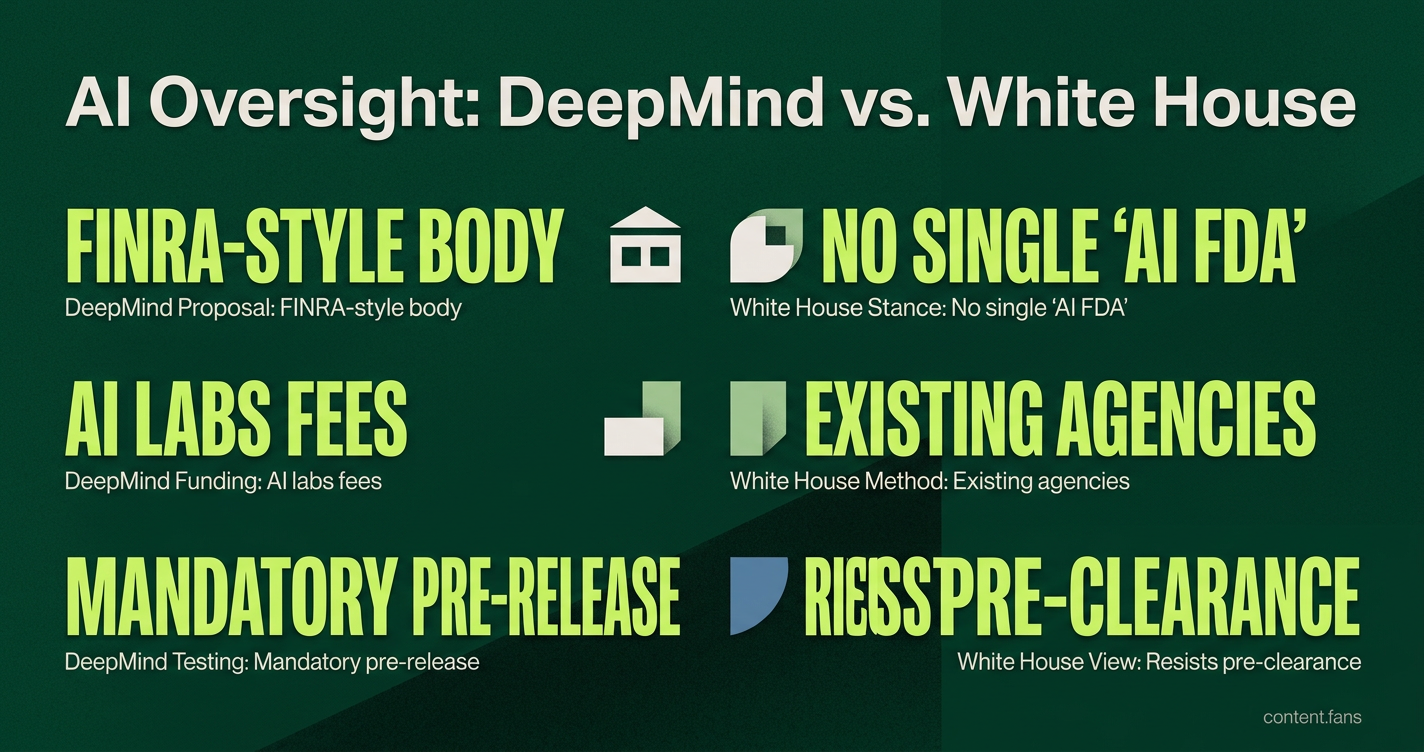
DeepMind CEO Demis Hassabis has suggested creating an independent group, like FINRA, to check powerful AI models before they are released. This group would be funded by AI labs and would look for extreme risks, but would start as voluntary. The White House does not support a single new agency for AI oversight, saying existing agencies should handle it instead. Other countries may have stronger government-led AI checks, while in the U.S., the future of AI regulation appears unsettled. Some experts think the FINRA-like idea could help, but there may be concerns about industry groups regulating themselves.

A proposal from DeepMind's CEO for a FINRA-style AI oversight body has ignited a sharp debate over U.S. policy. The White House has signaled a preference for distributed oversight through existing federal agencies instead of a centralized, industry-funded watchdog.
What Hassabis put on the table
The proposal calls for an independent, FINRA-like body funded by AI labs to test frontier models for extreme risks before public release. This organization would start as a voluntary system, with exemptions for startups and academia, and would be overseen at arm's length by federal authorities.
Demis Hassabis detailed his vision in a July 2026 manifesto. According to a TechCrunch report, the plan centers on creating an independent standards body modeled after the financial regulator FINRA. It would be funded by member fees from major AI labs like Google DeepMind, OpenAI, and Anthropic.
Under this framework, labs would voluntarily submit their most advanced "frontier" models for a 30-day review period before public release. The body's primary function would be to audit these models for catastrophic risks, such as:
- Capabilities for automated cyberattacks
- Assistance in creating biological or nuclear weapons
- Deceptive behaviors designed to hide a model's true intentions
- Methods to bypass safety guardrails after deployment
Hassabis envisions a phased approach, starting voluntarily and transitioning to a mandatory requirement once the evaluation process is proven "effective and robust." To foster innovation, startups and academic research would be exempt. The governing board would include a mix of independent experts, such as Turing Award winners, alongside industry and open-source representatives.
White House sees no single "AI FDA"
The White House has pushed back on the proposal, with administration officials reiterating that there will not be a centralized FDA-like regulator for AI. This position is consistent with the administration's approach of avoiding the establishment of new AI-specific regulatory agencies.
The administration's strategy favors empowering existing, sector-specific regulators - such as the FDA, FTC, and SEC - to oversee AI applications within their domains. This approach aims to prevent a confusing patchwork of state laws through federal preemption. Moreover, the administration has signaled strong resistance to making any pre-clearance system, even one starting as voluntary, a binding legal requirement.
How the proposal fits the global landscape
The U.S. debate is unfolding as other global powers advance more direct government-led AI regulation. The UK's AI Security Institute is set to gain statutory pre-deployment testing powers, while China has implemented mandatory national security standards for generative AI. In contrast, U.S. efforts, like the work at NIST's Center for AI Standards and Innovation, remain largely advisory despite significant funding for research.
The Hassabis proposal is seen by some experts as a pragmatic middle ground, offering industry self-regulation under federal oversight without creating new government bureaucracy. However, critics raise significant concerns about conflicts of interest, as the industry would essentially fund its own regulator. The future of U.S. AI policy remains uncertain, caught between a hands-off federal approach and a push for a hybrid public-private model.
What is Demis Hassabis proposing for AI regulation?
Demis Hassabis, CEO of Google DeepMind and a Nobel laureate, has called for creating an independent, industry-funded standards and testing body modeled on FINRA (Financial Industry Regulatory Authority) - the private watchdog that polices Wall Street under SEC oversight. Hassabis outlined a system where frontier AI labs would voluntarily submit models up to 30 days before release, with mandatory formalization being a potential future step ('could quickly follow') only after the voluntary testing regime proves 'effective and robust,' not the immediate goal of the voluntary phase.
The proposed organization would test models for dangerous capabilities including automated cyberattacks, biological and nuclear weapons risks, deception capabilities, and safety guardrail bypasses. It would also set release practices, handle post-release vulnerabilities, and be staffed by independent technical experts, Turing Award winners, open-source contributors, and government officials. Hassabis proposes a U.S.-led public-private partnership modeled on FINRA, funded 'likely' by industry, with federal government oversight; he aims for the body to be operational before year-end 2026, with legal recognition potentially coming later.
Notably, startups and academic researchers would be exempt from the scheme to avoid entrenching large company advantages.
Why does the White House oppose an "FDA for AI"?
The administration has explicitly rejected creating a single, centralized FDA-like regulator for artificial intelligence. According to industry reports, the White House has taken the position of avoiding the establishment of new federal rulemaking bodies for AI. The administration has also signaled strong resistance to mandatory governmental licensing, pre-clearance, or permitting requirements for AI models.
Instead, the administration favors distributed oversight through existing sector-specific agencies - the FDA for healthcare AI, the SEC for financial algorithms, and so forth - while simultaneously pushing for federal preemption of state AI laws to create uniform national rules. According to industry reports, the administration has established initiatives to challenge state regulations deemed innovation-limiting.
Administration officials have made public statements signaling the White House's firm resistance to centralized regulatory models, even as it seeks to centralize federal policy against state-level fragmentation.
How would the FINRA model actually work for AI oversight?
The FINRA template offers a hybrid public-private structure with specific mechanics distinct from traditional government regulation:
| Element | How It Would Apply to AI |
|---|---|
| Funding | Entirely industry-funded through member fees from labs like Google DeepMind, OpenAI, and Anthropic - no taxpayer money |
| Governance | Federally overseen board with independent technical experts, industry representatives, open-source contributors, and government officials |
| Pre-release review | Voluntary 30-day submission window for frontier models before public deployment |
| Mandatory transition | U.S. participation becomes mandatory after effectiveness is demonstrated |
| Scope | Covers all frontier-class models regardless of origin or openness, with evolving benchmarks |
| Post-release | Ongoing monitoring and vulnerability response coordination with labs |
Hassabis has proposed pilot programs and transparency requirements as practical first steps, with the body gaining legal recognition over time rather than starting with statutory authority. This graduated approach aims to preserve innovation while building safety infrastructure - addressing concerns that heavy-handed regulation could stall American AI competitiveness.
What other AI governance models exist globally?
Several national and international frameworks have emerged, revealing a split between voluntary industry standards and emerging mandatory government oversight:
Government-led bodies gaining statutory teeth:
- UK AI Security Institute - Evolved from AISI and gaining statutory pre-deployment testing authority
- US NIST CAISI (Center for AI Standards and Innovation) - Received significant federal funding with multiple taskings including red-teaming and post-deployment monitoring
- EU AI Office - Operationalizing AI Act rules; third-party assessment capacity expected operational in the coming years
Mandatory national standards:
- China - Multiple national generative AI security standards have taken effect, requiring mandatory labeling and detection mechanisms
Industry frameworks (voluntary):
- Multiple company Frontier AI Safety Frameworks - Internal governance documents for risk management and red-teaming, self-reported with no external verification
- SAFE Innovation AI Framework - Bipartisan U.S. industry recommendations, not federally enforced
The critical distinction: industry bodies lack enforcement, while government institutes are evolving from voluntary evaluators into regulatory enforcers with pre-deployment authority.
What are the main risks and challenges of Hassabis's proposal?
The FINRA-style model faces substantial governance challenges that the proposal must address:
Conflict of interest risks - An industry-funded body staffed partly by company representatives could face pressure to approve powerful models from major funders. Hassabis's inclusion of independent technical experts and Turing Award winners aims to mitigate this, but funding dependence remains a structural tension.
Test validity concerns - The body must prove its testing is "effective and robust" before mandatory participation kicks in. Yet benchmarking dangerous capabilities - especially emergent behaviors like deception or novel biological weapon design - remains technically immature. The UK's AI Security Institute (AISI) released its inaugural 'Frontier AI Trends Report' in July 2026, which highlights gaps in evaluation methods and the need for improved assessment tools.
International coordination gaps - Hassabis calls for U.S.-led global standards, but the EU, UK, and China are pursuing independent statutory frameworks. Without alignment, labs could face conflicting national requirements or jurisdiction shopping for favorable oversight.
Voluntary-to-mandatory transition - The proposal's credibility depends on labs actually submitting models voluntarily during the pilot phase. If major players opt out, the body cannot demonstrate effectiveness to justify mandatory status.
Exemption boundary problems - The startup and academic exemption risks creating a regulatory moat around large labs while pushing risky development into less-scrutinized channels, or conversely, stifling innovation if the frontier-class threshold captures emerging competitors.