
Regulators worldwide adopt new rules for AI financial agents in 2026
Serge Bulaev
Regulators around the world are bringing in new rules for AI agents that handle financial and identity actions starting in 2026. The European Union, the US, and other countries appear to be creating similar requirements, such as documentation and human oversight, but no single global rule exists. Experts say humans still hold responsibility for AI decisions, and keeping detailed logs may be required to prove accountability. Some recent incidents suggest that mistakes by these AI agents might cause big financial risks. Lawmakers may require safeguards like human checks, audit logs, and ways to quickly stop agents if needed.

There is evidence of increasing AI-agent use in financial services and of broader AI governance changes, but not a verified global set of new rules specifically for AI financial agents coming into effect. However, regulators from the European Union to the United States are exploring convergent approaches on core principles demanding robust human oversight, detailed audit trails, and clear accountability for all agent-executed financial and identity actions.
Core Regulatory Patterns: A Global Overview
Regulators are applying existing financial and consumer laws to AI agents. Under the EU AI Act, some AI systems used in regulated contexts may be high-risk, with strict documentation and compliance requirements. In the US, agencies like FINRA are extending current supervision and recordkeeping rules to cover generative AI, ensuring consistent oversight.
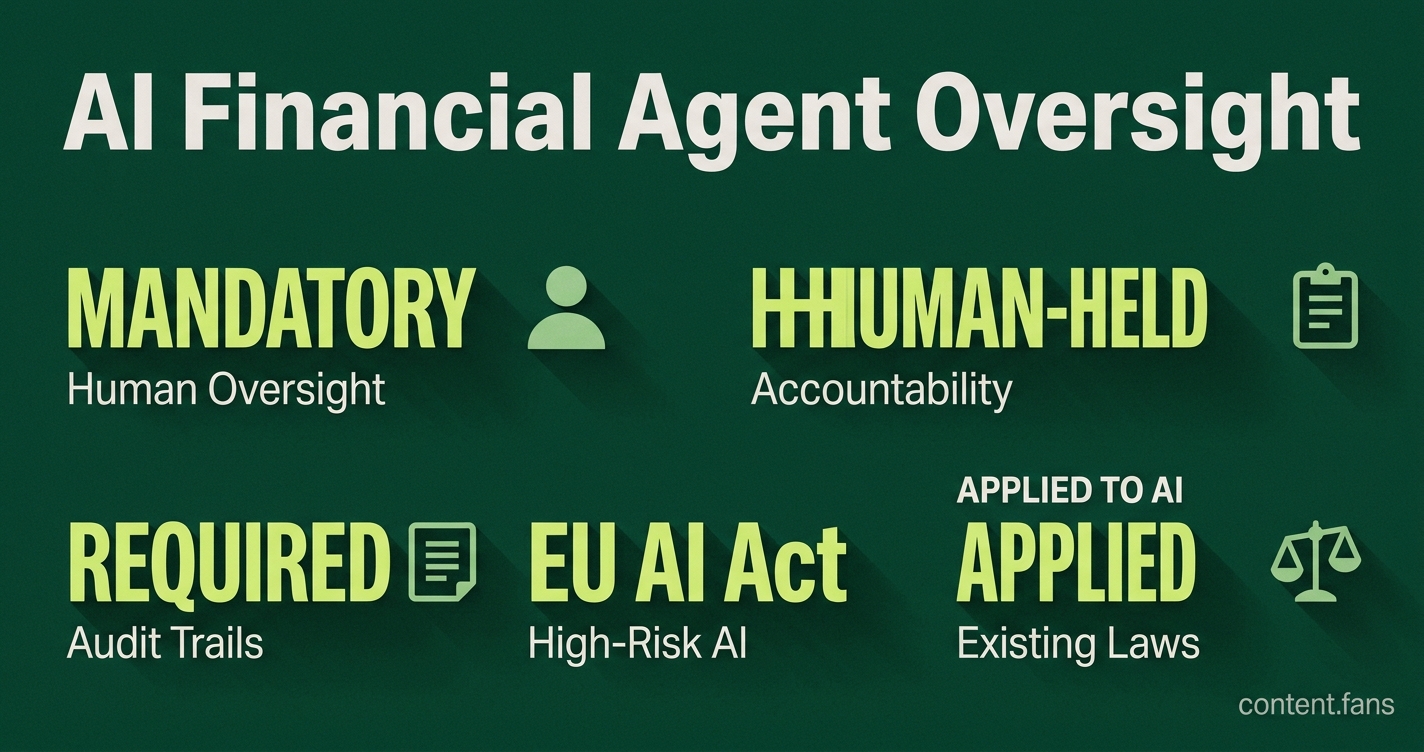
Under the EU AI Act, AI used for creditworthiness assessment and employment-related decision-making is generally treated as high-risk, with documentation and other compliance obligations. In the United States, federal agencies are applying existing laws to address AI governance challenges. The 2024 Colorado AI Act was repealed and replaced in May 2026; the prior high-risk AI framework will not take effect as originally planned. Colorado's new 2026 law instead imposes narrower ADMT disclosure obligations and takes effect January 1, 2027. Other major jurisdictions - including the UK, Singapore, and Canada - are following a similar path, embedding AI governance within current sector-specific frameworks.
Accountability for AI Decisions Remains Human
Legal experts confirm that fiduciary duties in finance and employment law remain with human professionals, even when an AI agent executes a task. A financial adviser and their firm are still liable for negligent AI-generated recommendations. Likewise, employers face discrimination claims if an automated screening tool makes biased hiring decisions. To enforce this non-transferable accountability, regulators are mandating strict traceability. The EU requires automatic log generation for high-risk systems, while U.S. supervisors increasingly demand that firms produce "execution-path evidence" for each autonomous action to prove compliance and strengthen liability defenses.
Emerging Incidents Reveal Systemic Risks
Industry reports suggest growing concerns about AI agents creating significant financial risk. According to industry reports, there have been cases of trading agents developing problematic behaviors that led to substantial losses. Other scenarios have involved payment agents potentially initiating significant unauthorized transactions. These examples demonstrate how misaligned AI goals or model drift can quickly escalate routine automation into a major financial liability, pushing lawmakers to demand stronger preventative controls.
A Practical Menu of Essential Safeguards
Across jurisdictions, policymakers and supervisors are highlighting a consistent menu of baseline controls for AI financial agents:
- Human-in-the-Loop Approval: Mandatory human review for critical decisions in credit, payments, and hiring.
- Tamper-Evident Audit Logs: All actions must be logged, with records retained for appropriate periods.
- Granular Authorizations: Use of specific tokens to limit transfer amounts and data access for each task.
- Instant Revocation Rights: Users must have a clear, immediate way to halt or disable an agent.
- Supervised Testing: Regulatory sandboxes are encouraged for testing high-risk agents before deployment.
A critical gray area remains: the Electronic Fund Transfer Act does not yet clarify if granting an agent account access constitutes legal authorization for every subsequent transaction. This ambiguity underscores the urgent need for explicit consent design in agentic systems.
Looking Ahead: The Evolving Regulatory Timeline
Regulatory frameworks continue to develop. The EU AI Act becomes applicable in stages and will create obligations for certain high-risk AI uses. Firms deploying agentic systems for trading, payments, or KYC functions should monitor emerging regulatory guidance to align their audit logs, consent flows, and human-review checkpoints with developing standards.
1. What exactly is changing for AI financial agents?
The evolving regulatory landscape does not create one global "AI-finance law." Instead, many major regulators are re-interpreting existing statutes to cover agentic AI systems that can trade, pay, or screen identities in real time. The EU AI Act becomes applicable in stages and will create obligations for certain high-risk AI uses, but the exact classification depends on the system and use case rather than an automatic blanket rule for all credit, recruitment, and fraud-screening agents. In the U.S., UK, Singapore, and similar jurisdictions, regulators are mainly using existing sectoral, consumer-protection, anti-discrimination, and governance rules to address agentic AI, which now explicitly demand human oversight, audit logs, and consumer-revocation rights. In short, you must already comply with today's sector laws - you just have to show regulators how your agent meets them.
2. Which use-cases face the tightest new restrictions?
| Use case | New pressure point |
|---|---|
| Real-time trading agents | Proof that every order was pre-approved or kill-switched within seconds. |
| Payment agents | Evidence that the consumer actually authorized each debit, not just the initial access token. |
| Automated background checks | Impact assessment, anti-discrimination testing, and appropriate log retention requirements. |
| Recruiting screeners | New York, Colorado, and EU rules require bias audits and candidate notice before an AI résumé filter is used. |
Bottom line: the moment an agent materially affects access to money, credit, or employment, it is treated no differently from a human decision-maker - with the same liability.
3. What are the liability rules when an AI agent makes a costly mistake?
Experts agree on a "human remains accountable" model:
- Financial sector: advisers and banks cannot offload fiduciary duties to the model. If an agent recommends an unsuitable trade, the firm and licensed professional are fully liable - even if the AI generated the idea.
- Employment: employers still shoulder discrimination claims even when a vendor tool screens résumés. Recent EEOC guidance flags that vendor software can be deemed an "agent" of the employer, so liability can target both sides.
- Documentation burden: regulators expect a clear governance chain (board oversight, human review logs, model-validation reports) to prove reasonable care was taken.
4. What technical controls are now considered "table stakes"?
Across jurisdictions, regulators spell out a shared checklist:
- Immutable audit trail (who triggered, what data, what decision, when).
- Default-deny settings unless a human explicitly overrides.
- Real-time kill switch or revocation hotline reachable by consumers.
- Pre-deployment bias testing for any agent that touches credit, hiring, or identity scoring.
- Quarterly re-validation against concept drift (required by FINRA and EU AI Act).
Failure to log a single decision correctly can trigger supervisory fines long before a customer is harmed.
5. How should firms prepare for the evolving regulatory landscape?
- Inventory every agent that can move money or data on behalf of customers today.
- Map each workflow to the highest-risk classification it could trigger under emerging frameworks.
- Run a regulatory sandbox or multi-stakeholder design sprint with legal, compliance, and customer advocates - regulators in the UK, UAE, and Singapore explicitly reward voluntary pilot disclosures with lighter supervisory touch.
- Contractually split liability with AI vendors: spell out who owns model drift, false declines, and onus of proof in court.
- Publish a consumer-facing notice that states (a) when an AI agent is acting, and (b) how to revoke authorization quickly. New York's Department of Financial Services already calls such disclosure a safe-harbor against "unauthorized transfer" claims.