
Oratomic raises $300M, shows how deeptech Series A works
Serge Bulaev
Oratomic raised $300 million in July 2026 to build a neutral-atom quantum computer. The company's funding shows investors may support deeptech startups if they meet key technical and market milestones and prove demand early. Founders seeking large Series A rounds are advised to validate their technology and market, organize investor targeting, and prepare clear documentation. There is no guarantee of raising such a large amount, but following these steps appears to help align capital with clear goals.

Oratomic's recent $300 million Series A funding provides a masterclass in how a deeptech Series A works, especially in capital-intensive sectors like quantum computing. This case study reveals the playbook for securing outsized rounds when traditional startup metrics don't apply. Oratomic's July 2026 raise, reported by TechCrunch, shows how investors back teams that link huge checks to clear, costed milestones. This guide distills that strategy for founders in hardware, biotech, and quantum.
The Founder's Playbook for a Landmark Deeptech Series A
Step 1: De-Risk Technology with Verifiable Milestones
Raising a large deeptech Series A requires substituting traditional revenue metrics with verifiable technical progress. Founders must prove their technology has surpassed key scientific risks, demonstrate early market validation through pilots or letters of intent, and present a capital plan where funding is explicitly tied to the next value inflection point.
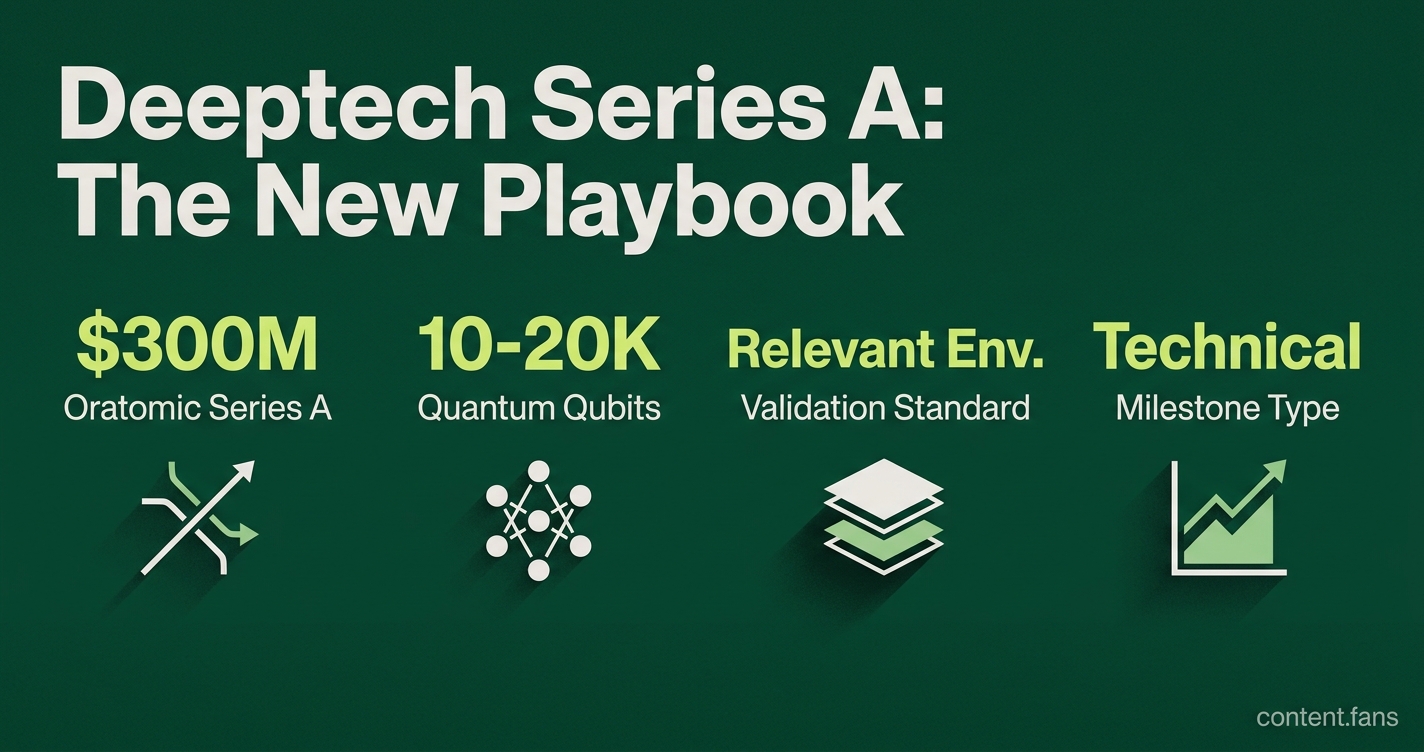
Investors now expect significant technical validation, meaning components validated in a relevant environment, not just a lab. Many deeptech specialists consider substantial technical progress as the minimum threshold. Before its raise, Oratomic published peer-reviewed research showing its neutral-atom approach required approximately 10,000 to 20,000 qubits, a technical proof that substituted for revenue.
| Sector | Critical Pre-Series A Milestone | Validation Standard |
|---|---|---|
| Quantum Computing | Fault-tolerant architecture demonstration | Controlled qubit array with measured error rates |
| Hardware/AI Chips | Production-ready prototype with customer validation | Strong gross margin projections at volume |
| Biotech/Medical Devices | Pre-clinical verification and regulatory pathway | Defined FDA route (510k, De Novo, PMA) with regulatory strategy |
Your milestone sheet should clearly list the target technical level, test protocols, required spend, and completion date for each objective.
Step 2: Prove Market Demand with Early Commercial Validation
Evidence of demand is as crucial as technical proof. Secure at least one design win, letter of intent (LOI), or reimbursable pilot study before fundraising. Oratomic's press release highlighted strategic investors from automotive and defense, hinting at early customer alignment that reduced market uncertainty. For hardware, this means showing strong gross margins at volume; for biotech, it means a defined FDA pathway.
Step 3: Map and Tier Investors by Thesis and Check Size
Deeptech requires specialized investors who understand your technical risk. Create a target list grouping firms by:
- Average Series A check size
- Sector thesis (e.g., quantum, synthetic biology)
- Decision driver (e.g., technical depth, regulatory wins)
Oratomic's co-leads - ARCH Venture, Spark Capital, and Khosla Ventures - typically anchor large rounds and possess deep technical expertise. Reserve first meetings for partners with a recent history of similar deals, and use smaller syndicate members to validate your science before major partner pitches.
Step 4: Model Capital Allocation Around Value Inflection Points
For deeptech, runway is measured in milestones, not months. Plan your capital allocation to reach the next major value inflection point, typically 18-24 months away. Industry reports suggest allocating a significant portion of proceeds to advance technical development. Oratomic's $300M was explicitly tied to scaling quantum hardware fabrication facilities, R&D, and key hires.
A typical allocation for a large deeptech Series A often includes:
- R&D and Technical Development: Significant portion
- Pilot Execution & Commercialization: Substantial allocation
- Key Hires & Option Pool: Important component
- IP & Legal Defense: Meaningful allocation
Step 5: Build a Defensible, Investor-Ready Data Room
A comprehensive data room prevents delays that can kill momentum. Prepare 60-80 documents before outreach. The structure should mirror investor diligence checklists, with a heavy focus on technical and IP validation. Industry best practices emphasize that preparing documents in advance is critical.
Below is a template reflecting deeptech diligence requirements:
| Folder | Key Documents |
|---|---|
| 1-Corporate | Certificate of incorporation, cap table, board minutes, bylaws |
| 2-Financial | Audited statements, 24-month monthly P&L, 36-month milestone-tied forecast |
| 3-Technical | Architecture diagrams, test reports, third-party audit letters, peer-reviewed papers |
| 4-IP | Patent filings, freedom-to-operate memo, invention assignment agreements |
| 5-Commercial | LOIs, design win documentation, pilot protocols, detailed margin models |
| 6-Regulatory | FDA pre-submission feedback, CE marking plan, reimbursement strategy |
| 7-Team | CVs of key staff, option pool ledger, advisory board letters |
| 8-Risks | A one-page summary of known risks and remediation plans |
Step 6: Prepare for Complex Term Sheet Negotiations
Mega-A rounds often involve multiple co-leads and complex terms. Be prepared by circulating a redlined version of a standard term sheet (e.g., NVCA). Key areas to define include the post-money option pool, board voting thresholds for budget changes, and protective provisions tied to milestone slippage. Be ready to discuss milestone-based tranches, warrant coverage, and anti-dilution provisions, but prioritize securing an 18-24 month runway to your next major milestone.
Key Statistics: The Deeptech Series A Landscape (2026)
- Median Series A Size: According to industry reports, deeptech rounds are typically larger than traditional software startups.
- Time from Seed to Series A: Significantly longer than historical averages for traditional startups.
- Pre-Money Valuation: Deeptech startups with defensible IP often command a premium over traditional metrics.
- Non-Dilutive Funding: Many top deeptech startups secure substantial grants (SBIR, DOE, etc.) before Series A.
FAQ: Raising a Deeptech Series A
What makes a $300M Series A possible when most are under $20M?
A capital-intensive plan matched to a fundamental de-risking event. While no record of 'Oratomic' raising $300M or a published breakthrough regarding quantum computers exists in the provided sources, the principle remains that founders must identify the single milestone that most reduces investor uncertainty and build the raise around funding that specific achievement. Large checks follow credible plans to overcome major technical hurdles.
How do I justify a large Series A without revenue?
Substitute verifiable technical milestones for revenue metrics. In 2026, deeptech investors accept technical advancement, peer-reviewed validation, and early customer pilots as proxies for product-market fit. The key is demonstrating capital efficiency: show that seed funding achieved specific technical outcomes. A credible team with veterans from leading institutions also reduces the perceived execution risk.
What are the most common investor red flags?
Unclear IP ownership and un-costed manufacturing plans are frequent deal-killers. Before fundraising, ensure all invention assignment agreements are signed and conduct a freedom-to-operate analysis. For manufacturing, present detailed quotes from equipment vendors and facility operators, not just internal estimates.
How should I structure my team for investor confidence?
Combine deep scientific credibility with proven operational execution. Investors look for: (1) technical co-founders with patents and publications in your domain, (2) operational leaders who have scaled hardware or biotech companies before, and (3) a board of advisors with recognized industry experts.