
Claude Fable 5 costs $10/$50 per million tokens
Serge Bulaev
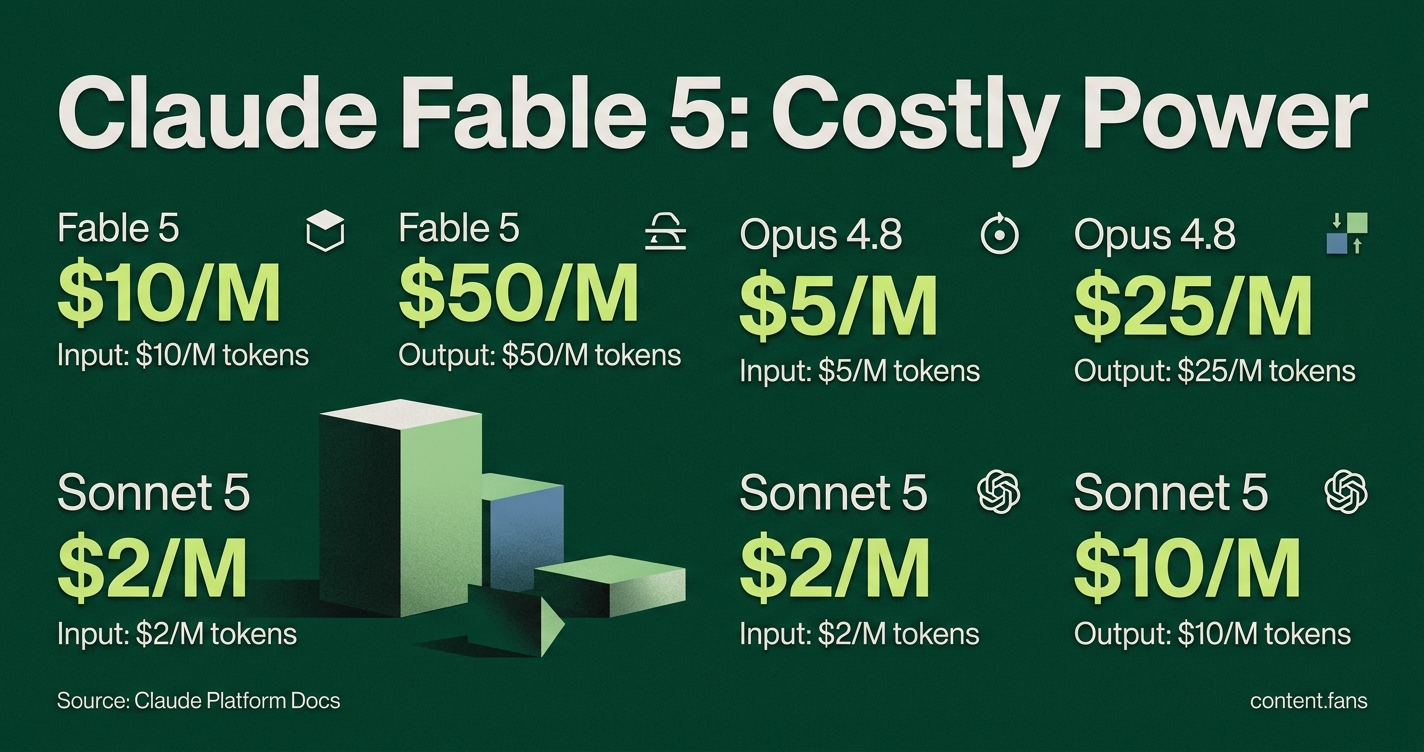
Claude Fable 5 may cost about $10 for input and $50 for output per million tokens, which is much higher than some other models. Teams that do not route tasks carefully might see their bills double quickly, because each extra call to a premium model can add a lot of cost. Experts suggest using Fable 5 only for important planning steps and switching to cheaper models like Sonnet 5 or Opus 4.8 for most tasks. Managing how much conversation history is sent and using batching might help cut costs by 30-70%. FinOps dashboards can help teams track token use and avoid surprise charges.

The high cost of Claude Fable 5, which bills at $10 for input and $50 for output per million tokens, presents a significant financial risk for teams that fail to implement smart model routing. Without proper routing hygiene, every unnecessary call to this premium model can cause AI operational costs to spiral, potentially leading to substantial budget overruns.
A look at the pricing reveals the challenge: Claude Fable 5 costs $10 for input and $50 for output per million tokens, figures confirmed by the official Claude Platform Docs. This is a steep increase from Claude Opus 4.8 at $5/$25 and Sonnet 5 at $2/$10. Compounding this cost, conversational context windows can dramatically inflate input tokens; a 20-turn chat can resend the entire history with each turn, leading to significant budget increases when Fable 5 is used as a default.
Routing Mistakes Can Turn Agents into Runaway AI Spend - 'Use the Principal for Planning, Analysts for Execution'
To avoid runaway AI costs, experts recommend a 'consulting team' approach to model routing. This strategy reserves the expensive Claude Fable 5 model for high-level planning and strategic tasks, while offloading the bulk of execution and repetitive work to more cost-effective models like Sonnet 5 or Opus 4.8.
This strategy frames AI models as a consulting team: Fable 5 acts as the 'principal' for high-level planning, while Sonnet 5 and Opus 4.8 are the 'analysts' for execution. The core rule is to use the principal for strategic prompts and then delegate to analysts. This approach can be highly effective; industry reports suggest that offloading a significant portion of an agent's tasks to Sonnet 5 can substantially reduce the cost of large token workflows.
The cost impact of context length often exceeds expectations. As described in this LLM cost guide, cumulative history replay means a 50-turn conversation can accrue 382,500 input tokens. This quadratic scaling of costs also impacts performance, with latency and accuracy concerns emerging as context windows grow substantially, regardless of advertised model limits.
Implement these key checks in your routing logic to maintain cost control:
- Complexity filter - Route only high-judgment tasks to Fable 5; use cheaper models when quality thresholds are met.
- Context cap - Trim or summarize conversation history to keep the active context window below the 200K token threshold where some pricing tiers can double.
- Batch flag - Leverage the Batch API for non-urgent background jobs to achieve significant rate reductions.
A practical starting point is simple 'if/then' routing coded directly into your application: if a prompt is short and low-risk, use Sonnet 5; otherwise, escalate to Opus 4.8 or Fable 5. After collecting model-level performance metrics for a few weeks, teams can often progress to more sophisticated ML-based routers without premature optimization.
FinOps dashboards are essential for managing AI spend, providing real-time visibility into token consumption. These tools allow enterprises to connect costs directly to specific workflows and prevent budget overruns. By integrating intelligent routing, batch processing, and prompt caching, organizations report substantial savings compared to using a single frontier model for all tasks.
FAQ: Claude Fable 5 Pricing and Intelligent Model Routing
How much does Claude Fable 5 actually cost?
Claude Fable 5 is priced at $10 per million input tokens and $50 per million output tokens - making it Anthropic's most expensive generally available model. This is exactly double the cost of Claude Opus 4.8 ($5/$25) and five times the introductory price of Claude Sonnet 5 ($2/$10). For context, a single planning pass using 200,000 input tokens and 40,000 output tokens costs approximately $4.00 with Fable 5, versus just $0.80 with Sonnet 5.
Why does using Fable 5 for every conversation turn get so expensive?
Every chat turn re-sends the entire conversation history, causing input token volume to grow geometrically. In a 20-turn conversation averaging 300 tokens per message, you're billed for 382,500 cumulative input tokens rather than the 15,000 tokens actually generated - a 25× markup on what you might expect. This quadratic scaling means routine multi-turn workflows become prohibitively expensive when run entirely on frontier models.
What is the "consulting team" routing analogy?
Think of your AI stack as a consulting firm with four seniority levels. Fable 5 serves as the "principal" - reserved for high-judgment planning and strategy. Sonnet 5 and Opus 4.8 function as "analysts" handling execution and implementation. This tiered approach treats model selection as a deliberate operating decision rather than a default, achieving significant cost reductions in typical workflows while preserving frontier capabilities for tasks where advanced reasoning materially improves outcomes.
When should I actually use Fable 5 versus cheaper alternatives?
Reserve Fable 5 for tasks requiring frontier-level reasoning - complex strategic planning, novel problem decomposition, or high-stakes judgment calls. Route execution, drafting, iteration, and routine multi-turn conversations to Sonnet 5 or Opus 4.8. For background jobs that don't need real-time responses, the Batch API offers substantial rate reductions - providing meaningful cost savings for non-urgent workloads.
Has access to Fable 5 changed recently?
According to industry reports, Fable 5 access policies have evolved, with many organizations now requiring usage credits (metered billing) and standard API rates for premium model access. Opus 4.8 and Sonnet 5 remain within normal plan limits for many subscription tiers. Organizations should audit workflows to avoid unexpected bills - particularly for teams accustomed to different access patterns.