
Hybrid AI Workflow Cuts Cloud Spend, Boosts Code Security
Serge Bulaev
Running continuous code security scans with a hybrid AI workflow may help teams save money and keep code safe. Teams use a local AI model (GLM 5.2) to scan code often, and send only important findings to a more powerful cloud model (Claude Code) once a day. This setup appears to lower costs because local scans are much cheaper, and it may also reduce false alerts by up to 95 percent. Accuracy seems to stay high, and sometimes the hybrid method might even be more accurate than using just the cloud model. This workflow might help teams stay secure without unexpected cloud charges.

Implementing a continuous code security scan with a hybrid AI workflow is no longer a niche experiment but a proven strategy for reducing costs. This approach involves frequent, rapid scans with a local model and daily batch triage with a frontier model like Claude, optimizing both security precision and cloud spend.
Why a hybrid scan loop costs less
A hybrid AI workflow reduces security scanning costs by using inexpensive local models for frequent, high-volume analysis. Only a filtered set of critical findings is sent to powerful, costly cloud-based frontier models for final triage, preventing unpredictable API charges and focusing expensive resources where they matter most.
According to industry reports, analysis from a top-tier frontier model can be significantly more expensive than a lightweight local scan, as noted in the guide to Neurotechnus. By running on-premise models, which operate substantially more cheaply under consistent load, organizations fundamentally alter their cost structure. This tiered approach also eliminates expensive "runaway token" sessions by having the frontier model only inspect a pre-filtered set of alerts.
This cost efficiency does not come at the expense of accuracy. While specific benchmark comparisons vary across different security scanning scenarios, local models can often provide competitive performance for initial vulnerability detection at a fraction of the cost. The frontier model is then reserved for its strength: applying deep, context-aware reasoning to the most critical findings.
Wiring the hybrid loop into a CI/CD pipeline
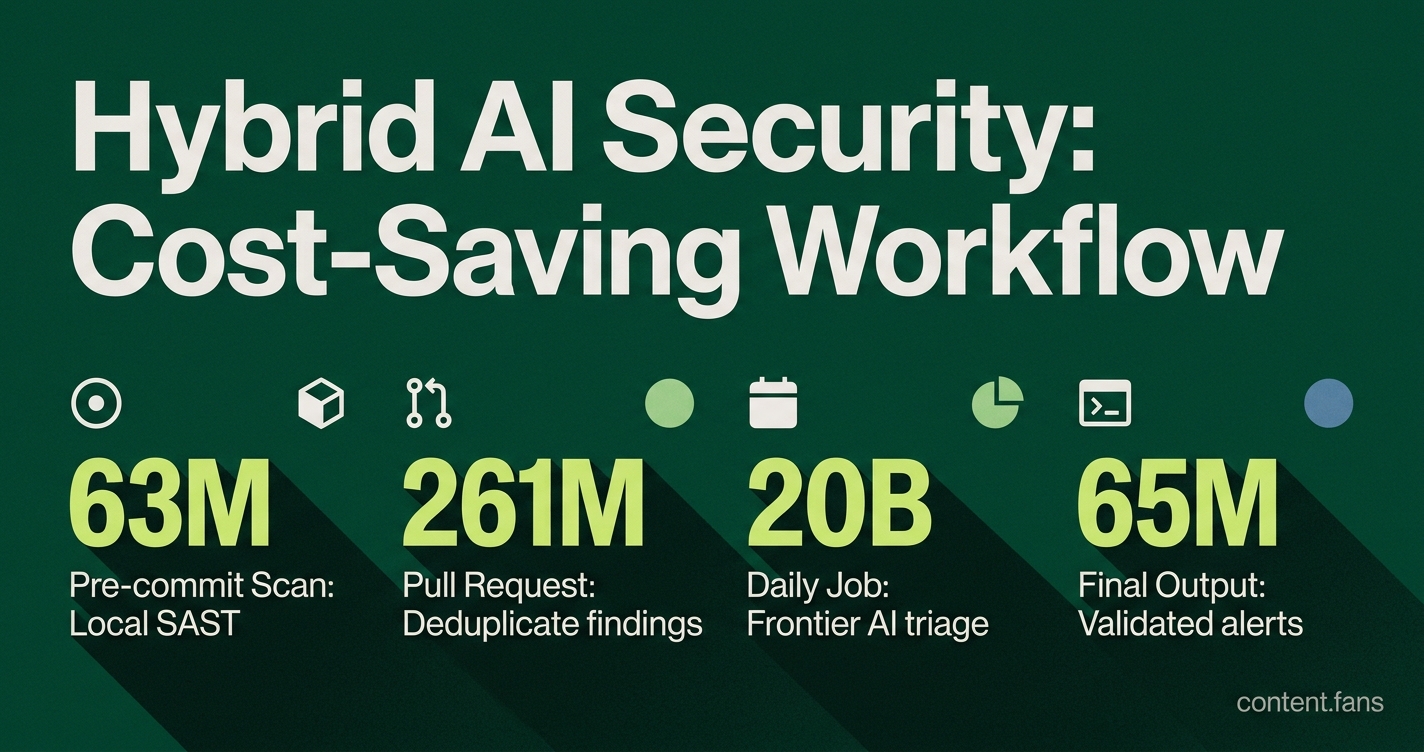
Integrating this workflow into a CI/CD pipeline involves three key checkpoints to provide developers with early feedback without alert fatigue:
- Pre-commit: A lightweight local SAST scan runs inside a container, providing immediate comments on clear vulnerabilities.
- Pull Request: New findings are aggregated with the existing backlog and deduplicated. Merges are blocked only for high-severity issues.
- Daily Job: A consolidated JSON of findings is sent to a frontier model for advanced semantic triage, with validated alerts pushed to the defect tracker.
To maintain a secure pipeline, engineers should implement least-privilege Role-Based Access Control (RBAC) and refresh containers after each run. These measures are among Snyk's CI/CD best practices. Furthermore, builds should be configured to fail automatically if the triaged vulnerability severity exceeds a defined risk threshold, ensuring security accountability without constant manual oversight.
Continuous code security scan with hybrid AI workflow: guardrails for actionable alerts
Raw SAST tools can generate thousands of alerts per repository, overwhelming security teams. A hybrid AI funnel dramatically reduces this noise, reportedly cutting the volume to a manageable number of actionable findings - a significant reduction in false positives. This efficiency substantially lowers review costs, as engineers spend less time managing tickets and classifying noise. The alerts that do surface are enhanced with rich context, including call-site reasoning and remediation guidance from the frontier model.
Alert quality can be improved even further by storing historical verdicts from the frontier model. Subsequent local scans can then bypass recently validated code regions, which shrinks scan times and reduces GPU overhead. For compliance and oversight, it is recommended to pair this "memory" feature with strict audit logs, creating a traceable record of every automated security decision.
The result is a sustainable security feedback loop that operates within existing DevSecOps budgets. It delivers accuracy that matches, and in some cases exceeds, a frontier-model-only approach, all while eliminating the risk of unpredictable API charges on the monthly cloud bill.
How does the hybrid AI model reduce cloud spending compared to running frontier models continuously?
The hybrid approach delivers substantial cost savings by strategically routing tasks to the most economical model tier. Local open-source models run significantly cheaper under constant workloads than cloud-based frontier APIs, while the substantial cost multiplier of autonomous agent-level frontier analysis is reserved only for high-value triage decisions. Organizations using this architecture eliminate "runaway token bills" entirely. The financial impact extends beyond direct API costs - hybrid configurations can reduce manual review expenses and cut review times through intelligent false positive filtering.
Why run local models frequently but frontier models less often?
Frequency aligns with cost and capability. Local models execute rapid, inexpensive scans every 20 minutes to cast a wide net for potential issues. This high cadence ensures continuous visibility without budget strain. Frontier models run daily because their superior reasoning excels at triage and validation - determining which findings represent genuine security risks worth engineering attention. This temporal separation prevents noise from overwhelming development teams while preserving the nuanced judgment that frontier models provide for complex security decisions.
What performance differences exist between local and frontier models for security scanning?
Performance comparisons between local and frontier models vary significantly across different security scanning scenarios. While frontier models generally excel at complex reasoning tasks, local models can provide competitive performance for initial vulnerability detection at substantially lower costs. However, frontier models retain advantages in broader coding benchmarks and respond well to custom harnesses - optimized pipelines with frontier models can achieve strong performance, indicating framework optimization often outweighs raw model selection.
How should organizations integrate hybrid AI scans into CI/CD pipelines?
Effective implementation follows a multi-layered triad architecture: AI-aware SAST for code logic, SCA for dependencies, and IaC scanning for infrastructure configurations. Key integration points include:
- Pre-commit/Early CI: Lightweight AI SAST for immediate feedback
- Pull Request stage: Contextual scanning with PR comments, avoiding merge blocks
- Post-deploy: DAST in isolated containers for runtime validation
Critical enforcement requires build failures on threshold-exceeding vulnerabilities. Additional safeguards include ephemeral environments to prevent drift, RBAC-based least privilege, and AI-specific protections like SafeTensors serialization and prompt injection detection.
What measurable outcomes can teams expect from this hybrid workflow?
The hybrid loop produces quantifiable operational improvements: false positive reduction can reach significant levels in optimized configurations, transforming raw scan volumes from thousands of findings to hundreds of actionable items - a substantial noise reduction. Review cycles can compress from multiple days to 1-3 days. For organizations measuring broader impact, GitHub Enterprise Cloud with Copilot delivers 376% three-year ROI with $48.3M in productivity gains and payback under 6 months, while automated detection can accelerate breach identification and reduce incident costs compared to manual processes.
For a practical implementation guide, see how to set up a continuous code security scan using a hybrid AI workflow.