
Publishers cut six-figure AI licensing deals via Snowflake RAG platform
Serge Bulaev
Some publishers, including major news outlets, are selling access to their news feeds to companies using Snowflake's data cloud, with deals that may reach six figures. These arrangements let companies pay for licensed news content using their existing Snowflake credits and access the information securely without moving the original files. Financial firms appear to be early buyers, using this licensed news for tools like market updates, sentiment analysis, and compliance checks. Experts warn that while this model may help some big publishers, most newsrooms might not see significant revenue from these deals. There is no clear leading approach yet, but these early experiments suggest publishers want more control and enterprises want trusted, traceable data.

Major publishers are securing six-figure AI licensing deals through Snowflake's RAG platform, creating a new revenue stream from their content archives. A growing number of news organizations, including major outlets like The Washington Post and the Associated Press, are now selling direct access to their news feeds to enterprise clients within Snowflake's secure data cloud.
This model functions as a private marketplace where an enterprise licenses content directly from a publisher, paying the fee with existing Snowflake credits. The company can then query the articles using retrieval-augmented generation (RAG) without the raw data ever leaving Snowflake's secure environment. Snowflake takes no cut of the licensing fee, profiting only from the compute and storage used.
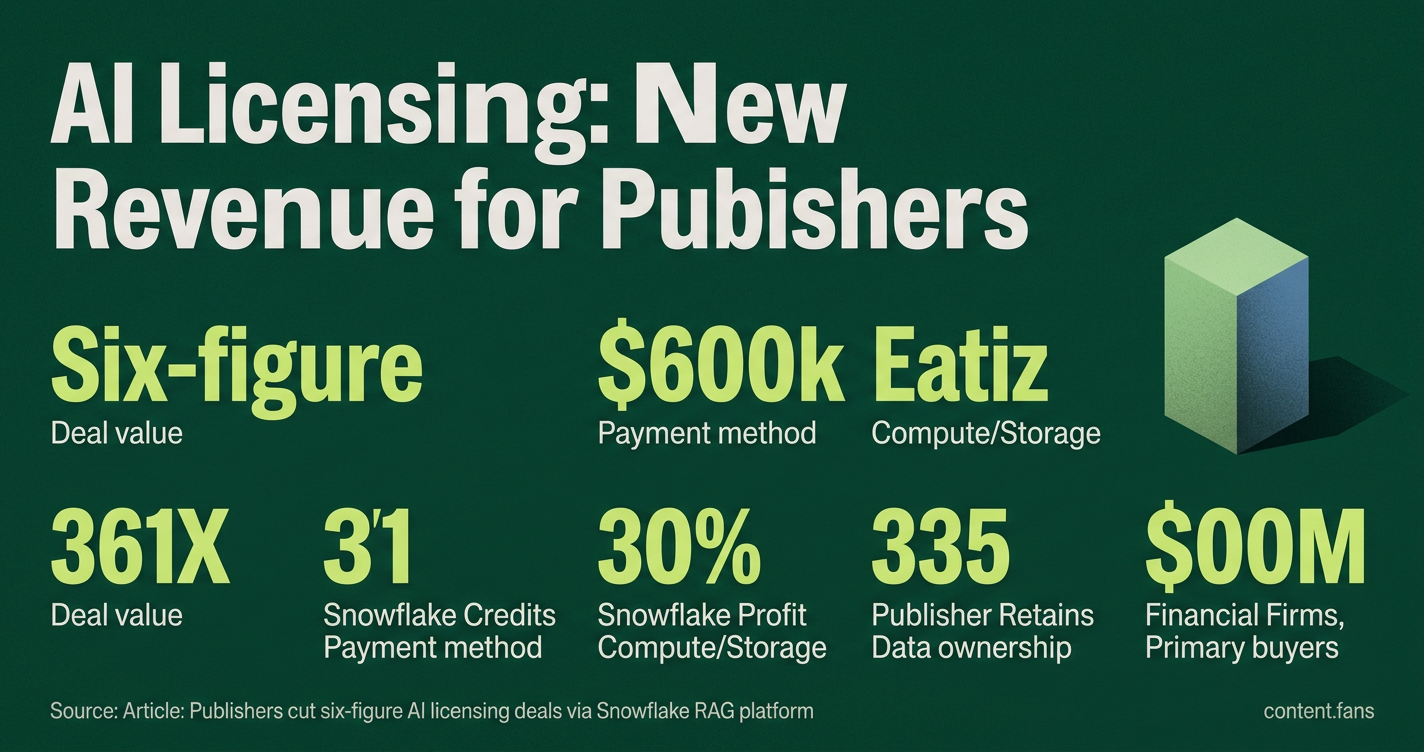
How AI Licensing Deals on Snowflake Are Structured
This framework allows publishers to monetize their content archives by licensing them directly to enterprises for AI applications. It provides a secure, controlled revenue stream while giving buyers access to trusted, verifiable information for tools like market analysis and sentiment tracking without unrestricted data scraping.
Key terms of these publisher deals include:
* Contract Type: Deals typically involve flat-fee annual licenses or usage-based pricing models.
* Payment Method: Payments are streamlined using a company's prepaid Snowflake credits, which simplifies procurement.
* Data Ownership: Publishers retain full ownership, as Snowflake's Terms of Service affirm that the customer retains all rights to their data.
As highlighted in recent Digiday coverage, the approach appeals to publishers seeking revenue without giving up their archives for unrestricted AI model training. Experts at Ithaka S+R identify this model as a legal and governable method for large language models to access high-quality journalism.
Why Financial Firms Are the Primary Buyers
Financial institutions have become the leading early adopters. Banks and asset managers are licensing news content to power a range of internal tools, including:
1. Real-time market briefings and automated event alerts.
2. Sentiment analysis and reputational risk dashboards.
3. Investment research copilots combining news with internal data.
4. Compliance surveillance systems that flag articles related to misconduct.
5. Customized daily news digests for clients based on their portfolios.
This trend aligns with industry forecasts, as news sentiment analysis is a recognized finance use case. By building retrieval-first AI copilots, firms can use licensed content for specific queries rather than training opaque, black-box models. This emphasis on traceable retrieval is critical in regulated industries that demand clear audit trails.
The Impact on Publisher Revenue Models
While these six-figure deals provide a material boost for major national brands, analysts from Nieman Lab caution that this model is unlikely to generate significant AI licensing revenue for the average newsroom. With outlets facing significant traffic losses due to AI-powered search, this new income helps but may not fully offset declining ad revenue.
However, premium publishers are finding new leverage. Industry reports indicate that a significant portion of recent AI data deals have involved news media, highlighting strong enterprise demand for vetted journalism. Although a single dominant model has not yet emerged, these early experiments point toward a market realignment where publishers monetize trust, enterprises prioritize data governance, and platforms like Snowflake provide the underlying infrastructure.