
Publishers Adapt for AI: Zero-Click Web Cuts Traffic, Shifts Monetization
Serge Bulaev
More people are getting answers from search engines without clicking on websites, which may be causing a big drop in web traffic for publishers. Studies suggest that AI-generated summaries can reduce clicks by over half, and some publishers report losing up to 89% of their clicks on certain searches. To adapt, publishers are changing their content and websites so AI models can easily read, understand, and show their information. These changes might include adding more easy-to-quote facts, using technical tools for better data sharing, and highlighting expert authors. This shift suggests that making content readable for machines, not just people, could help publishers stay relevant and make money, even if fewer people visit their pages directly.

Publishers face a fundamental restructuring of how audiences discover and consume content. As AI agents increasingly deliver answers directly to users without requiring website visits, traditional traffic-dependent revenue models are collapsing. Here is what industry leaders need to know about adapting to this zero-click future.
How are publishers redesigning content to remain discoverable by AI agents?
Publishers are redesigning content for AI by creating concise, fact-rich content and structuring pages with "answer-first" paragraphs. This involves using clear language and technical enhancements like Schema.org markup and llms.txt files to ensure machines can easily parse, verify, and cite their information.
Publishers are shifting from keyword-centric SEO to AI-centric content optimization focused on modularity and machine readability. Industry experts advise creating original research, video, and interactive tools that AI cannot replicate, while tracking AI visibility to maintain competitive advantage.
Key structural changes include modular sections with "answer first" paragraphs, where each section functions as a standalone building block. Publishers lead with the takeaway, then provide context, using precise nouns and strong verbs while avoiding ambiguous pronouns. This approach ensures AI agents can parse individual sections without requiring full article context.
Technical implementation focuses on entity mapping via Schema.org markup to explicitly define organizations, products, and authors as machine-readable entities. Specialized schemas for video, audio, image, and FAQ content help AI systems index rich media. Emerging standards like llms.txt files - directories designed specifically for LLM navigation - are becoming best practices for agent-friendly architecture.
What financial impact has zero-click AI search had on publisher revenue?
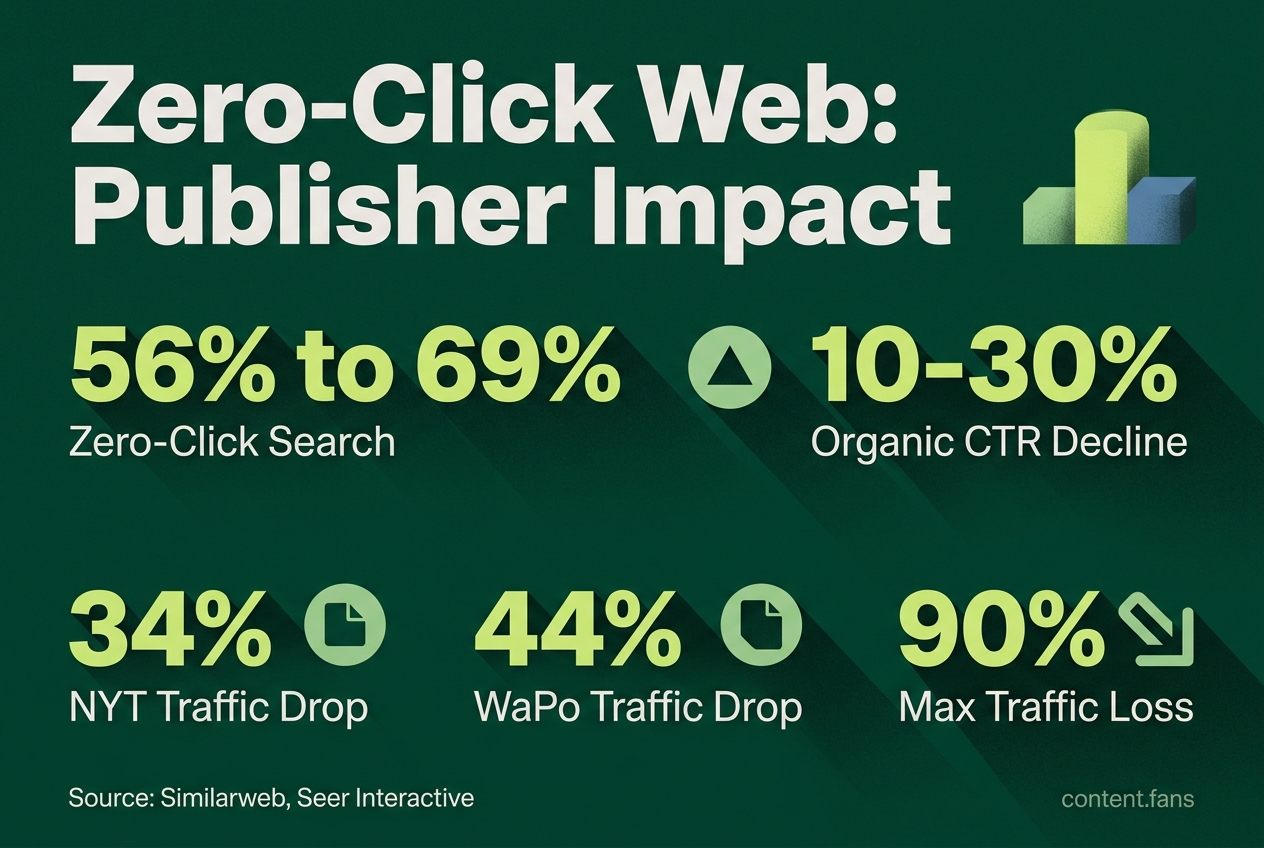
The transition to zero-click search has triggered severe revenue disruption across the publishing industry. Zero-click searches increased from 56% to 69% between May 2024 and May 2025 per Similarweb, with corresponding collapses in click-through rates. Seer Interactive reported significant drops in organic clicks when AI Overviews appeared.
General studies indicate the scale of impact:
| Metric | Impact |
|---|---|
| Organic CTR with AI Overviews | Declines ranging from 10-30% in early tests |
| Paid CTR with AI Overviews | Varies by industry; significant drops reported |
| Overall traffic impact | Major publishers report substantial declines |
Major publishers have suffered disproportionately. U.S. news websites collectively saw traffic drop more than 40% in December 2025, with The New York Times dropping 34% and The Washington Post falling 44%. Some publishers report losing up to 90% of traffic and revenue on affected queries.
The fundamental problem: when pageviews decline significantly, advertising revenue drops proportionally. Subscription models falter because users never hit paywalls - AI extracts useful snippets directly. Affiliate revenue declines because AI responses rarely include referral links. AI Overviews contribute substantially to overall publisher traffic decline.
What new monetization strategies are publishers exploring?
Forward-thinking publishers are pursuing three primary revenue diversification paths.
Content licensing to AI companies represents a direct monetization of publisher expertise. As one industry analysis notes, "If you have unique, high-quality content, consider licensing it to AI companies." This creates revenue streams independent of traffic volume.
Agent-driven transactions through API-enabled commerce show early promise. Major e-commerce comparison sites are publishing structured product data via APIs, enabling agents to query availability and book placements programmatically. Early adopters report that agent-driven transactions are becoming a meaningful new revenue category.
Attention-based pricing and agentic commerce optimize what traffic remains. Leading news publishers implementing attention measurement across inventory are discovering that significant portions of placements are technically viewable but deliver minimal engagement. By pruning low-attention inventory and repricing high-attention placements, publishers are seeing improved monetization efficiency.
Some publishers are also developing direct audience relationships through newsletters, mobile apps, and podcast subscriptions - channels insulated from AI Overview disruptions.
How can publishers maintain authority and trust in AI-driven discovery?
In a zero-click environment, AI models must verify source credibility before citation. Publishers are operationalizing E-E-A-T signals (Expertise, Experience, Authoritativeness, Trustworthiness) through verifiable digital footprints.
Critical trust-building measures include:
- Author vectors with verifiable credentials: Every piece links to human authors with bios, social footprints, and topical history
- Organizational entity definition: Clear presence in Wikidata, Crunchbase, LinkedIn, and via Organization Schema on homepages
- Google Knowledge Panel management: Active claiming and optimization of knowledge panels
- Visual proof and original data: Screenshots, original photography, and proprietary research that create "trust anchors"
- Freshness maintenance: Updating core pillar pages every 90-180 days to maintain recency signals
These measures ensure publishers remain citable sources even when users do not visit directly.
What concrete results have early adopters achieved?
Several publishers demonstrate successful adaptation strategies.
Tamedia (Switzerland) has implemented AI-assisted personalization for automated hyperlocal newsletter production, reporting improved efficiency and engagement rates through structured local data.
Industry case studies show news sites successfully tying breaking coverage to live commerce suggestions using agentic commerce, achieving meaningful lifts in commerce engagement and revenue per thousand impressions.
The Daily Maverick (South Africa) experimented with ChatGPT for summary articles and cards, optimizing content specifically for agent summarization workflows.
Relevo (Spain) used AI-supported coding to measure mobile homepage success, improving engagement significantly through TikTok-like interface optimization.
These cases illustrate a fundamental shift: from "content for humans" to "structured data for agents", enabling programmatic discovery and new monetization models even as traditional traffic declines.