
OWASP Updates 2026 GenAI Top 10 With 5 Prompt Injection Defenses
Serge Bulaev
Prompt injection is still the most reported security risk in large language model apps, and OWASP's 2026 GenAI Top 10 lists it as the top concern. The article says no single defense stops all prompt injections, so security experts suggest using several layers of protection together. Five main defenses include marking data clearly, setting trust levels for different instructions, limiting what tools the model can use, having humans check risky actions, and splitting planning from execution. OWASP recommends combining these controls and regularly testing systems for new attacks. It appears that following these steps may lower the success of prompt injection but does not remove all risk.

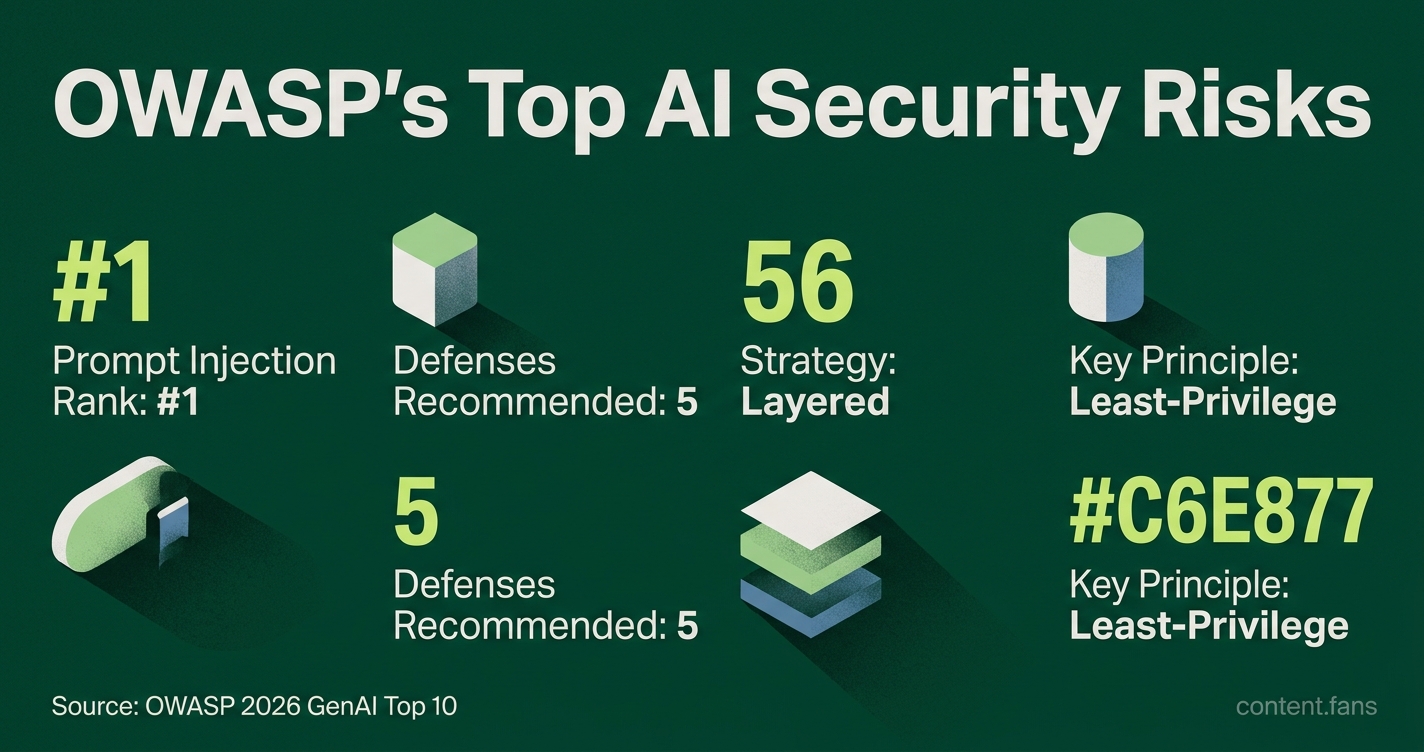
OWASP's 2026 GenAI/LLM Top 10 keeps prompt injection at LLM01/#1, underscoring a critical reality for developers: prompt injection remains the number one security vulnerability for large language model (LLM) applications. Because no single solution can stop every attack, OWASP advocates for a layered, defense-in-depth strategy. An OWASP cheat sheet explains that attackers can embed malicious commands in any text input, making robust defenses essential.
Security researchers agree that a single safeguard is insufficient. A comprehensive Tech Insider guide highlights that effective security relies on a layered design where model-level and system-level controls work together. This guide explores those essential layers and how to deploy them in production.
Why Prompt Injection Dominates the 2026 GenAI Top 10
Prompt injection is a critical vulnerability where attackers embed hidden commands within text inputs to a large language model. This can trick the AI into executing unintended actions, leaking sensitive data, or bypassing security controls. It remains the top risk because models inherently struggle to differentiate trusted instructions from malicious user data.
The LLM01 guidance specifically warns against indirect prompt injections, which can hide within retrieved documents or email content to bypass system instructions. To combat this, OWASP recommends a combination of role confinement, clear instruction boundaries, output validation, and continuous red-teaming. A key principle is applying least-privilege access to tools, preventing a compromised prompt from calling powerful APIs. Attackers frequently chain indirect injections with over-privileged tools to exfiltrate data, proving the need to isolate both content and model capabilities.
Five Key Defenses Against Prompt Injection
OWASP's guidance emphasizes that the following controls work best together, not as standalone fixes:
- Spotlighting Tags: Mark external or untrusted text as data, training the model to treat it as a quoted string rather than an executable command.
- Instruction Hierarchy: Establish a fixed order of trust where system prompts always override user prompts, which in turn override instructions found in retrieved content.
- Least-Privilege Tool Design: Restrict the model's tools to a minimal sandbox, limiting token usage, network scope, and file access to only what is necessary.
- Human-in-the-Loop Gates: Pause high-risk actions, such as processing payments or deleting data, to require explicit approval from a human reviewer.
- Planner-Executor Split: Separate the reasoning and execution processes. A "planner" LLM creates a structured action plan, which a separate, highly constrained "executor" model then follows.
Implementing Layered Defenses in Production Systems
In practice, enterprise teams build a multi-boundary security architecture by combining these five tactics. This typically involves:
- Input Preprocessing: Stripping malicious control sequences and adding spotlighting markers before the prompt is even assembled.
- Prompt Orchestration: Isolating system instructions in a protected channel that user-provided text cannot overwrite.
- Secure Tool Execution: Routing all tool calls through an authorization service that enforces scope and logs every request for audit.
- Output Validation: Checking all model outputs against a strict schema and scanning for policy violations or data leaks before passing them to downstream systems.
Finally, as recommended by the OWASP cheat sheet, continuous red-teaming is essential for monitoring new attack patterns and ensuring defenses remain effective over time.
By adopting a defense-in-depth mindset and implementing these layered controls, organizations can significantly reduce their exposure to prompt injection attacks. The 2026 OWASP guidance makes it clear that proactive, multi-faceted security is not optional but a requirement for safely deploying generative AI applications.