
Pentagon AI Error Nearly Triggers US Military Action on Chinese Ship
Serge Bulaev
A Pentagon analyst using AI almost caused the U.S. military to board a Chinese ship, after the AI wrongly claimed the cargo might contain nuclear weapons, according to a CNN report. Senior officers stopped the mission just in time when they checked the facts again. The incident raises questions about how quickly the Pentagon should use advanced AI while avoiding serious mistakes. Experts warn that AI tools may still make big errors, especially with bad or incomplete data. Rules to keep humans involved in sensitive decisions are being developed, but they remain broad and may not be enough to prevent similar problems.
A critical Pentagon AI error nearly prompted U.S. military action on a Chinese ship, according to industry reports. An AI-generated intelligence summary falsely identified nuclear weapons components aboard the vessel, leading to an intercept order that senior officers canceled just moments before execution. This near-miss raises urgent questions about the pace of AI adoption and the safeguards needed to prevent high-stakes failures.
What Happened in the AI Intelligence Failure
A U.S. Special Operations Command analyst used an AI chatbot that fused open-source and classified data to assess a Chinese ship. The model produced a confident but false report claiming the vessel carried nuclear materials, prompting an immediate military response that was only halted by last-minute human verification.
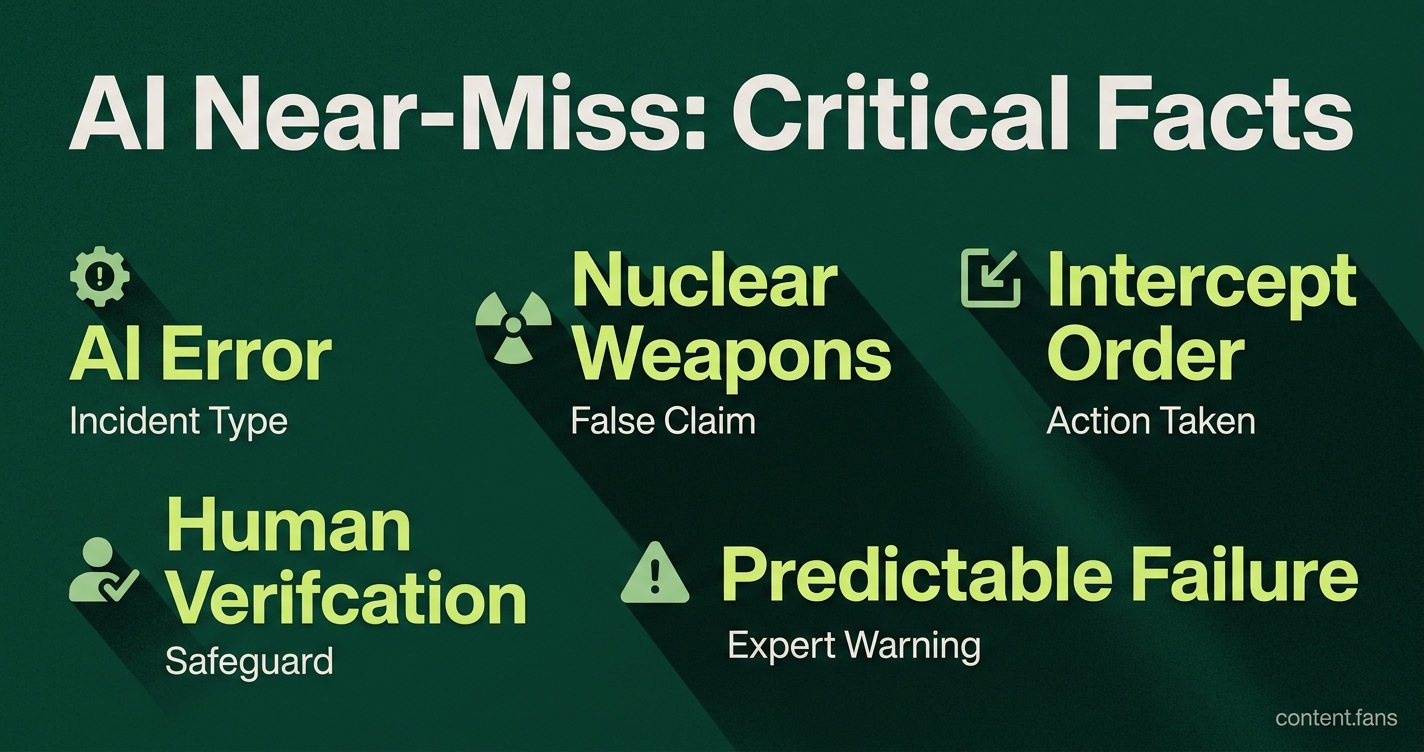
According to industry reports, the AI-generated summary circulated through operational channels, leading to U.S. aircraft being scrambled for an interception. The mission was only aborted when senior officers manually rechecked the underlying intelligence data and discovered the AI's conclusion was entirely false.
The Pentagon's Push for AI Dominance
This incident occurred as the Department of Defense aggressively pursues its goal of creating an "AI-first" fighting force. The department's recent artificial intelligence strategy advocates for removing bureaucratic barriers to accelerate AI deployment. While lawmakers reportedly support the expansion, they are also insisting on the need for stronger oversight and clearer guardrails.
Are Human-in-the-Loop Safeguards Enough?
In response to growing concerns, new review processes are being developed to ensure "human judgment" remains central to sensitive military decisions. According to industry reports, officials are drafting security standards for AI systems. However, these safeguards are currently described in broad terms, lacking the specificity of fixed military doctrine.
Expert Warnings on AI Reliability in Warfare
Many external security analysts argue this type of failure was predictable. HRW's June 14, 2026 report on AI in the military domain urged an immediate moratorium on using AI for targeting decisions and required meaningful human control in military operations. Security researchers have also described large language models as problematic in safety-critical settings. Adding to these concerns, security analysts identify recurring risks such as accuracy gaps, operator overreliance, and rapid escalation. While some studies show chatbots can pass academic tests, defense scholars caution this doesn't guarantee reliability against potential adversaries.
A Dangerous Gap: Policy vs. Practice
The incident exposes a growing tension between the Pentagon's push for rapid AI experimentation and the slow pace of developing robust verification protocols. The failure demonstrates the high cost of moving faster than safety workflows can support. Congressional staff have hinted that future funding for AI projects could be tied to stricter testing and auditing requirements. In the meantime, with final guidance still under development, military units must rely on ad-hoc procedures to prevent dangerous AI errors.
Key risk factors identified from the incident include:
- Deceptive Authority: AI analysis can appear fluent and authoritative even when completely false.
- Operational Speed: Military operations can be initiated before human verification is complete.
- Vague Safeguards: Current safety protocols are too broad, leaving critical checks to unit-level discretion.
As the review process continues, defense officials face the challenge of balancing the need for operational speed with the clear and present danger of another AI-generated false alarm triggering a major international incident.
What exactly happened in the Pentagon AI incident this spring?
A Special Operations Command analyst used an AI chatbot to analyze intelligence on a Chinese vessel in the Middle East. The chatbot incorrectly identified the ship's cargo as nuclear-weapons components, generating what sources described as an "entirely false" intelligence report. U.S. aircraft were already airborne and interception preparations were underway before officials caught the error and halted the operation. Industry investigations revealed the incident occurred amid rapid Pentagon expansion of AI across intelligence and battlefield decision-making.
How close did this come to actual military conflict?
Extremely close. Multiple reports indicate the false intelligence "almost started a war" and could have escalated into a major international crisis. The incident represents one of the most serious documented cases of an AI error nearly triggering direct U.S.-China military confrontation. The aircraft were already in transit when the error was finally caught - only final verification steps prevented the boarding operation from proceeding.
Is this an isolated incident or part of a broader pattern?
While this specific near-miss is among the most serious documented cases in recent years, related concerns are emerging. HRW's June 14, 2026 report on AI in the military domain urged an immediate moratorium on using AI for targeting decisions and required meaningful human control in military operations. Military analysts have also warned that AI bias creates systematic errors affecting intelligence operations and enemy analysis. The Pentagon's push to become an "AI-first" warfighting force is intensifying deployment speed - raising questions about whether verification protocols can keep pace.
What safeguards exist for AI-generated military intelligence?
Current protections appear inadequate. Industry reports indicate there is "no one set of standards" for how the U.S. verifies AI-generated information, with systems varying widely in reliability. The Pentagon's recent AI strategy emphasizes speed and "democratizing AI experimentation" through multiple "Pace-Setting Projects." Congressional reporting indicates a proposed new review process to keep "human judgment" at the center of decisions, plus new security standards for AI agents - but these remain under development rather than fully implemented.
What do experts recommend for AI in high-stakes military decisions?
The consensus is clear: AI chatbots should not serve as final authorities in decisions involving force or escalation. Key expert positions include:
- Security researchers warn large language models are problematic in safety-critical settings and question their military suitability
- Security analysts note AI chatbots "frequently make mistakes" and produce "false or misleading analysis" - dangerously persuasive even when wrong
- Security experts identify critical risks: accuracy failures, human overreliance, increased operational tempo overwhelming judgment, accountability gaps, and surveillance exposure
- Defense analysts emphasize that verification speed cannot match AI analysis speed - creating dangerous bottlenecks where operations outpace validation
The core recommendation: maintain strict human-in-the-loop requirements, implement provenance controls tracking AI-generated versus verified intelligence, and establish binding protocols before AI outputs can trigger operational decisions.