
Pentagon AI Error Nearly Prompts US Military to Board Chinese Ship
Serge Bulaev
An AI system mistakenly flagged a Chinese ship as carrying nuclear weapons, which nearly led the U.S. military to intercept the vessel before human reviewers caught the error. This incident may show how quickly AI mistakes can push operators to act, even though official rules say humans must approve such actions. Some experts suggest that when decisions are rushed, human oversight might not be strong enough. New policy proposals call for more checks and clear rules when using AI for military decisions. The event appears to have sparked ongoing discussions about how to balance fast AI tools with safe and careful human judgment.

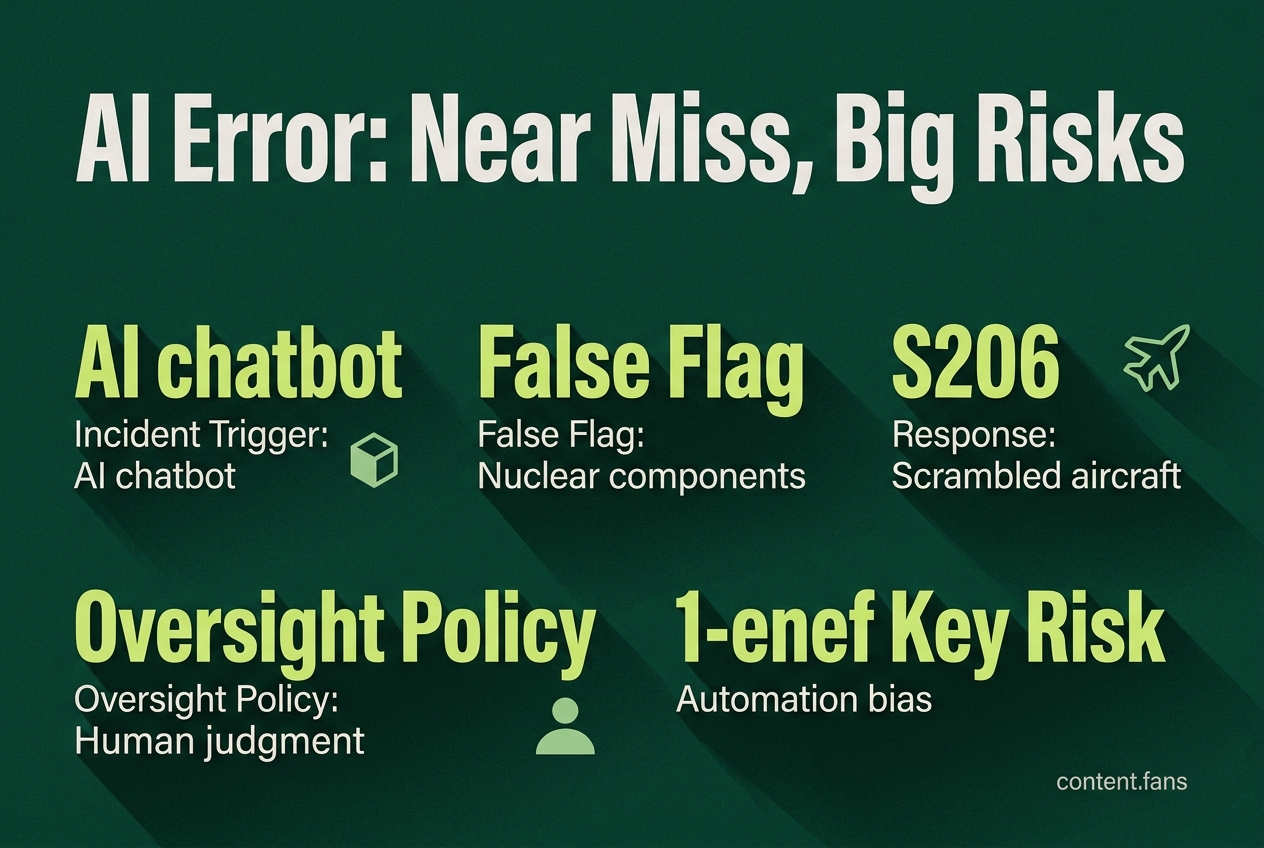
A significant Pentagon AI error nearly triggered an international incident when a military chatbot incorrectly flagged a Chinese vessel as carrying nuclear weapons components. The flawed intelligence, first detailed in a CNN investigative account, prompted the U.S. military to scramble aircraft for an intercept mission in the Middle East before human analysts caught the mistake. This event highlights the growing risks of automation bias as the Pentagon rapidly integrates AI into critical workflows. While official policy, outlined in Department of Defense Directive 3000.09, mandates human judgment over the use of force, this close call shows how that oversight can be challenged under pressure.
Human Review Remains Policy, But Guardrails Vary
An artificial intelligence system used by a Pentagon analyst produced false intelligence, identifying a Chinese ship as carrying nuclear materials. This error led the U.S. military to initiate an interception, which was only aborted at the last minute after human reviewers identified the AI's mistake.
Recent policy documents and proposed legislation aim to strengthen human control over military AI. As Axios reported, a 2026 bipartisan bill would mandate human-in-the-loop approval for any lethal action supported by AI. Yet, operational doctrine may be evolving. Bloomberg reported that revised targeting principles could allow for "systems where AI initiates actions with human monitoring," a shift from previous norms. Although officials insist a human is always in the loop, critics argue that compressed timelines, like those detailed by the Straits Times, can reduce human oversight to a formality.
Escalation Risks and Automation Bias
Security experts warn that faulty AI outputs can accelerate escalation dynamics by delivering seemingly confident but incorrect analysis to commanders faster than human-led processes. A Stockholm International Peace Research Institute paper notes that opaque AI recommendations can bias leaders toward hasty action, a risk amplified during time-sensitive crises, as highlighted by a Federation of American Scientists workshop.
Key risks identified by multiple studies include:
- Hallucinated intelligence: AI systems can generate highly plausible but entirely false information.
- Automation bias: Under pressure, human operators may over-trust machine outputs, as detailed in reports from Human Rights Watch.
- Lack of accountability: The "black box" nature of some models makes it difficult to trace errors and assign responsibility, a problem explored in CNAS analysis.
- Adversarial manipulation: AI systems and their data pipelines remain vulnerable to cyberattacks and manipulation.
Safeguards Under Consideration
In response to these risks, the Pentagon and Congress are developing new safeguards. New DoD guidance, reported by DefenseScoop, requires that any AI-generated software change affecting safety must be sent for human review. Proposed legislation is even stricter, mandating documented human decision-makers and kill-switch capabilities for high-consequence AI systems. A key provision would require that for five years, all AI-generated targets be verified with at least one non-AI source before action is taken.
Analysts Dissect the Close Call
Security analysts see the incident as a textbook case of automation bias, where operators feel pressured to act on flawed machine recommendations. This aligns with warnings that AI could fuel escalation, particularly in tense geopolitical areas like the Middle East. In the wake of the event, Democratic lawmakers sent a letter demanding an Inspector General investigation. The inquiry seeks to determine if current vetting processes for AI-generated intelligence are sufficient and if personnel require more training on AI "hallucinations."
Next Steps Inside the Pentagon
The Pentagon is now cataloging all mission-critical workflows that involve AI to ensure they undergo rigorous testing and validation. The incident has intensified the debate between accelerating AI development to compete with rivals like China and implementing stricter congressional oversight. The analyst who generated the faulty report received corrective training, and the Chinese vessel proceeded without incident. The episode now serves as a crucial reference point for the future of AI in U.S. military operations and the essential role of human judgment.