
Nvidia, Palantir Restrict Anthropic AI Over Data Retention Fears
Serge Bulaev
Nvidia, Palantir, and Booz Allen have decided to limit their use of Anthropic's AI models because of worries about how data and logs are stored. Reports suggest that Nvidia now only uses Claude for less sensitive tasks, while Palantir wants strict no-data-retention rules before using the model. These companies appear to be concerned that stored data could be accessed by attackers or reveal important information. Experts believe that new contract rules, like redacting data before sending prompts and not allowing training on customer data, may lower but not remove all risks. Some analysts suggest that this move might lead more companies to use private AI models for sensitive data and public models for less risky tasks.
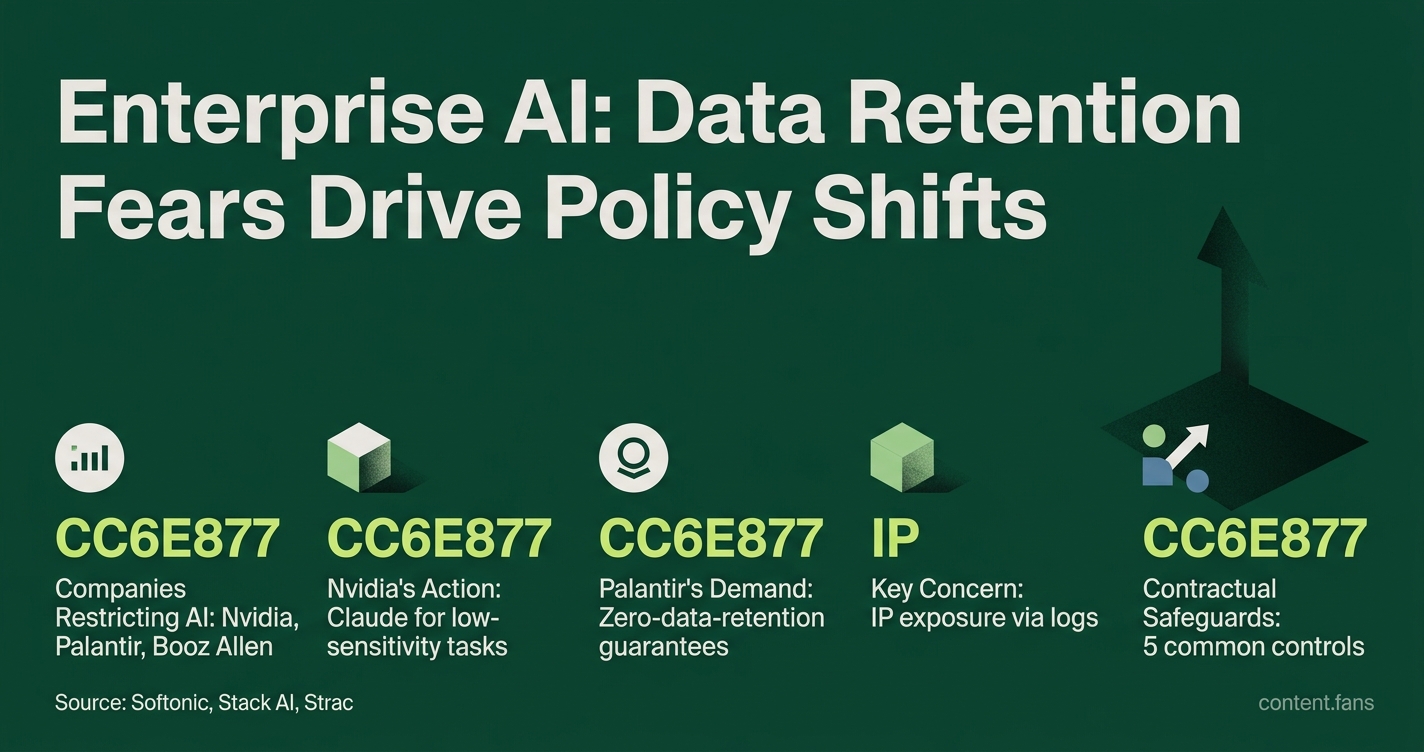
The decision by Nvidia, Palantir, and Booz Allen to restrict Anthropic AI over data retention fears highlights growing enterprise concern about how third-party AI vendors handle sensitive data. According to reports, the firms tightened internal usage rules after reviewing Anthropic's policies for storing prompts and logs. A Softonic summary notes that Nvidia now relegates the Claude model to low-sensitivity tasks, while Palantir demands zero-data-retention guarantees for its platforms.
Enterprises utilizing externally hosted foundation models face significant risks, including unauthorized training on their data, long-term log retention, and accidental disclosure of IP through prompts. In response, industry reports from Stack AI show a growing trend toward integrating data, AI, and third-party risk management into a unified operating model.
Why the three companies cared about logs
Nvidia, Palantir, and Booz Allen restricted Anthropic's AI due to significant concerns over data retention policies. The companies feared that stored prompts, usage logs, and metadata could expose sensitive intellectual property or be compromised, prompting them to demand stricter zero-retention guarantees and limit the AI's internal use.
The firms' primary concerns centered on two key questions: could attackers access logs via a vendor breach or subpoena, and would the stored metadata itself reveal intellectual property or constitute regulated data?
Common controls now appearing in contracts
To address these risks while still using external models, large enterprises are demanding a recurring set of contractual and technical safeguards, as listed by Stack AI and Strac.
- Mandatory data classification to redact regulated fields before a prompt is sent.
- Least-privilege access controls with unique service identities for each integration.
- Explicit contractual prohibitions against using customer inputs for model training.
- Customer-owned, tamper-evident audit logs for every individual request.
- A formal certificate of deletion once an agreed-upon data retention period expires.
Security experts agree that while these controls mitigate risk, they do not eliminate it entirely. This explains why a firm like Palantir continues to prohibit public AI models for its sensitive classified and cybersecurity programs, even with robust contractual safeguards in place.
Shifts in deployment strategy
This cautious approach is influencing broader market deployment strategies. Market watchers observe a pattern where companies adopt a tiered model portfolio based on data sensitivity. For example, Softonic reports that Nvidia uses its proprietary "Nemotron" models for core operations while using Claude for less critical experimentation. Similarly, Booz Allen has barred Claude from its proprietary cybersecurity projects. Analysts quoted by Stack AI predict this will lead to a broader shift toward hybrid AI strategies: private or on-prem models for high-risk data, paired with commercial APIs for public or medium-risk content.
Takeaway for governance teams
The actions of these industry leaders highlight a clear directive for governance teams: adopt a data-first security posture. The cited governance playbooks recommend layering technical controls and assessing vendor terms before activating any frontier model. Enterprises following this approach are likely to:
- Conduct a comprehensive inventory of all GenAI touchpoints, including browser plugins.
- Route all prompts through a centralized AI gateway to enforce redaction and security policies.
- Reserve zero-data-retention or self-hosted models for "crown-jewel" workloads.
While implementing these steps can lengthen evaluation cycles, the precedent set by Nvidia, Palantir, and Booz Allen demonstrates that leadership teams perceive this deliberate caution as preferable to unbounded data exposure.
Why did Nvidia, Palantir, and Booz Allen restrict Anthropic AI models?
According to reporting from The Information, these companies imposed restrictions due to "data fears" - specific concerns about how Anthropic handles user and customer data. Nvidia reportedly limits Anthropic use to less sensitive tasks, Palantir pushed for stronger zero-data-retention guarantees, and Booz Allen blocked use for proprietary cybersecurity work. The restrictions reflect worries about data handling practices, potential exposure of proprietary information, and insufficient contractual protections regarding data retention and logging.
What specific data concerns prompted these enterprise restrictions?
The core issue centers on data retention policies and what happens to enterprise inputs. Sources indicate that Anthropic's policy changes around retention of model usage logs made large customers cautious - not just about training data, but about prompts, outputs, metadata, and logs that can reveal internal workflows and proprietary information. For companies handling sensitive IP, cybersecurity, and regulated workloads, these artifacts represent significant intellectual property and operational security risks. The restrictions reportedly followed Anthropic's shift to require business customers to retain data for 30 days while offering customer-controlled infrastructure options.
How are enterprises responding to data risks with externally hosted AI models?
Enterprises are implementing stricter governance and data controls across several dimensions:
| Control Area | Implementation |
|---|---|
| Data classification | Tagging sensitive content before any AI connection |
| Least privilege access | Scoped, revocable identities for AI agents and integrations |
| Prompt controls | Redaction and minimization at the point of use |
| Vendor governance | Explicit contracts defining training restrictions, retention limits, and data residency |
| Audit logging | Per-request tracking with tamper-evident records |
| Output monitoring | Automated checks for PII, bias, and policy violations |
The most practical approach combines data governance, AI governance, and third-party risk management into a single operating model rather than managing them separately. According to industry reports, enterprises are increasingly treating AI as a "data-in-motion" problem requiring classification before connection and continuous monitoring after deployment.
What alternatives are enterprises pursuing instead of public frontier models?
Organizations are shifting toward sensitivity-tiered usage patterns:
- Restricted use of public LLMs - limited to low-risk tasks only
- Private or self-hosted AI stacks - for sensitive workflows
- Internal/proprietary models - Nvidia reportedly uses its own Nemotron models for core internal tasks
- Zero-data-retention contracts - becoming a baseline purchase requirement, not a premium feature
- On-premises, air-gapped, or private cloud deployments - to keep sensitive data away from external vendors
This represents a move from "public model first" to "control first" decision-making. Industry reports indicate that a significant portion of organizations cite data-related issues (privacy, location, sovereignty) as their top challenge, with many also citing regulatory and ethical concerns.
What should enterprises require from AI model vendors to mitigate data risks?
For externally hosted foundation models, contract terms should explicitly cover:
| Requirement | Why It Matters |
|---|---|
| Training-use restrictions | Confirmation that customer prompts, embeddings, and outputs are excluded from vendor training |
| Data retention limits | Defined durations for prompts, logs, and files with guaranteed deletion |
| Zero-data-retention options | Irrevocable ZDR for eligible workloads |
| Residency and sovereignty | Processing and storage meeting internal policy and sector requirements |
| Encryption and key management | Encryption in transit/at rest with customer-managed key options |
| Subprocessor visibility | Review of upstream and downstream data handlers |
| Security audit evidence | SOC 2, ISO-aligned controls, and incident notification commitments |
Anthropic has responded to enterprise pressure by developing Enterprise Frontier Safeguards, giving businesses more control over data review, storage, and management - though adoption is reportedly rolling out in phases.