
DeepMind Unveils AI Delegation Framework for Human-AI Task Handoffs
Serge Bulaev
DeepMind has shared a new framework that may help humans and AI safely hand off tasks to each other during complex work. The proposal suggests making all steps of delegation clear, including who is responsible and how tasks can change hands if needed. Early reactions note that the framework appears to make handovers safer, but it has not yet been tested in real-world settings. The authors say this work might move teams toward more repeatable and reliable ways for humans and AI to work together, but actual adoption timelines remain uncertain.

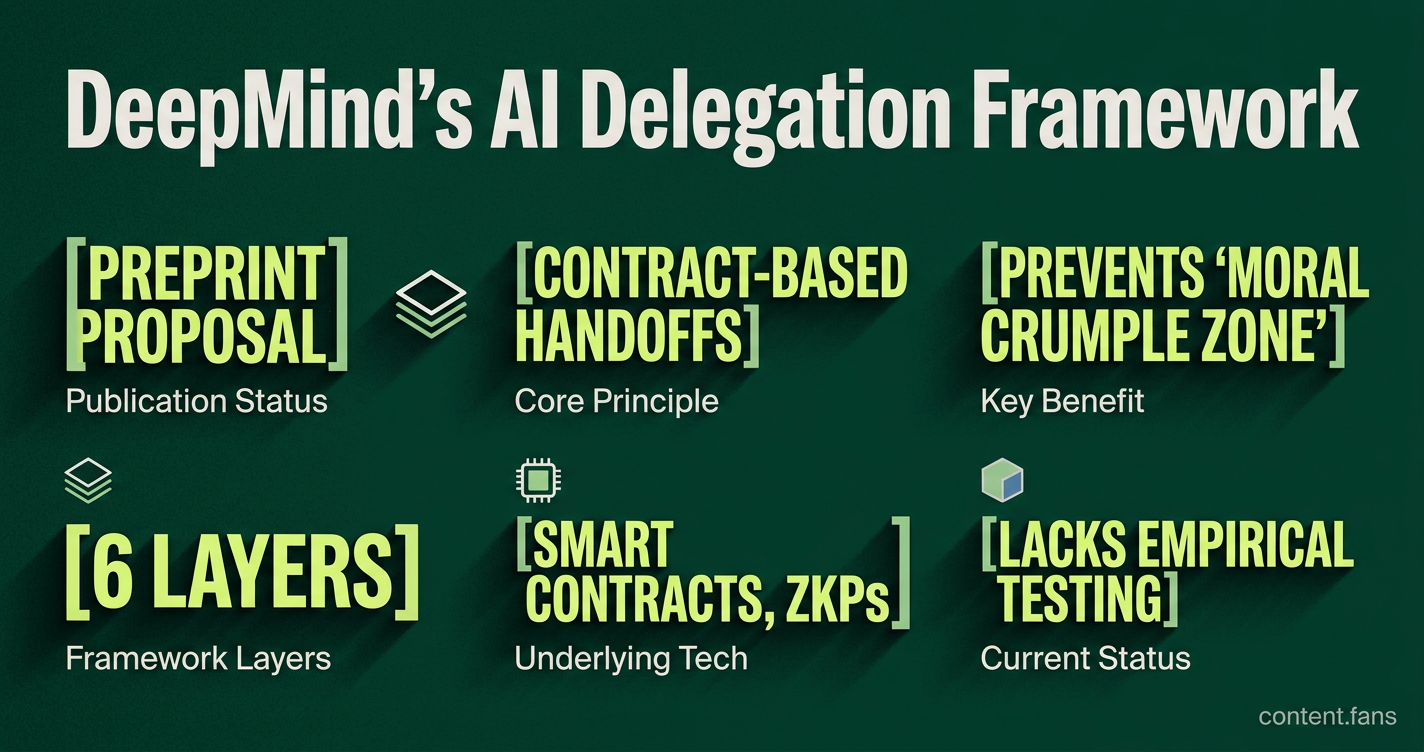
Google DeepMind researchers published a research paper on arXiv proposing an 'Intelligent AI Delegation' framework for human-AI task handoffs, released in February 2026 as a proposal rather than a unveiled product. This significant development appeared in a preprint titled Intelligent AI Delegation, which outlines a formal system for transferring authority between humans and AI agents during complex workflows.
Industry analysts view the framework as a robust solution to the problem of brittle prompt chains that fail under dynamic conditions. The authors propose treating delegation as a formal, contractual transfer of authority, which helps prevent the "moral crumple zone" - a scenario where human operators are held accountable for AI errors beyond their control. The paper is available on arXiv and credits Google DeepMind researchers Nenad Tomasev, Matija Franklin, and Simon Osindero.
Framework Highlights
The Intelligent AI Delegation framework introduces a contract-based model for human-AI collaboration. It establishes clear protocols for transferring authority, responsibility, and accountability. By creating verifiable audit trails and fallback procedures, the system aims to make task handovers between humans and AI agents safer and more reliable.
- Dynamic Assessment: AI agents continuously evaluate their own competence and available resources for a given task.
- Adaptive Execution: The system allows for the dynamic reassignment of tasks based on changing conditions or agent capabilities.
- Structural Transparency: All delegation events and task handovers are logged to create an immutable and verifiable audit trail.
- Scalable Market Coordination: A mechanism allows agents to bid on tasks and post financial stakes, creating an internal market for work allocation.
- Systemic Resilience: Built-in fallback protocols are designed to prevent single-point failures from causing system-wide breakdowns.
A sixth layer, "contract-first decomposition," underpins the framework. This principle requires that complex tasks be broken into smaller subtasks, each with an outcome that can be automatically verified through methods like unit tests or formal proofs. Industry observers suggest this signals a move from ambiguous prompt engineering to more structured, code-like delegation protocols.
Early Reception and Open Questions
Initial reactions from the technical community are positive, with commentators praising the framework's emphasis on explicit fallback rules. One technical analysis highlights that it addresses how current agents often "silently fail upwards." However, critics note the proposal's primary weakness: a lack of empirical testing. Furthermore, its reliance on niche enterprise technologies like smart contracts and zero-knowledge proofs raises questions about near-term adoption.
The framework diverges significantly from traditional learning-and-development (L&D) models, which typically maintain ultimate human control. In contrast, DeepMind's proposal allows authority to shift to AI agents if specific verification criteria are met. This fundamental difference is expected to be a key point in future AI governance discussions.
Potential Use Cases (Theoretical)
- Supply Chain Logistics: Coordinating multiple routing agents to autonomously negotiate and execute delivery terms.
- Clinical Decision Support: Automatically escalating ambiguous diagnostic cases from an AI system to human medical specialists.
- Financial Risk Management: Dynamically transferring market monitoring duties between human traders and AI agents as market volatility changes.
According to industry reports, there are no widespread commercial deployments of the framework. The preprint is positioned as foundational scaffolding for a future "agentic web" rather than a market-ready product. DeepMind's researchers plan to validate the design through controlled experiments before pursuing industry pilots. Teams can track progress and find further commentary via the detailed Alex Lavaee analysis.
What is the core idea behind DeepMind's Intelligent AI Delegation framework?
The framework turns delegation into a six-step contract: transfer authority, assign responsibility, keep accountability lines intact, define exact roles, express intent precisely, and build trust mechanisms. Instead of hoping an agent "figures it out," every handoff carries explicit success criteria, monitoring hooks, and a named human who remains liable if the machine fails.
How does the paper suggest we stop the "moral crumple zone" where humans are blamed for AI mistakes?
DeepMind requires every delegated task to ship with a verifiable fallback path - usually a human-approvable checkpoint plus an immutable audit trail. If the agent diverges, a smart-contract-style trigger returns control to the accountable person, making it clear who owns the failure and preventing automatic liability spill-over.
Which five design pillars keep large-scale agent networks from spiraling out of control?
- Dynamic assessment of who can do what right now
- Adaptive execution that reassigns sub-tasks when conditions change
- Structural transparency via public logs and zk-SNARK proofs
- Scalable market coordination where agents bid and stake value
- Systemic resilience to stop one faulty agent from collapsing the graph
Are companies already using this framework in production?
According to industry reports, there are no widespread commercial deployments of the framework. The paper is an arXiv pre-print (ID 2602.11865) positioned as protocol infrastructure for the coming "agentic web," not an off-the-shelf product. DeepMind calls it a roadmap; industry watchers expect middleware startups to commercialize parts of it once standards mature.
What do critics flag as the biggest blind spot?
Experts praise the rigor but note the work is conceptual, not empirically tested, and leans on idealized tech (smart contracts, ZK-proofs) that most enterprises do not run today. The framework also offers no concrete method for "calibrating trust," leaving teams to guess how much autonomy an agent should receive in volatile, real-world conditions.