
OpenAI Unveils Three New Realtime Voice Models for Enterprise AI in 2026
Serge Bulaev
OpenAI has introduced three new voice models in 2026: Realtime-2, Realtime-Translate, and Realtime-Whisper, each designed for a specific audio task. These models may help businesses use voice AI in daily work by letting developers combine them as needed, instead of using one all-in-one solution. Reports suggest that Realtime-2 extends the memory for conversations and lets developers adjust how fast the answers come, which might keep call response times low. There are early signs of improved performance, but most results come from outside reports and are not confirmed by OpenAI. The new models appear to work well with current phone systems, but companies may need to balance better memory with costs and speed as they try them in real situations.

In a significant move for enterprise AI, OpenAI has unveiled three new realtime voice models: Realtime-2, Realtime-Translate, and Realtime-Whisper. First released in May 2026, these models form a specialized toolkit for developers, targeting discrete audio tasks like live reasoning, translation, and transcription. This launch signals a strategic push toward practical, day-to-day adoption of voice AI in business workflows, moving away from monolithic, one-size-fits-all solutions.
A Strategic Shift to Disaggregated Voice AI
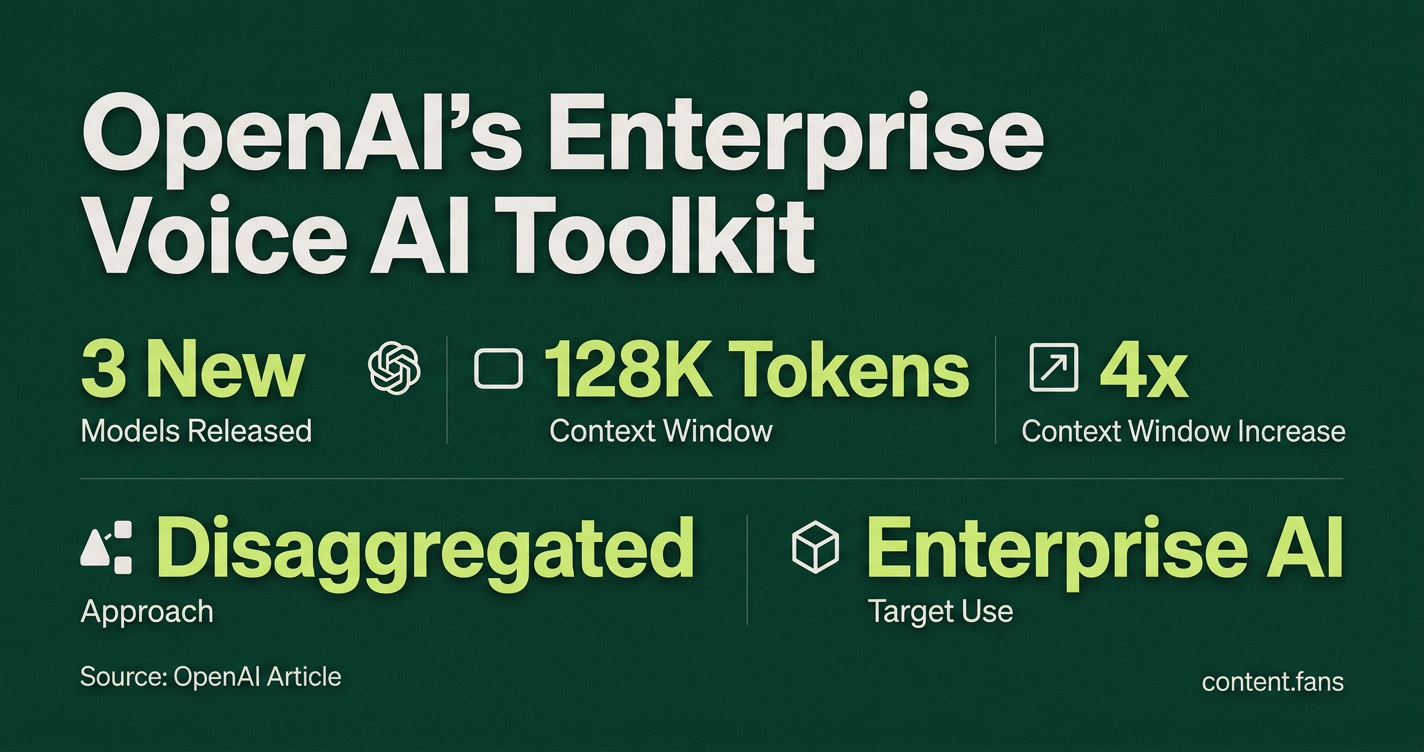
OpenAI's new voice models - Realtime-2 (reasoning), Realtime-Translate (translation), and Realtime-Whisper (transcription) - are designed as separate components. This disaggregated approach allows developers to build more efficient and cost-effective enterprise solutions by selecting only the specific capabilities needed for a given task, improving performance and reducing overhead.
This strategy aligns with OpenAI's focus on embedded, practical solutions over flashy demos, a point emphasized in their enterprise AI message. Industry reports suggest that 2026 is about bridging the gap between model capabilities and real-world business integration. According to a Friar interview with Business Insider, the commercial opportunity in sectors like health and science is "large and immediate."
A key feature of Realtime-2 is its expanded 128K-token context window, a fourfold increase that enables an AI agent to hold a complete customer history within a single interaction. OpenAI's prompting controls for GPT-Realtime-2 include reasoning-effort and latency-oriented behavior settings to optimize performance for different use cases.
Practical Applications and Workflow Advantages
The modular architecture enables powerful new workflows:
- Contact Centers: Can use Realtime-Whisper for efficient transcription while reserving the more powerful Realtime-2 for complex reasoning tasks.
- Global Support: Teams can stream audio through Realtime-Translate to get live translated text before an agent ever responds.
- Compliance & Archiving: Low-latency transcripts can be generated for record-keeping without interrupting the live agent's conversation.
To ease adoption, HPCwire reports that OpenAI has established a dedicated deployment company to help customers integrate the new models with existing telephony, logging, and policy systems. This move indicates a keen awareness of the significant integration challenges often associated with enterprise voice AI.
Performance Benchmarks and Technical Considerations
While official benchmarks from OpenAI are pending, early secondary reports suggest notable performance gains. Industry analyses indicate significant improvements in audio reasoning capabilities and instruction-following performance, though specific metrics remain unconfirmed.
However, a larger context window is not a silver bullet for latency. WebRTC Ventures cautions that 128K prompts can increase time-to-first-token. Consequently, production environments often pair the large window with rolling summaries or external memory to maintain a 300-500 millisecond latency budget. Furthermore, a Mem0 analysis clarifies that the context window does not provide persistent memory; data from previous sessions, like CRM history, must still be managed externally.
Competitive Landscape and Market Impact
The new API is already making waves in the competitive landscape. Developer commentary, including analysis from YouTube channels, suggests this upgraded stack could narrow the competitive moat for specialized voice AI vendors like Bland AI and Vapi. If enterprises can achieve sufficient performance directly via OpenAI's API, many may reconsider their reliance on third-party layered solutions.
Ultimately, the Realtime model trio is engineered to integrate seamlessly into existing enterprise telephony workflows - from customer support to healthcare - without requiring changes to user behavior. The true measure of their success will be how effectively implementation teams balance the benefits of a larger context window against the practical realities of cost and speed in production environments.
What are the three new OpenAI voice models and how do they differ?
Realtime-2 handles conversational reasoning, Realtime-Translate provides live translation across 70+ input and 13 output languages, and Realtime-Whisper delivers ultra-low-latency transcription.
By splitting the stack, OpenAI lets enterprises route each voice task to the model optimized for that job instead of forcing everything through a single, heavier model.
Why did OpenAI disaggregate voice into separate models?
Disaggregation cuts cost and boosts performance.
Developers can now mix-and-match primitives - transcription-only for logging, translation-only for multilingual support, or reasoning-heavy Realtime-2 for complex customer calls - paying only for the compute they actually need.
How does the 128K-token context window change voice applications?
The window is 4× larger than the previous 32K limit, letting a single session hold roughly 3 hours of spoken dialogue.
This means an agent can recall an entire customer history, policy rules, and earlier turns without summarization, reducing "lost context" hand-offs and repetition.
What enterprise use cases are emerging first?
Early adopters in healthcare intake, global contact centers, and sales-call analytics are already piloting the trio.
For example, a nurse-triage agent can transcribe symptoms with Whisper, translate for non-English patients with Translate, and reason through triage protocols with Realtime-2 - all in one continuous call.
Does 128K context eliminate the need for memory or retrieval systems?
No. The 128K window resets at the end of each call, so it cannot remember yesterday's appointment or a user's chronic conditions.
Best-practice stacks still pair short, latency-sensitive context with external memory / CRM retrieval for true long-term personalization.