
OpenAI Unveils Secure MCP Tunnel for Enterprise Data Privacy
Serge Bulaev
OpenAI has introduced the Secure MCP Tunnel, which may let companies keep their Model Context Protocol servers inside their own networks while still using tools like ChatGPT and Codex. The tunnel uses outbound-only HTTPS connections, so companies do not have to change inbound firewall rules. The security setup appears to lower risk by avoiding open ports and using cloud IAM roles instead of long-lived API keys. There is no confirmation yet of formal security certifications, so compliance might depend on how companies set up their own security controls. Early use seems to be for secure data access and automation inside companies, but exact adoption numbers are not available.

OpenAI's new Secure MCP Tunnel enhances enterprise data privacy by letting companies keep Model Context Protocol (MCP) servers within their own private networks. This feature allows tools like ChatGPT and Codex to securely access internal systems via an outbound-only HTTPS connection, removing the need for inbound firewall changes and positioning the feature as a production-ready enterprise security control.
OpenAI Secure MCP Tunnel enables outbound-only HTTPS tunnel for private MCPs
The OpenAI Secure MCP Tunnel creates an encrypted, outbound-only connection between OpenAI's services and a company's private network. It allows AI agents like ChatGPT to interact with internal data and tools without exposing the network to inbound traffic, thereby enhancing security and maintaining data residency.
According to the official announcement, the tunnel allows teams to "run private MCP servers entirely inside their own network," with AI agents connecting "via outbound-only HTTPS tunnels" Secure MCP Tunnel | OpenAI API. The process involves installing a lightweight client within the private subnet. This client establishes a long-polling connection to the OpenAI control plane, securely forwards signed MCP calls to internal services, and transmits the results back through the same encrypted TLS session.
Security Architecture and Governance Tooling
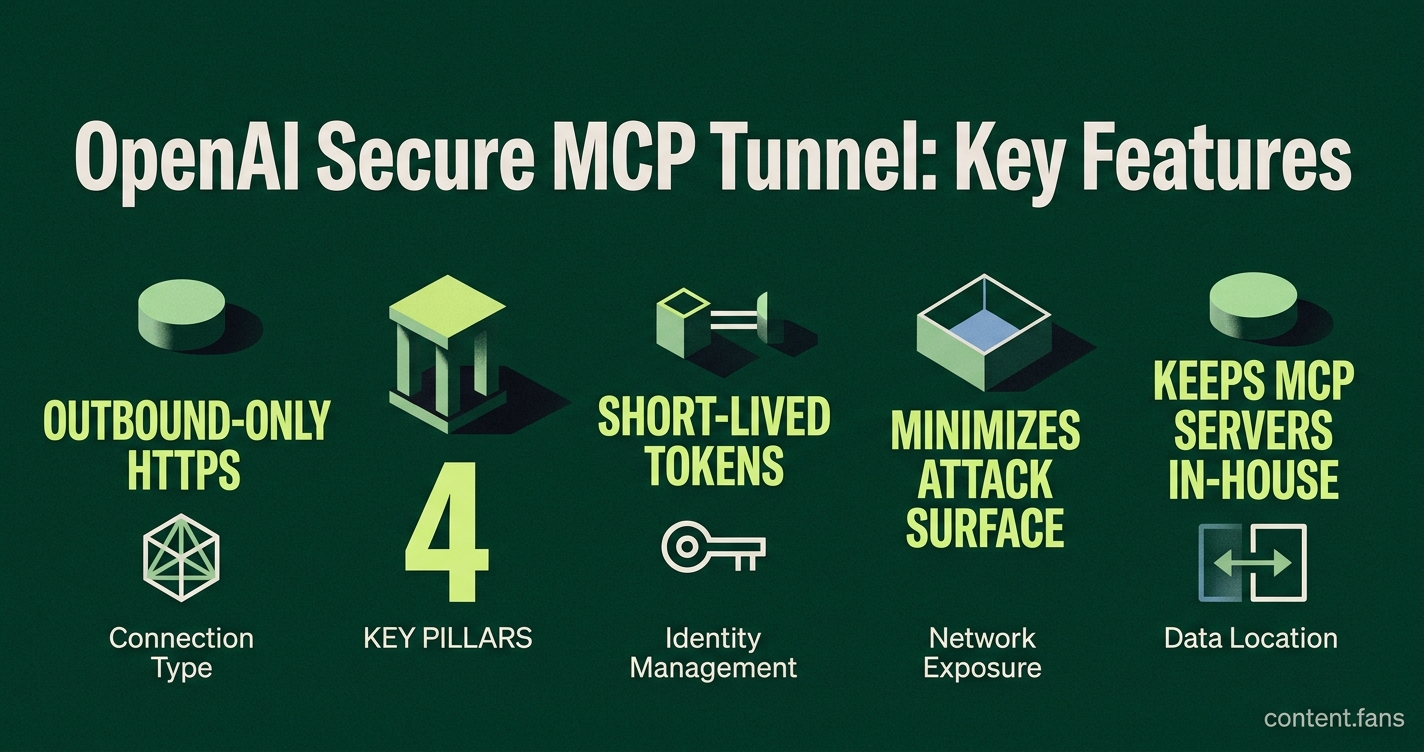
The tunnel's security architecture is built on four key pillars:
- Outbound-Only Connections: Minimizes the network attack surface by eliminating the need for open inbound ports.
- Workload Identity Federation: Replaces static, long-lived API keys with short-lived tokens mapped to cloud IAM roles for improved credential management.
- Administrative Governance: Provides operators with robust API-driven controls for model allowlisting, data retention policies, and spend management.
- Data Residency Support: By keeping MCP servers in-house, the tunnel helps enforce data residency policies, as data is only transmitted via the encrypted channel.
While OpenAI provides advisory guidance on implementing further controls like scoped OAuth tokens and input validation, enterprises should evaluate how the tunnel aligns with their specific compliance requirements for identity, logging, and data retention.
Early Adoption Patterns and Enterprise Use Cases
The Secure MCP Tunnel is primarily aimed at organizations in regulated industries or those with strict security policies that block inbound traffic. Early adopters are reportedly exploring several key use cases:
- Internal Knowledge Retrieval: Enabling ChatGPT to securely query internal document repositories and databases.
- Workflow Automation: Allowing AI agents to trigger internal systems for tasks like creating support tickets or running analytics jobs without public endpoints.
- Regulated Data Processing: Facilitating workloads that require strict data residency and centralized identity management.
Although public adoption metrics are not yet available, the tunnel is marketed as generally available, suggesting production readiness. According to industry reports, comprehensive gateway platforms from various vendors offer features like PII redaction and multi-vendor policy management, while OpenAI's native tunnel provides a more lightweight, focused solution for secure transport.
For future updates, organizations should monitor official OpenAI release channels. When evaluating the Secure MCP Tunnel, enterprises must map its security and governance features to their existing IAM, logging, and data privacy frameworks to ensure full compliance.
What is the OpenAI Secure MCP Tunnel and why was it built?
The OpenAI Secure MCP Tunnel is an outbound-only HTTPS tunnel that lets enterprises keep MCP (Model Context Protocol) servers on-prem or inside a private VPC while allowing ChatGPT, Codex, and the Responses API to call them.
By removing the need for inbound firewall openings or public endpoints, the tunnel closes the gap between sensitive internal tools and hosted OpenAI agents.
How does the tunnel protect my data and network?
Security is built on three pillars:
- Outbound-only traffic - the tunnel initiates every request, so no inbound ports are ever exposed.
- Workload Identity Federation - replaces long-lived API keys with short-lived tokens tied to your cloud IAM roles.
- Admin API controls - give teams granular allowlists, spend alerts, retention policies, and cost tracking all in one place.
These features align with enterprise best-practice patterns such as zero-trust access, least privilege, and centralized audit logging.
Which enterprise use cases are customers already exploring?
Early adopters are using the tunnel for:
- Internal knowledge retrieval - ChatGPT can query documents and databases behind the firewall.
- DevOps automation - Codex can spin up tickets, run build jobs, or query observability stacks without exposing those tools.
- Regulated workloads - finance and healthcare pilots are testing the tunnel to keep data inside their region while still leveraging OpenAI models.
While vendor momentum is strong, precise adoption counts have not been released.
How is OpenAI's tunnel different from competing hybrid-cloud AI gateways?
According to industry reports, many competitors offer full-stack platforms (identity, PII redaction, orchestration).
OpenAI's tunnel is lighter-weight: it focuses only on secure connectivity between private MCP servers and OpenAI products.
Choose OpenAI Secure MCP Tunnel when you already want to use ChatGPT/Codex and need fast, low-overhead integration.
Consider alternative gateways if you need broader governance across multiple AI vendors.
Is the tunnel compliant with SOC 2, ISO 27001, or GDPR?
OpenAI has not published certifications specific to the tunnel, but the released feature set supports compliance-ready controls:
- Centralized identity and access management through federated credentials.
- Audit logging and monitoring for every MCP call.
- Data retention and regional controls available in the Admin API.
Enterprises can map these capabilities onto frameworks like SOC 2, ISO 27001, and GDPR using existing internal compliance tooling.