
OpenAI opens ChatGPT ads to all US businesses, cuts $50,000 minimum
Serge Bulaev
OpenAI has made its ChatGPT Ads Manager available to all U.S. businesses, removing the previous $50,000 minimum and agency-only restriction. Now, any verified advertiser can run campaigns with smaller budgets, and ads are priced per click, with suggested bids of $3-5. Early data from small business tests is limited, but initial results suggest low click numbers and possibly high conversion rates. Experts say more data may become available soon, and some recommend using organic methods to appear in ChatGPT while paid results are still being tested. The ad platform may be best for niche or high-value products until more performance data is available.

OpenAI's beta self-serve Ads Manager launched May 5, 2026, for U.S. advertisers in select categories, fundamentally changing the landscape of conversational advertising. The company removed the restrictive $50,000 minimum spend and opened its Ads Manager to all verified advertisers, a move that PPC Land notes makes small-budget "weekend tests" possible for the first time.
This new accessibility is paired with a shift to cost-per-click (CPC) bidding. OpenAI suggests maximum bids of $3 - $5, a price point that positions it competitively against mid-market Google Ads. However, as MediaPost highlights, these ads target high-intent moments within user conversations, not just keyword auctions.
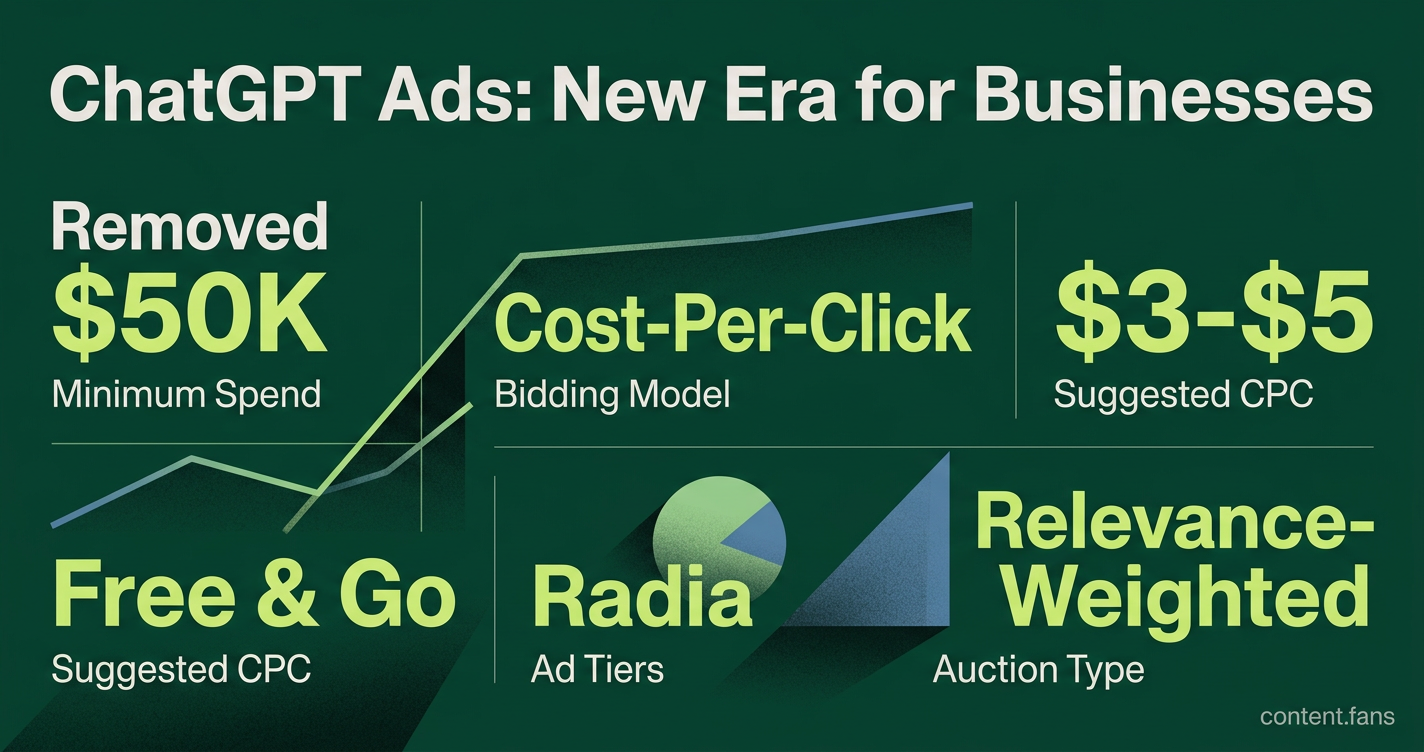
The core premise is to serve ads during key decision-making moments within ChatGPT conversations. While comprehensive small business data is still emerging, early industry reports suggest promising engagement metrics and competitive cost structures.
How the conversation auction works
The system analyzes user conversations in real-time for semantic cues indicating purchase intent, such as "best CRM for restaurants." It then runs a relevance-weighted auction to place a "Sponsored Recommendation" at the end of the AI's response, aligning the ad with the user's immediate informational needs.
The auction system is designed for contextual relevance. It avoids demographic targeting and restricts ads in sensitive categories like health and politics. Instead, Raconteur explains the auction weighs relevance heavily, ensuring sponsored content is tightly aligned with the conversation's context.
Key mechanical details:
- Objectives: Reach (CPM) or Clicks (CPC 3-5 USD suggested)
- Auction: second-price, relevance-weighted
- Tracking: pixel and Conversions API; third-party measurement in development
- Eligibility: Free and Go tiers see ads; Plus and Pro remain ad-free
Early economics for small budgets
With public small-business case studies still pending, marketers are exploring the potential viability of the platform. Industry reports suggest that performance may be favorable when customer lifetime value exceeds several hundred dollars. However, experts caution that live SMB data should emerge within weeks, according to Findskill.ai.
Alternate routes while data matures
While paid performance data accrues, marketers have a powerful free alternative: Answer Engine Optimization (AEO). Industry reports indicate that many B2B firms using AEO have captured significant organic citation share in ChatGPT within months, offering a parallel path to visibility.
The new Ads Manager offers three immediate tests for marketers willing to experiment:
1. Claim an account and complete verification.
2. Install the OpenAI Pixel or Conversions API.
3. Launch a $50-300 USD CPC campaign focused on a high-intent query cluster.
Current performance metrics suggest that while click volume may be modest, the conversion quality can surpass traditional search. This makes OpenAI ChatGPT ads an ideal testing ground for niche or high-value products, with broader adoption likely to follow as more performance data becomes available.
What changed on May 5th for U.S. advertisers?
OpenAI flipped the switch from invite-only to self-serve access for every U.S. business.
The two biggest gatekeepers disappeared: the $50,000 minimum spend and the agency-only sign-up. Now you can open an account at ads.openai.com, add a company credit card, and launch a campaign with as little as $50. The Ads Manager is open 24/7 and supports both CPC and CPM buying.
How does the "conversation-intent" ad unit work?
Instead of bidding on keywords you bid on moments inside a conversation where the AI detects purchase intent. Examples:
- A user asks "What's the best noise-canceling headset under $200?"
- Or "Plan a week-long trip to Costa Rica on a budget."
The system runs a relevance-weighted second-price auction, then displays a Sponsored Recommendation at the bottom of the AI's response. Early testers report that clicks convert up to 23× higher than traditional search because the user is already in a research or decision mindset (source).
What does CPC bidding cost right now?
OpenAI suggests a starting max bid of $3 - $5 per click across most verticals.
Industry reports suggest these bids are holding steady, with no significant upward pressure detected in early testing. CPMs, meanwhile, vary depending on the partner or agency path you choose (source).
Is there any proof that small campaigns can work?
No public SMB-specific case studies exist yet the platform has only been broadly open for a week. What we do have:
- Many pilot advertisers ran managed campaigns in April and reported significant conversion lift versus other channels (source).
- Early engagement metrics show promise compared to traditional channels, though with different user behavior patterns (source).
Until the first wave of small-budget numbers hit blogs or Reddit (expected mid-next week), treat your first $50 - $300 test as your own living case study.
How do I set up conversion tracking?
OpenAI provides two options:
1. OpenAI Pixel - a lightweight JavaScript pixel you place on your site.
2. Conversions API - a server-to-server connection for tougher privacy environments.
Inside the Ads Manager you simply:
- Claim your account and verify your business (no spend required).
- Install the pixel or configure the API endpoint.
- Choose the "High-Intent" campaign preset (optimized for purchase-ready moments).
Both tools feed real-time data back to the dashboard so you can optimize bids and creatives on the fly.