
OpenAI integrates Plaid for ChatGPT Pro finance tools
Serge Bulaev
OpenAI has launched personal finance tools for US ChatGPT Pro users using Plaid, which may let users link their bank, credit card, and investment accounts securely. The feature is in preview and only available to some users for now. Users can reportedly ask questions about their spending and savings in plain language, and ChatGPT will answer based on real-time account data. OpenAI says the system is read-only and deletes data 30 days after disconnecting, but some security risks and privacy questions remain. The rollout is limited, and future changes or broader access may depend on user feedback and adding more account aggregators.

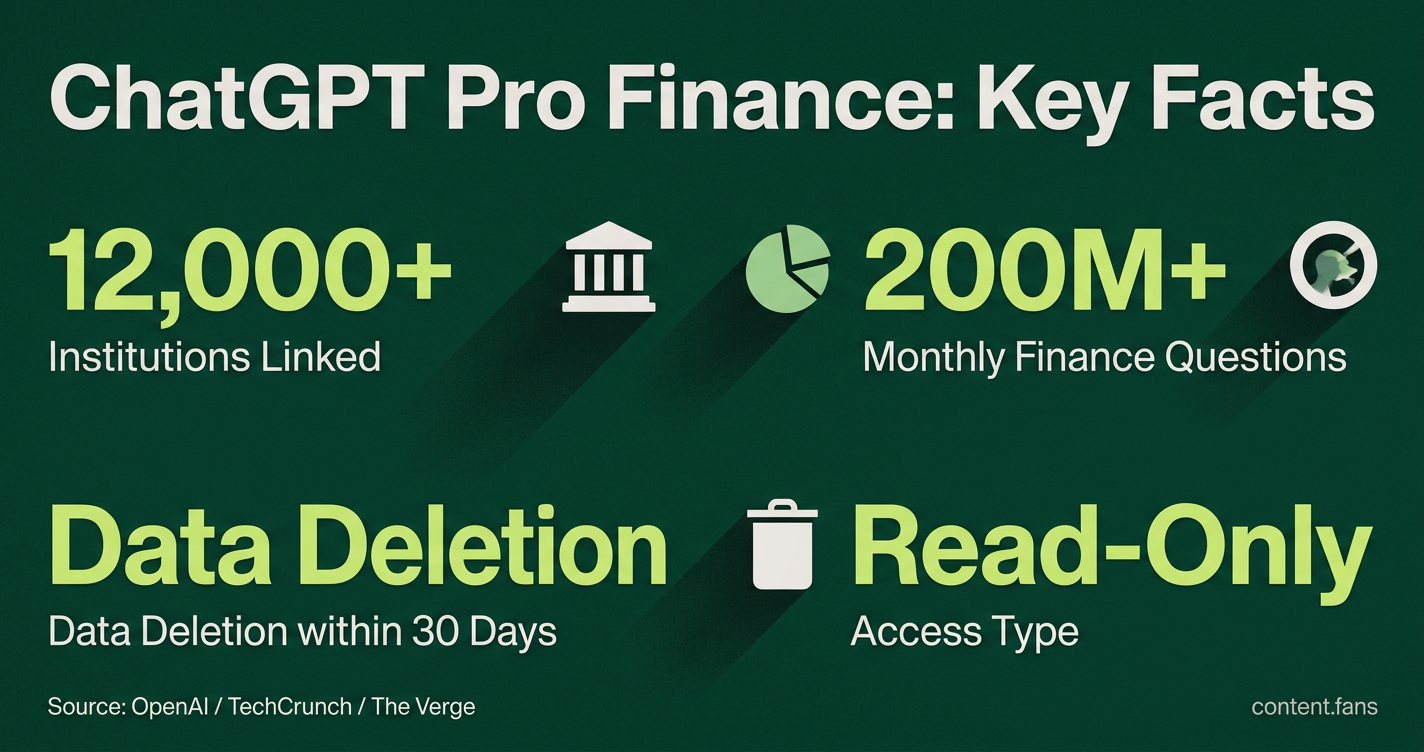
OpenAI now integrates Plaid for its ChatGPT Pro finance tools, giving U.S. subscribers secure, read-only access to their bank, credit card, and investment accounts for real-time analysis. The new feature, which launched in preview on May 15, 2026, according to TechCrunch, uses Plaid to link over 12,000 financial institutions, enabling users to ask detailed questions about their spending and savings goals.
To get started, Pro users navigate to the 'Finances' tab or use a simple prompt to trigger Plaid's secure authentication. Once linked, ChatGPT creates a dynamic dashboard summarizing portfolio performance, recurring subscriptions, and spending trends. This integration addresses significant user demand, as OpenAI notes over 200 million people monthly ask finance-related questions, a point reinforced by The Verge's coverage.
What users gain
ChatGPT's new finance feature allows users to connect their bank and investment accounts via Plaid for conversational analysis. They can ask plain-language questions about their spending habits, track savings goals, and get real-time summaries of their financial health, moving beyond the limitations of traditional spreadsheet-based budgeting.
The primary benefit is a conversational interface that replaces the friction of spreadsheets. Users can ask natural questions like, "Why did my grocery spending increase last month?" or "Create a five-year savings plan for a house down payment." According to Plaid, answers are based on real-time account balances and cash flow, offering more personalized insights than standard budgeting apps.
Guardrails and open questions
OpenAI has established several security guardrails for the Plaid integration. The connection is read-only, and all synced financial data is deleted within 30 days of disconnecting an account. Furthermore, OpenAI states that this data will not be used for model training without explicit user consent.
Despite these measures, security experts highlight several potential risks:
- Prompt logs may store sensitive transaction data until they are manually deleted.
- Malicious prompt injection attacks could potentially extract private information or manipulate financial advice, as warned by ESET.
- Standard ChatGPT accounts may default to using data for model training unless users specifically opt out, unlike the privacy-focused Enterprise tier.
For these reasons, privacy advocates recommend users verify their data-retention and model-training settings before connecting accounts. It is also crucial to confirm that the integration only accesses transaction and balance data, not full account numbers or statements.
Limited rollout and next steps
Currently, the finance feature is a limited preview available exclusively to ChatGPT Pro subscribers on web and iOS. OpenAI is using this initial phase to gather user feedback, which will inform a potential wider rollout, including possible access for Plus subscribers. The company also plans to expand its integration partners, with reports from 9to5Mac that Intuit connectivity is "coming soon," which could add another major aggregator alongside Plaid.
Competitive context
While traditional budgeting platforms also aggregate financial data, their rule-based systems can be inflexible. ChatGPT's key advantage is its flexible, conversational Q&A, though it currently lacks the formal budgeting workflows of its competitors.
For complex tasks like tax optimization or portfolio stress-testing, specialized financial modeling software remains superior. As analysts at Wall Street Prep observe, while LLMs are excellent for generating narrative summaries, they cannot yet match the precision of purpose-built financial software.
This positions the ChatGPT finance tool as a powerful solution for exploratory analysis and quick insights, rather than a replacement for professional-grade financial suites. Its mainstream adoption will ultimately depend on OpenAI's ability to ensure data security, provide clear user controls, and deliver consistently accurate, non-hallucinated financial guidance.