
OpenAI briefs White House on GPT-Rosalind biodefense program
Serge Bulaev
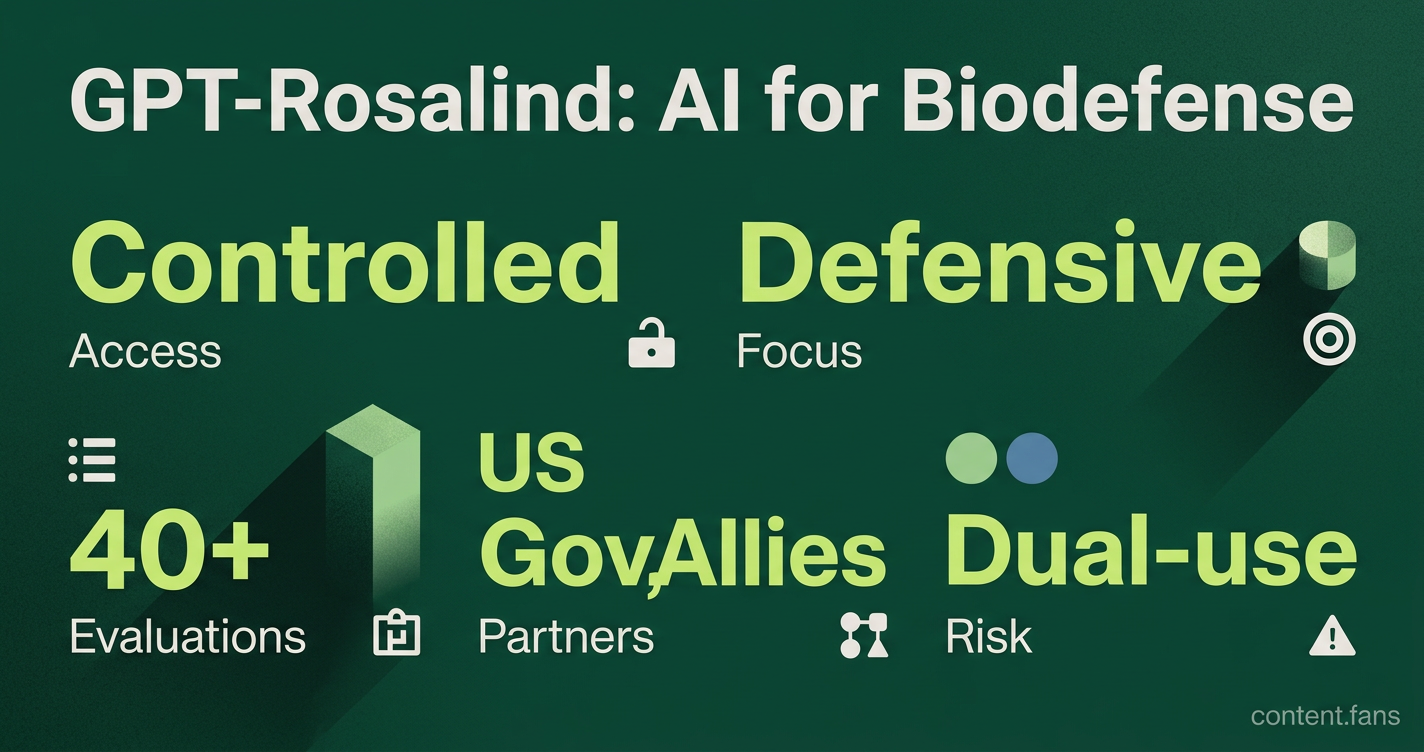
OpenAI recently briefed the White House on its GPT-Rosalind biodefense program, which may help federal agencies with pandemic preparedness and biological threat detection. Reports suggest officials are considering if models like GPT-Rosalind can improve defenses without raising new risks. Access to GPT-Rosalind appears to be tightly controlled and limited to trusted partners. Experts warn there might be dual-use risks, as such AI could also be misused. Early public-health projects may start in late 2026, but performance results for GPT-Rosalind have not yet been shared.

OpenAI recently briefed the White House on its GPT-Rosalind biodefense program, detailing how the AI model can help federal agencies with pandemic preparedness and biological threat detection. This high-level engagement signals the U.S. government's growing interest in leveraging frontier AI for national health security. Officials are now reportedly evaluating how models like GPT-Rosalind can bolster defensive capabilities without introducing new biological risks.
What the briefing covered
GPT-Rosalind is OpenAI's frontier reasoning model for life sciences. During a White House briefing, the company showcased its defensive applications, including improved epidemiological modeling, rapid genomic screening, and support for developing medical countermeasures to help prevent, detect, and respond to large-scale biological threats.
According to an official OpenAI blog post, company representatives highlighted several key defensive applications for its "frontier reasoning model" designed for life sciences:
- Epidemiological modelling and early outbreak detection
- Rapid screening of genomic data
- Scenario planning for non-pharmaceutical interventions
- Support for diagnostics and medical countermeasure design
These capabilities are framed as tools to help agencies better prepare for and respond to emerging biological threats.
Controlled access model
OpenAI confirmed that access to GPT-Rosalind is tightly controlled, limited to "trusted developers" and select partners within the U.S. government and allied nations. This "defensive acceleration" strategy aims to ensure the technology empowers defenders, not adversaries. OpenAI will sponsor usage credits for approved biodefense projects and is actively onboarding federal public health agencies. According to industry reports, multiple agencies have seen demonstrations, though the specific partners remain undisclosed, and the White House has not issued a public statement on the briefing.
Policy context
The briefing occurs as Washington expands its oversight of advanced AI. The Commerce Department's Center for AI Standards and Innovation has already conducted over 40 pre-release risk evaluations of frontier models. This initiative follows agreements in May 2026 with Microsoft, Google, and xAI for early access, placing the GPT-Rosalind program within a broader government trend of vetting powerful AI before public release.
Dual-use concern
Biosecurity experts caution that AI models powerful enough for defensive research also present significant dual-use risks. If not properly secured, they could lower informational barriers for malicious actors, with CSIS warning that such tools might even provide step-by-step instructions for creating dangerous pathogens. OpenAI states it is addressing this threat through internal red-teaming and is developing robust safeguards to prevent the model's misuse for harmful biological work.
Next steps under discussion
Initial pilot projects will target near-term applications like automated literature review and pathogen surveillance. According to industry reports, these tools could enter public health workflows in the coming years, pending security reviews. However, OpenAI has not yet released performance benchmarks for GPT-Rosalind, leaving external validation pending. Meanwhile, federal stakeholders are developing policies to formalize pre-deployment testing and access controls, which will determine how broadly these models are integrated into national biodefense strategies.
What is the GPT-Rosalind biodefense program and how did it reach the White House?
OpenAI launched GPT-Rosalind, described as a model for life sciences research; separately, the White House briefed AI firms on planned model-review policies in May 2026. The Rosalind Biodefense initiative opens GPT-Rosalind, its frontier reasoning model for life-sciences, to trusted U.S. government and allied partners. The company will sponsor developer access and provide launch support so that new tools for epidemiological modeling, pathogen early-detection, diagnostics, and medical countermeasures can be built faster and at national scale.
Which partners are getting "trusted access" first and for what missions?
Select U.S. federal agencies focused on public health and biodefense are first in line, followed by "allied partners" in the same mission space. OpenAI is onboarding these groups so that GPT-Rosalind can support outbreak-response planning, non-pharmaceutical interventions, and high-impact defensive applications - explicitly not offensive bio work.
How is this different from the broader wave of government AI testing?
The U.S. government has been conducting pre-release evaluations of frontier models for cyber, bio, and chemical weapons risks. Microsoft, Google, and xAI have already agreed to give early model access to federal reviewers. The Rosalind program goes further by offering sustained, sponsored access to a specialized life-sciences model - making it one of the first concrete examples of offensive-risk-tested AI being actively deployed for defense.
What do experts say about the dual-use risk?
A CSIS analysis warns that AI tools like GPT-Rosalind could lower informational barriers and, if misused, provide step-by-step guidance on designing lethal pathogens. Georgetown's biosecurity forum calls AI in life sciences a "double-edged sword": the same capabilities that speed up vaccine design can accelerate harmful experimentation. The consensus is that defensive gains are real, but only if paired with tighter oversight, mandatory red-teaming, and stricter DNA-synthesis screening.
What practical results should we expect in the coming years?
According to industry reports, we can expect AI-powered threat-forecasting platforms to become more tightly integrated with national public-health systems. If safeguards keep pace, Rosalind-style tools could become standard issue for biosurveillance, rapid diagnostics, and real-time containment planning - potentially reducing outbreak response times from weeks to hours. A key question for the future is whether today's pilot programs scale into unified national biodefense architectures or remain fragmented, niche deployments.