
Open-weight models integrate agentic features, challenge proprietary AI in 2026
Serge Bulaev
Open-weight AI models are adding more advanced features like long-context processing, tool use, and handling different data types, and they may be catching up to proprietary AI models. Early results, such as those from MiniMax M3, suggest that open models are becoming better at real tasks, especially coding. Many companies seem to prefer open models because they can control, customize, and manage costs more easily. However, most companies are still only partly using agentic AI in their daily work, with strong rules and monitoring needed before bigger rollouts. Experts suggest that the main competition now may be about control, reliability, and cost, not just accuracy.

Open-weight models are rapidly integrating advanced agentic features like long-context windows, tool calling, and multimodal routing, closing the capability gap with proprietary systems. Recent releases from various providers are exemplifying this trend with expanded context capabilities and improved agent performance.
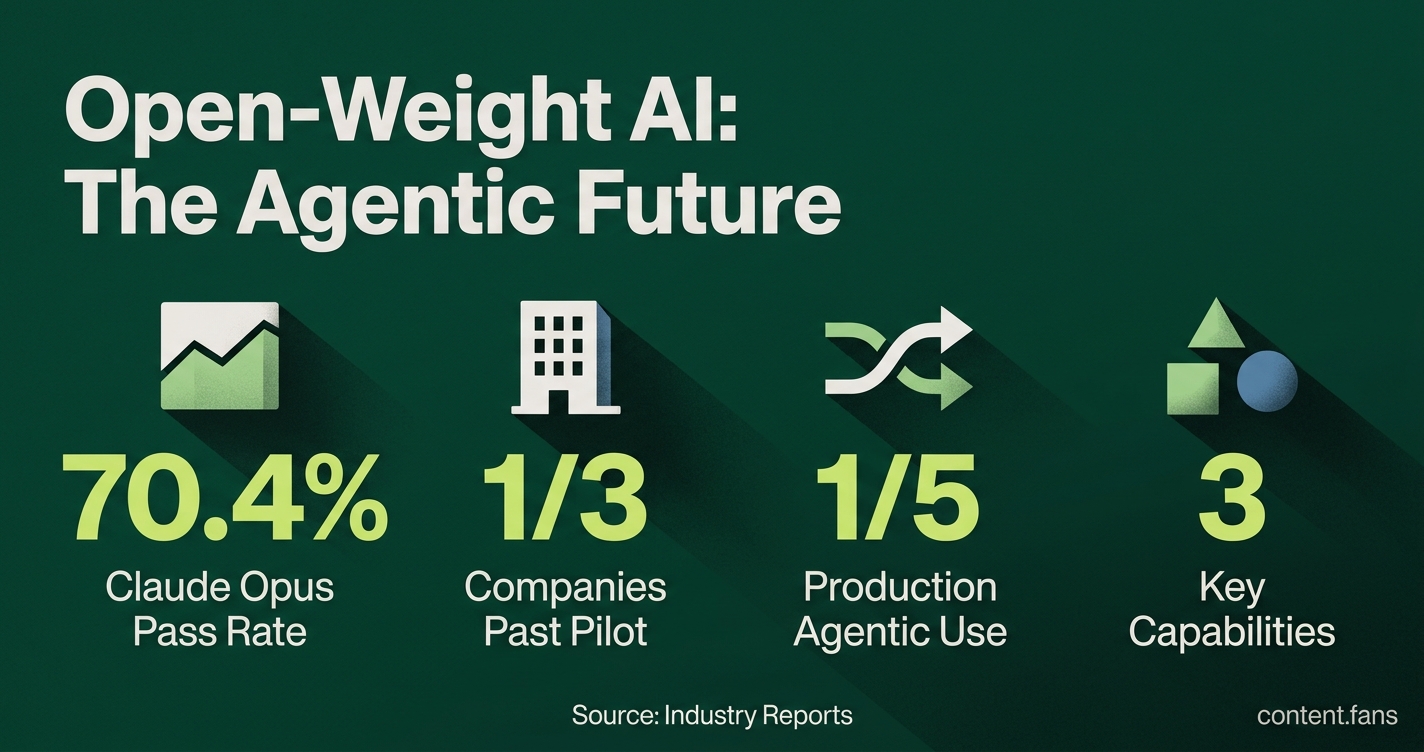
The industry's focus is shifting from static benchmarks to sustained task performance. Available Claw-Eval sources show current leaders such as Claude Opus 4.6 at 70.4% pass^3, indicating the competitive landscape for coding agent proficiency. Concurrently, models from various providers are gaining attention for their advanced reasoning and tool use capabilities, as tracked in technical digests from outlets like BentoML.
This shift highlights a new competitive landscape where deployment control, customization, and cost-effectiveness are as crucial as raw accuracy. Many enterprises favor open-weight models for agentic workflows because they can be self-hosted, fine-tuned, and managed on proprietary infrastructure to control inference costs.
How Enterprises Are Adopting Agentic AI in 2026
According to industry reports, enterprises increasingly favor open-weight AI for its customizability, cost control, and deployment flexibility. While proprietary models once led in advanced capabilities, open-source alternatives are rapidly closing the gap in agentic tasks like multi-step reasoning and tool use, offering a powerful, sovereign alternative for many workloads.
Adoption is steady but cautious. According to Stanford's Enterprise AI Playbook, while about a third of companies are past the pilot stage, only a fifth of production use cases are fully agentic. Industry observers note common rollout patterns that include:
- Discovery and architecture planning
- Limited pilots with strict tool-level safeguards
- Monitored production deployments with orchestration
- Ongoing optimization of cost-quality tradeoffs
Industry guidance emphasizes that broad rollouts require robust governance, including audit logs, decision traceability, and approval workflows. This aligns with observations that open-weight models are becoming popular for high-volume, low-risk tasks, with proprietary APIs used for more sensitive operations.
Core Capabilities of Leading Open-Weight Agent Models
Three key capability clusters define the current generation of open-weight agentic models:
- Long-Document Reasoning: According to industry reports, several models are targeting significantly expanded context windows, allowing teams to process entire codebases or knowledge stores in a single pass without chunking.
- Advanced Tool Orchestration: Many new models are designed for interleaved reasoning and action, a critical architecture for building effective agents that interact with external tools.
- Agentic Coding: Several coding-focused models are frequently highlighted for their ability to plan, edit, and test code across complex, multi-step tasks.
The search results support Claw-Eval as an agent benchmark with current public leaders such as Claude Opus 4.6 at 70.4% pass^3 and Kimi K2.6 appearing on leaderboards, though specific context windows and benchmark highlights for individual models require verification from official sources.
Key Strategic Implications for 2026
According to industry reports, several strategic takeaways are emerging from these trends:
- Optimizing the Cost-Quality Frontier: With inference pricing becoming a significant factor in total cost of ownership, many teams are routing workloads to reliable open-weight models to manage expenses.
- Avoiding Vendor Lock-In: Experts warn that integrated platforms like Microsoft 365 AI can lead to tight coupling. Abstracting the model orchestration layer is crucial to maintain flexibility.
- Prioritizing Governance Over Benchmarks: True success hinges not on benchmark scores but on an organization's ability to effectively monitor tool calls, govern data access, and manage identity.
The AI landscape is rapidly converging. Open-weight models now offer agentic features once exclusive to proprietary systems, enabling enterprises to build hybrid stacks optimized for sovereignty, cost, and reliability. Future competition will likely focus on transparent auditing, efficient tool routing, and the economics of long-context processing.
What exactly is new about open-weight models entering the agentic space in 2026?
Until recently, open-weight releases were judged almost entirely on single-turn chat benchmarks. According to industry reports, recent releases are being positioned for long-context execution, tool-calling and multi-step planning. These capabilities used to be the exclusive domain of closed, API-gated systems. The competitive gap has narrowed most dramatically in coding agents, repository-scale reasoning and multimodal workflows.
How are enterprises choosing between open-weight and proprietary agentic models?
According to industry observations, a common buying pattern has emerged:
- Pilot stage - teams benchmark closed APIs for quick lift-off.
- Production stage - they offload high-volume, cost-sensitive tasks to open weights (self-hosted or via an inference gateway).
- Governance layer - all models sit behind an orchestration stack that enforces identity, approval, audit and traceability rules.
Stanford's Enterprise AI Playbook reports significant productivity gains in agentic use-cases once this hybrid pattern is adopted, even while only a portion of firms have moved past pilot so far.
Which metrics are replacing classic leaderboard scores for agentic evaluation?
Industry watchers now focus on sustained task success rates rather than single-turn accuracy. Available sources highlight benchmarks like SWE-Bench Pro, Claw-Eval and LOCA-Bench as emerging standards. Equally important are latency-corrected cost per 1 M tokens and tool-call success over multi-step workflows. These KPIs reflect the shift from "best model" to "best operating model".
What technical breakthroughs enable extended agentic windows?
Industry reports suggest that sparse attention mechanisms and similar optimizations are delivering significantly faster decoding at extended context lengths compared with earlier dense architectures. Similar techniques - ring attention, KV-cache compression and mixed-precision sparsity - are appearing across various model families, making extended-context agent runs economically viable for on-prem and VPC deployments.
What are the biggest governance pitfalls when deploying open-weight agents?
- Tool sprawl - every agent can spawn dozens of function calls; access control and audit trails must be centralized.
- Data residency - self-hosted weights solve residency issues, but fine-tuning with proprietary data requires clear model-card and red-teaming documentation.
- Orchestrator lock-in - governance vendors warn that workflows hard-wired to a single model API negate the "swap-any-model" advantage of open weights. The recommended approach is an open orchestration layer that speaks both OpenAI and Anthropic-compatible endpoints, letting teams evolve the model mix without re-architecting the business process.