
Okta reports Q1 revenue up 11% to $765M amid AI demand
Serge Bulaev
Okta's revenue for the first quarter rose 11% to $765 million, which was higher than expected. This growth appears linked to rising demand for identity services as more companies use AI agents that act as non-human users. Okta's management says they saw strong cash flow and record operating profits, and future growth may continue but at a slightly slower rate. Analysts seem mostly positive on Okta, though some want more proof that AI-linked demand will last. The company may invest more in new security and machine-identity features while aiming to keep profits high.

Okta's Q1 revenue for fiscal year 2026 grew 12% year-over-year to approximately $710 million, beating estimates as demand for identity services expands with the enterprise adoption of agentic AI. The company's strong results highlight a key growth trend for the access-management specialist.
Investors are now closely monitoring two key factors: the pace at which agentic AI adoption translates into new identity spending, and Okta's ability to maintain its profit margins while overhauling its sales strategy.
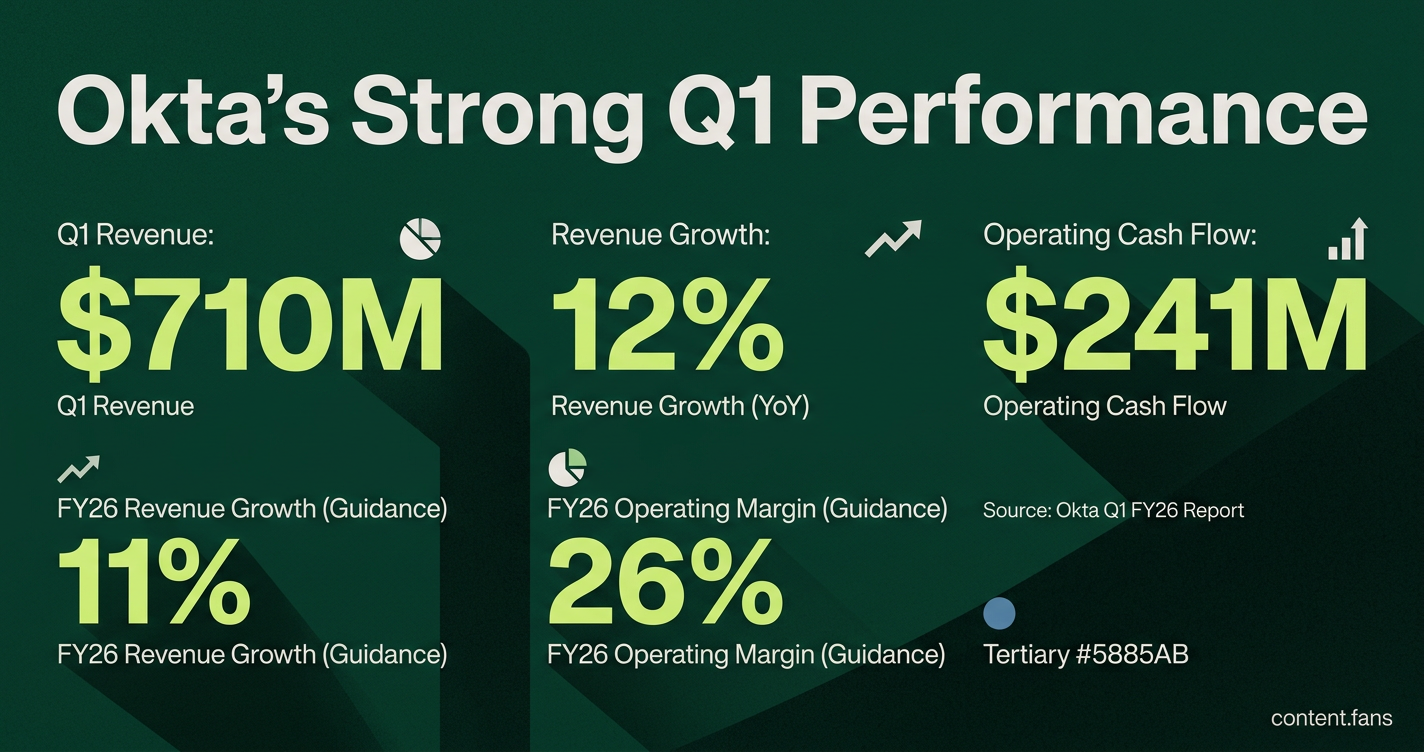
Okta reports Q1 revenue up 12% to $710M
Okta's first-quarter revenue for fiscal year 2026 was approximately $710 million, a 12% year-over-year increase that beat consensus estimates. The company also reported record GAAP and non-GAAP operating profitability and strong cash flow, signaling strong financial health and operational efficiency amid new market demands.
According to its official Okta Investor Relations release, Okta reported record GAAP and non-GAAP operating profitability, operating cash flow of $241 million, free cash flow of $238 million, and current RPO growth of 10% to 11% year over year.
Guidance shared on the call outlines steady, though moderating, top-line expansion:
- Q2 FY2026 Revenue Growth: Approximately 10% year-over-year
- Q2 FY2026 Non-GAAP Operating Margin: 26%
- Full FY2026 Revenue Growth: 11%
- Full FY2026 Operating & Free Cash Flow Margins: 26% and about 29%, respectively
Agentic AI demand lifts identity budgets
CEO Todd McKinnon explained to analysts that autonomous software agents are "increasingly acting as non-human users," creating new use cases for identity management, as noted in an Investing.com transcript. This trend requires enterprises to provision, monitor, and revoke credentials for these AI agents, directly aligning with Okta's core lifecycle management and privileged access solutions. Industry reports suggest that a significant portion of enterprise applications could feature task-specific AI agents in the coming years, signaling a significant future expansion in spending on identity controls.
Analysts maintain a constructive stance
A MarketBeat forecast shows analysts maintaining a generally positive outlook, with price targets reflecting varied perspectives on macro pressures and competitive risks. This spread suggests investors are waiting for more evidence of lasting AI-related demand and strong margin execution before awarding the company a higher valuation.
What to watch next
Looking ahead, management pointed to positive early results from a restructured go-to-market strategy that aligns sales teams by product specialization. Key metrics for observers to monitor in the coming quarters include:
- The adoption rate of new machine-identity features designed for AI agent workflows.
- The growth pace of current Remaining Performance Obligations (cRPO) as a key indicator of near-term billings.
- Progress toward achieving strong operating margins in Q2.
Okta enters the next quarter with record profitability and strong cash flow, enabling further investment in its zero-trust and machine-identity roadmaps while aiming for a return to sustainable double-digit growth.
How did Okta's Q1 FY2026 revenue compare to expectations?
Approximately $710 million landed above consensus expectations, a 12 percent jump year-over-year. On the call, management highlighted record operating profitability and stronger-than-expected cash flow, which contributed to positive market reaction.
Why is agentic AI creating fresh demand for Okta's identity platform?
Each autonomous AI agent must have its own machine identity, scoped privileges, and continuous token lifecycle control. Industry reports show a growing number of enterprise apps are expected to house task-specific agents in the coming years. That rapid ramp pushes security teams to deploy privileged access management for agents and zero-trust identity orchestration, two workloads Okta has been bundling into its core contracts.
What forward guidance did Okta provide after the Q1 release?
On the earnings call, executives provided guidance for continued growth, with expectations for steady revenue expansion and margin improvements in the coming quarters.
How are Wall Street analysts reacting to the results?
Analysts maintain a generally positive outlook on Okta's results, with the constructively bullish tone driven by both margin expansion and the narrative that agentic AI will be a multiyear tailwind.
What broader IAM market shifts are validating Okta's growth story?
- The IAM market is projected to experience significant growth in the coming years, largely driven by machine identity and agent governance demand.
- Industry reports suggest the agentic AI security segment will experience substantial growth through the end of the decade.
- Identity-first zero trust is increasingly replacing some legacy endpoint and perimeter spend, creating a direct budget shift toward vendors like Okta that can bind agent-to-agent and agent-to-app interactions within the same identity control plane.