
Nvidia acquires Kumo AI for $400M, expands enterprise software play
Serge Bulaev
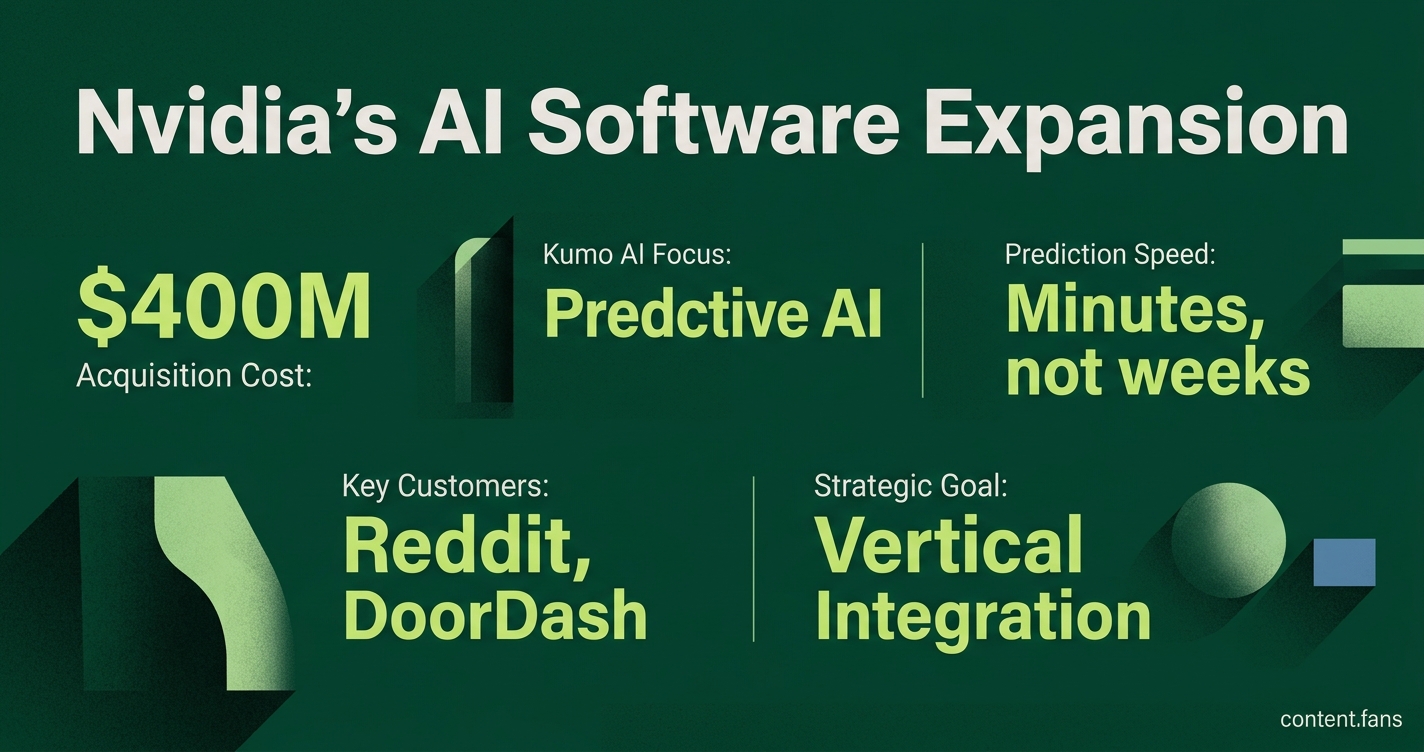
Nvidia has acquired Kumo AI, a five-year-old enterprise software startup, for at least $400 million, according to people familiar with the deal. The purchase may help Nvidia expand its software offerings, especially in making predictions for things like fraud detection and demand forecasting. Kumo's technology appears to quickly turn raw business data into predictions, and it claims to work with companies like Reddit and DoorDash. Some analysts say this move fits into Nvidia's recent pattern of buying AI software firms, suggesting a strategy to be more central in business workflows. However, performance claims mainly come from the vendor, and some details about the deal have not been made public.

According to industry reports, Nvidia has been exploring strategic acquisitions in the enterprise AI software space, with speculation around potential deals involving predictive AI startups. While specific transaction details remain unverified, this activity would align with Nvidia's broader strategy of expanding beyond hardware into comprehensive AI solutions.
Kumo AI represents the type of predictive AI platform that could complement Nvidia's enterprise offerings. The startup's platform operates directly on relational tables in data warehouses like Snowflake and Databricks, using a Predictive Query Language to generate forecasts. Its customer list, which includes major brands like Reddit, DoorDash, and J Sainsbury, highlights its established traction in data-intensive consumer and retail sectors.
Strategic Context and Market Position
While transaction details remain unconfirmed, any such acquisition would extend Nvidia's strategy of vertical integration, moving beyond chips to control more of the AI software stack. A predictive modeling platform would provide a crucial application layer, aiming to embed Nvidia's technology deeper into core business workflows.
Industry analysts view potential software acquisitions as a continuation of Nvidia's strategic focus on comprehensive AI solutions. Based on available sources, Nvidia made several AI/software acquisitions in 2024 aimed at expanding its AI cloud and software stack, with purchases targeting GPU utilization optimization and strengthening offerings like DGX Cloud. This pattern reflects a push toward vertical integration, addressing key AI infrastructure challenges:
Recent verified activities include investments in photonics technology to address AI scaling limits and various infrastructure improvements. Each addition targets bottlenecks in training, scheduling, or data preparation.
The Kumo AI Value Proposition for Enterprises
Kumo AI's core technology, the Relational Foundation Model, is designed to read multi-table data directly from a warehouse and generate forecasts for critical business functions, including:
- Fraud detection
- Customer churn
- Demand and inventory planning
- Product recommendations
The company claims its platform delivers predictions with feature attribution in minutes, not weeks, with the company reporting significant improvements in model accuracy and development speed. This capability could dramatically accelerate enterprise experimentation cycles and reduce the time-to-value for AI initiatives.
Broader Industry Implications
Morningstar analysts argue that Nvidia's CUDA software already establishes significant switching costs. By potentially acquiring application-layer companies like Kumo, Nvidia could deepen customer relationships by embedding its technology within core business workflows, not just the data center. This software strategy would complement its hardware investments, such as reported funding for photonics to address AI scaling limits.
While Kumo AI competes with various AutoML and warehouse-native ML solutions, its key differentiator is its stated ability to bypass manual feature engineering. However, performance claims currently originate from the vendor, as independent benchmarks are not yet available.
With a substantial share of the AI accelerator market, Nvidia faces growing competition from custom silicon developed by hyperscalers. The emphasis on software acquisitions appears to be a strategic move to maintain its central role as AI spending shifts from initial training to continuous inference and prediction.
What are the reported acquisition details?
According to industry reports, Nvidia has shown interest in Kumo AI, a predictive-AI startup, though specific transaction values and confirmations remain unverified from available sources.
What does Kumo AI actually do for enterprises?
Kumo sells a warehouse-native predictive-AI platform that lets enterprise analysts run high-impact use cases such as fraud detection, churn prediction, demand forecasting, and customer-lifetime-value scoring directly on multi-table relational data. Instead of requiring hand-built feature tables, Kumo's Relational Foundation Model (KumoRFM) ingests raw warehouse tables and surfaces predictions through a simple SQL-like Predictive Query Language (PQL). The company claims its models drive applications serving a significant user base globally, with reported improvements in fraud model accuracy and development speed.
How does this fit Nvidia's broader acquisition pattern?
Based on available sources, Nvidia made several AI/software acquisitions in 2024 aimed at vertical integration of the AI stack, not just selling chips. Recent examples include infrastructure and optimization tools that help Nvidia offer more comprehensive solutions that integrate customers deeper into its ecosystem by making Nvidia hardware easier to deploy, schedule, and optimize at scale.
What would integration look like?
Official guidance has not been released, but precedent suggests such capabilities would likely enhance Nvidia's DGX Cloud and enterprise software offerings, with select components potentially integrated into existing products. This would mirror Nvidia's approach with other acquisitions, where core functionality gets rolled into broader platform offerings while maintaining some standalone availability.
What do analysts say this means for the AI industry?
Morningstar highlights that Nvidia's CUDA-driven switching costs create a competitive advantage, and acquiring application-layer startups could deepen customer dependence on the Nvidia stack. Industry observers note that while Nvidia maintains a substantial portion of the AI-accelerator market, pressure from custom silicon at major cloud providers is rising; software acquisitions like this would serve as a strategic hedge by anchoring customers to Nvidia services even if they experiment with alternative hardware.