
Lumin Digital raises $115M, hits $1.6B valuation with client funding
Serge Bulaev
Lumin Digital has raised $115 million, reaching a company valuation of about $1.6 billion. The funding comes from both institutional investors and 15 client credit unions, which may help better align the company's products with user needs. The new money is planned for improving digital lending, payments, AI-powered customer management, and self-service tools. Analysts say Lumin's platform reportedly gives a strong return on investment, and the company's growth may lead to more strategic choices in the future, such as going public. Lumin competes in a busy market, and the fresh funds could help it stand out, though other companies are investing in similar technology.

Lumin Digital raises $115M in new capital, boosting its valuation to $1.6 billion in a July 2026 funding round. The investment combines $45 million from institutional leader Light Street Capital with a significant $70 million from client credit unions, according to the company's official announcement (Lumin Digital). This transaction underscores a unique funding strategy where customers become equity partners, a model that observers believe helps align the company's product development roadmap directly with the needs of its end-users.
Fresh fuel after a sizable 2024 raise
This latest round builds on recent momentum, following a $170 million growth equity investment in December 2024 co-led by Light Street Capital, NewView Capital, and Partners Group (Business Wire). With additional strategic investment from clients in recent rounds, the company's aggregate capital raised is over $245 million.
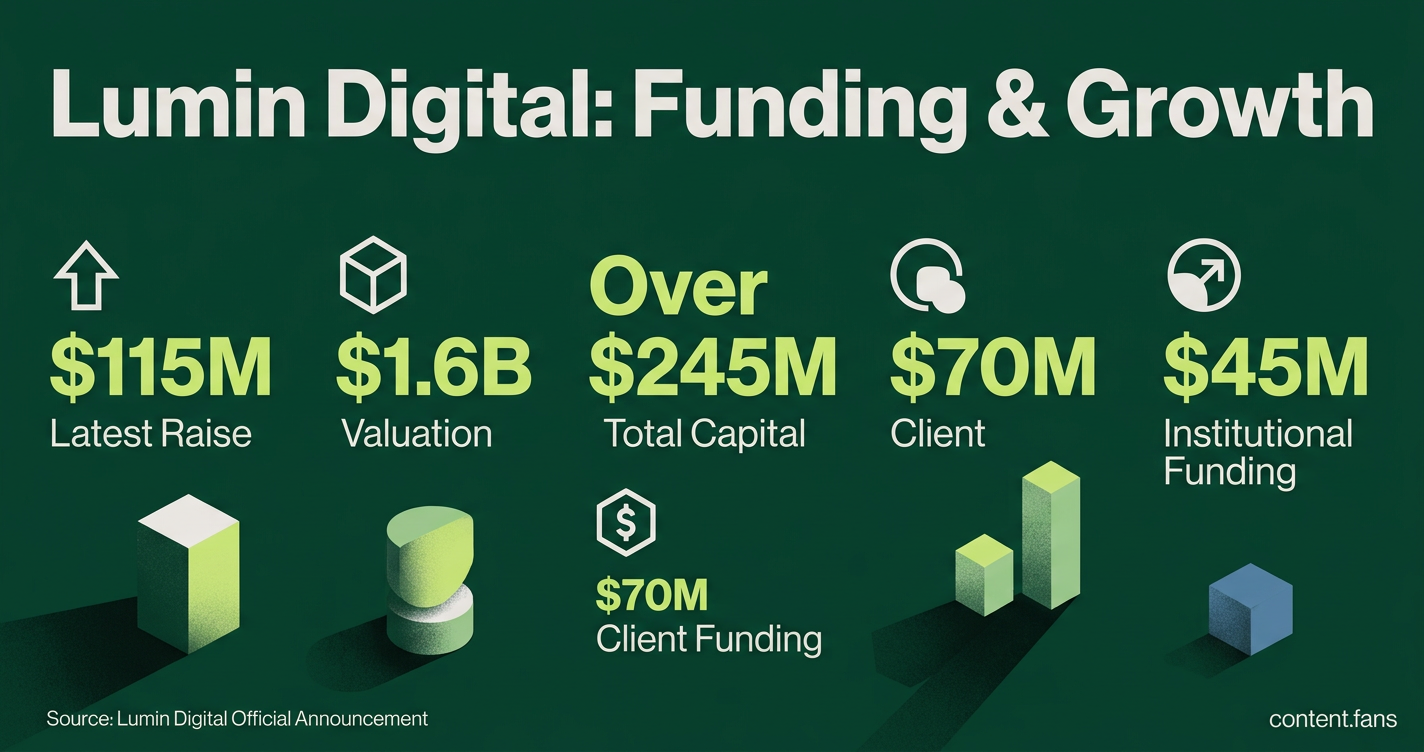
Lumin Digital, a cloud-native banking provider, secured $115 million in a July 2026 funding round, achieving a $1.6 billion valuation. The round was notable for its hybrid structure, combining institutional equity from Light Street Capital with substantial co-investment from client credit unions.
Where the $115M is earmarked
According to industry reports, the new capital is expected to accelerate development across key product domains including:
- Digital-first lending modules designed to keep borrowers inside each institution's ecosystem
- A unified payments center capable of supporting real-time rails such as FedNow and RTP
- AI-native CRM architecture that uses shared platform data for predictive insights
- A multichannel service suite aimed at scaling self-service while preserving human support
Company management noted that foundational work on its AI infrastructure started with the 2024 funding and will be a primary focus through 2026 as its engineering teams embed automation throughout the platform.
A "compounding" value proposition
Industry reports suggest that Lumin's platform delivers strong returns on investment with relatively short payback periods. Significantly, a substantial portion of this value is attributed to revenue growth, not cost savings. The platform's value proposition is designed to compound, with growing returns over time as institutions expand their use of the platform.
This strong ROI helps explain the high level of client participation in the funding. The client investment in the July round came from multiple client banks and credit unions. Lumin executives assert that having customers as equity holders fosters longer-term contracts and more effective product feedback loops.
Competitive lens
The digital banking market includes many vendors, with Lumin Digital positioned as a provider that competes on value accretion rather than volume. Key competitors include Alkami, ranked by analysts as a top alternative, and Apiture, which holds a significant share of the US credit union mobile banking market. While legacy providers like Fiserv and Jack Henry dominate with larger institutions, this $115 million injection will help Lumin differentiate its offerings, particularly its AI-driven growth tools. However, rivals including Backbase and Q2 are pursuing similar investments in AI capabilities.
Financial structure and advisors
FT Partners served as the exclusive financial advisor for the July financing. Velera (formerly PSCU), a major credit union service organization, continues its role as a primary corporate investor. Industry reports suggest Lumin has raised substantial funding over multiple rounds, though exact historical figures may vary from official announcements due to undisclosed seed funding.
Industry observers suggest that Lumin's combination of a client-centric investor base, a significant valuation increase, and a clear product expansion roadmap strategically positions the company for future options, including a potential IPO, as its platform matures.
Lumin Digital's latest funding milestone reflects a maturing fintech sector where institutional investors and strategic clients alike are doubling down on proven digital banking platforms. Below is a structured FAQ addressing the key details of this capital raise and what it signals for the company's trajectory.
How much did Lumin Digital raise and what valuation did it achieve?
Lumin Digital raised $115 million in July 2026, reaching a $1.6 billion valuation. This represents a significant step up from its implied valuation following the December 2024 funding round. The company has now secured over $245 million across multiple major rounds since late 2024, positioning it firmly in the upper tier of private fintech companies targeting the credit union and mid-market banking segment.
Who participated in this funding round?
The July 2026 round featured a distinctive client co-investment model that distinguishes Lumin from typical venture-backed competitors:
- Light Street Capital led with $45 million in growth equity
- Multiple existing bank and credit union clients contributed $70 million
This follows previous strategic rounds where clients have made significant investments, demonstrating Lumin's unusual ability to convert customers into shareholders. Traditional institutional backers including NewView Capital, Partners Group, and Velera (formerly PSCU) remain invested from prior rounds.
How will Lumin Digital deploy this capital?
The company has outlined four priority investment areas:
| Initiative | Strategic Purpose |
|---|---|
| AI-native CRM architecture | Predictive insights built on unified platform data |
| Digital-first lending | Keeping borrowers within the banking relationship |
| Unified payments center | Support for real-time payment rails (FedNow, RTP) |
| Multi-channel service suite | Scaling self-service while preserving human connection |
This expansion represents Lumin's evolution from a digital banking provider to what it terms a "Compounding Growth Platform" - a unified system spanning the full customer lifecycle.
What makes Lumin Digital's market position distinctive?
Unlike competitors competing primarily on cost reduction, Lumin has built its positioning around demonstrated revenue acceleration:
- Strong ROI with short payback periods according to industry reports
- Significant portion of platform value derives from revenue growth rather than cost savings
- Value compounds over time as institutions expand platform usage
This "compounding" model - where value accelerates post-launch rather than depreciating - offers a structural advantage against legacy providers and cost-focused competitors. Industry reports suggest Lumin deployments drive meaningful improvements in customer engagement and product adoption at scale.
What does this funding signal about broader fintech trends?
Lumin's capital structure reveals three emerging patterns in digital banking:
-
Client-capital convergence: The $70 million in client co-investment in the July 2026 round suggests financial institutions increasingly prefer equity partnerships over vendor relationships, aligning long-term incentives.
-
AI infrastructure as table stakes: The explicit allocation to AI-native architecture rather than bolt-on features indicates the sector is moving past experimentation toward fundamental platform redesign.
-
Valuation discipline: The $1.6 billion valuation represents measured growth, suggesting investors are rewarding proven unit economics over growth-at-all-costs narratives prevalent in earlier fintech vintages.
The participation of FT Partners as financial advisor for this round further validates the transaction's significance within institutional capital markets.