
DHS caps student visas at 4 years, costing universities $17.2 billion
Serge Bulaev
The Department of Homeland Security (DHS) has set a new rule that limits most international student visas to four years, starting September 2026. DHS says this change may result in fewer international students choosing to study in the U.S., but the exact impact is not clear. Early studies suggest universities could lose up to $\textbf{17.2 billion a year if enrollments drop, and local economies might lose over 60,000 jobs}. Many students in longer programs will need to apply for extensions, which may be difficult and costly. It is uncertain if the benefits of better monitoring will outweigh the possible economic losses.

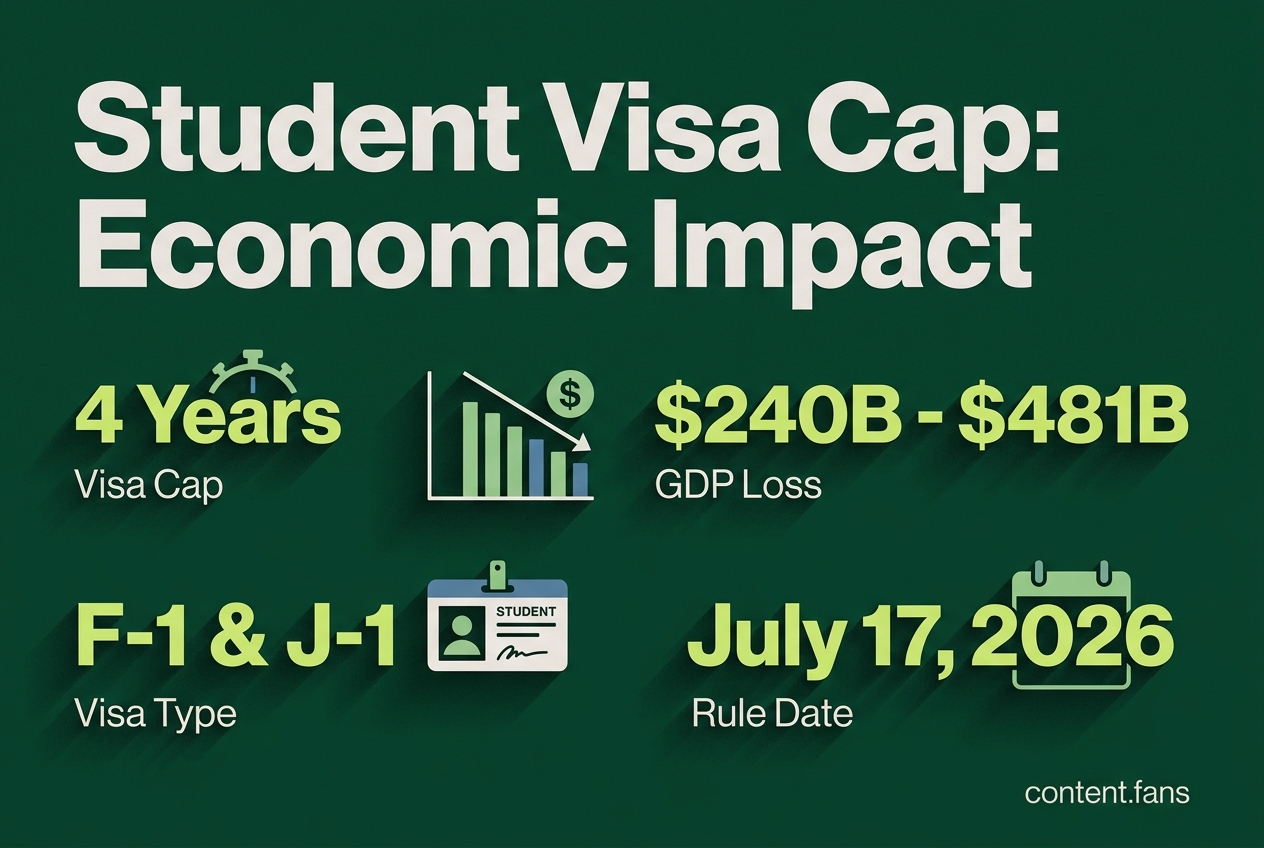
The new DHS rule capping student visas at 4 years is poised to dramatically alter the landscape for U.S. universities and over one million international students. Published by the Department of Homeland Security (DHS) on July 17, 2026, the final regulation replaces the flexible "Duration of Status" system with a fixed four-year admission period for most F-1 and J-1 visa holders, with significant economic consequences projected.
This policy arrives as new international student enrollment has already declined significantly according to industry reports. While DHS acknowledges the rule "may result in fewer international students choosing to study in America," it has not quantified the potential impact.
Economic Ripple Effects for Campuses and Towns
The four-year visa cap could result in substantial revenue losses for universities if international enrollment drops significantly. This revenue loss could translate to many fewer jobs in local economies and could lead to substantial GDP reductions over ten years.
A detailed Brookings analysis projects devastating financial consequences. The immediate revenue loss for universities could be substantial, with potential annual losses growing significantly if enrollment declines substantially. The economic damage extends far beyond campus, with local economies projected to lose many jobs dependent on international student spending. A decade out, annual U.S. GDP could be $240 billion to $481 billion lower than it otherwise would be if the decline holds.
Navigating the New Four-Year Clock
For students in programs longer than four years, such as doctoral tracks, medicine, or architecture, the new rule introduces significant uncertainty and administrative hurdles. Many international undergraduates already take longer than four years to graduate, meaning a significant portion will now require a visa extension.
Key challenges include:
- Extension of Stay Requirement: Students must file Form I-539 with U.S. Citizenship and Immigration Services (USCIS) before their four-year term expires, as late filings can trigger unlawful presence penalties.
- Discretionary Approval: EOS approvals are not guaranteed. A denial results in an immediate loss of legal status, with no grace period for departure.
- Program Change Restrictions: Switching academic programs mid-stream is prohibited unless a student obtains a DHS exemption for "extenuating circumstances."
- No Clock Reset: The four-year limit is cumulative. Students pursuing sequential degrees, like a bachelor's followed by a master's, must complete both within the initial four-year window or obtain an extension.
Institutional Response and Administrative Strain
U.S. colleges and universities face a significant administrative and financial crisis. With an implementation date of September 15, 2026, institutions have little time to prepare. International student offices must now manage thousands of complex Extension of Stay applications, each requiring fees and biometric screening. Administrators warn these new costs, combined with reduced tuition revenue, could force them to raise tuition for domestic students or cut essential programs.
The impact is expected to be most acute for universities with large STEM programs and high enrollment from India. A Forbes report notes that Indian nationals comprise a significant portion of all participants in the STEM Optional Practical Training (OPT) program, making this demographic particularly vulnerable.
While the Department of Homeland Security maintains that the fixed four-year term is necessary to "improve monitoring and oversight," critics question if the security benefits justify the steep economic and academic costs. For now, universities, students, and local businesses must adapt to a new reality where every academic plan is dictated by a four-year clock.