
Notion unveils 2026 Custom Agents with built-in auditability, reversibility
Serge Bulaev
Notion's 2026 Custom Agents are designed to be transparent, auditable, and reversible, with every action logged and visible to users. Admins can control who creates agents and monitor activity with real-time usage data and history. Users may undo any agent changes easily, reducing risk. The system's memory is built from regular Notion pages and databases, which might let compliance staff review actions more simply. Analysts suggest these safety features could make Notion a better fit for non-developer teams needing predictable and controlled AI tools.

The new Notion 2026 Custom Agents provide enterprise-grade AI automation built on a foundation of transparency, auditability, and reversibility. Addressing a core need for teams exploring autonomous workflows, this architecture logs every action, exposes agent decision-making, and allows users to undo any change. This approach treats governance as a primary product feature, not an afterthought, making it a strong fit for non-technical teams who require predictable AI inside their shared workspace.
Visibility first: transparency in every run
Each execution by a Custom Agent is recorded in a detailed activity log. This dedicated 'Activity' tab documents the trigger, the agent's reasoning process, the exact actions it performed, and any resulting errors. Notion's product documentation refers to these as "full audit logs". Furthermore, agents are available to everyone by default, with configuration inspection generally available to those with creation and edit rights. Agents are also listed in the standard share menu, allowing teams to verify permissions instantly.
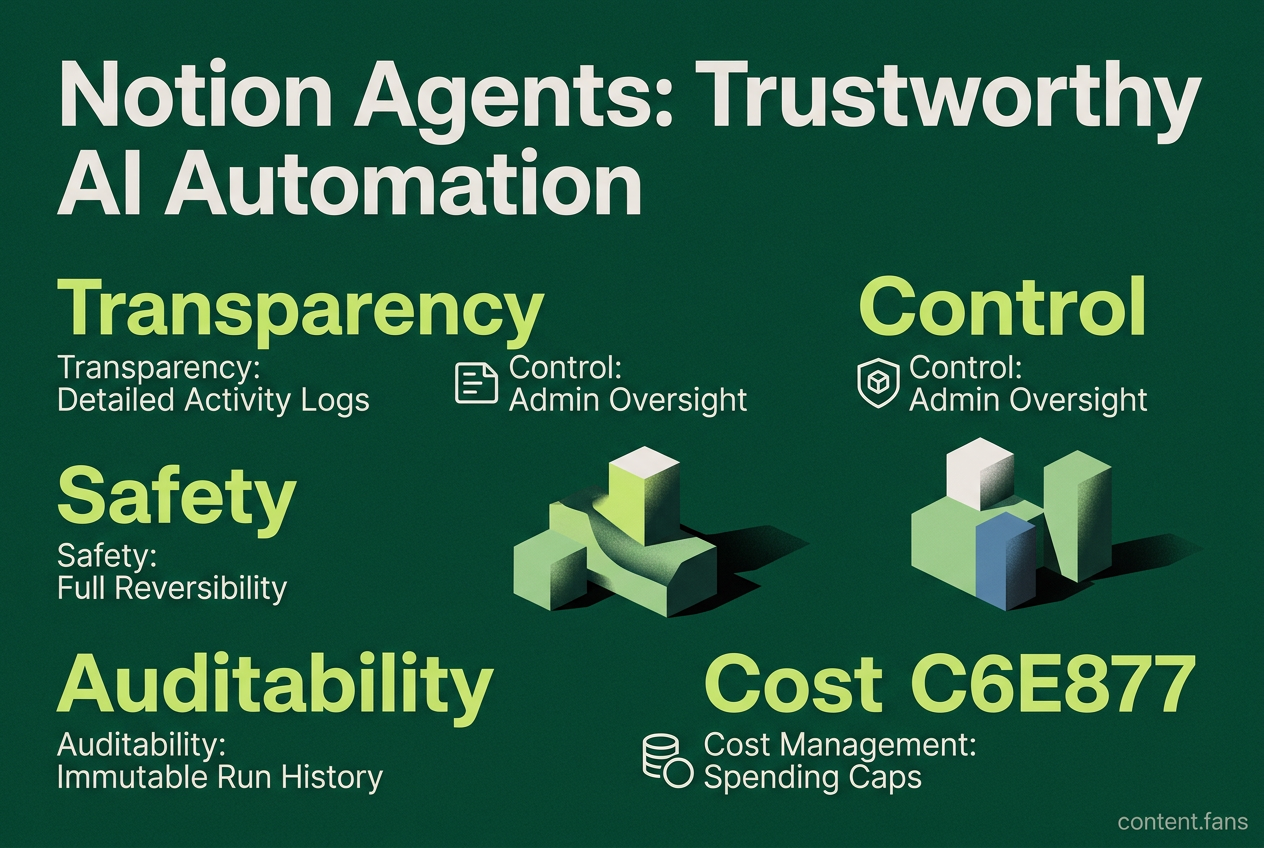
Notion's Custom Agents provide built-in safety through three core principles: transparency via detailed activity logs, administrative control over creation and monitoring, and complete reversibility of all agent actions using native version history. These features ensure that autonomous workflows remain predictable, secure, and auditable for enterprise teams.
Control layers: auditability for admins
Administrators in Workspace and Enterprise plans have centralized control over agent creation, monitoring, and resource consumption. The Notion 3.3: Custom Agents update from February 2026 allows admins to restrict agent creation permissions. A subsequent update, Notion 3.4 part 2, introduced spending caps and unusual-spend detection for Notion Credits to help control costs. With scoped permissions and activity logs, Notion provides comprehensive oversight capabilities for agent operations.
• Admin checkpoints presented in one place:
- Agent registry listing creator and purpose
- Real-time credit consumption graphs
- Immutable run history with query filters
These governance tools are designed to answer key procurement questions, such as who authorized an agent, what data it accessed, and whether its actions complied with company policy.
Built-in safety net: reversibility
Every modification made by a Custom Agent is captured in Notion's standard version history. This allows users to revert any incorrect classification, overwritten database entry, or other unwanted edit with just a few clicks. As noted in external guides on Notion Custom Agents, this built-in undo functionality significantly lowers the risk of deploying and iterating on new automations.
Design choice: auditable memory instead of black boxes
A core design principle is that an agent's 'memory' is composed of standard Notion pages and databases, rather than an inaccessible 'black box' or embedding store. This architecture ensures that compliance teams can inspect an agent's instructions and context using their existing workspace tools. This approach reflects proven software infrastructure patterns like deterministic records, comprehensive version control, and mandatory reviews before deploying changes.
Why safety features matter for adoption
While many enterprises are experimenting with AI agents, there is a commonly observed gap between pilot projects and full production deployment. Governance features were introduced in April 2026 to address adoption challenges. By prioritizing transparency, auditability, and reversibility, Notion provides the essential framework needed for legal, security, and operations teams to approve autonomous workflows, accelerating enterprise-wide adoption without requiring custom-built oversight tools.