
New Checklist Integrates AI Governance with Existing DevSecOps Pipelines
Serge Bulaev
A new checklist may help companies better manage AI agents by adding governance controls to their current DevSecOps processes. This checklist suggests tracking each agent's identity, setting risk levels, adding checks before actions, keeping unchangeable logs, limiting spending, and retiring agents properly. These steps appear to match trusted frameworks like NIST AI RMF, which could help teams reuse existing policies. The checklist might help spot problems early and give proof for regulators when new laws like the EU AI Act start. Teams that use these controls may avoid unexpected costs and and better control their AI projects.

Effective AI governance is critical as enterprises adopt autonomous LLM agents, where minor model calls can lead to significant operational incidents. For example, Cycles reported a $1.40 API call that escalated into a $50,000 pipeline loss after mis-routing 200 emails (Cycles incident catalog). This highlights the urgent need for technical guardrails, clear ownership, and auditable evidence.
A new agent governance checklist provides a practical framework of controls, connecting established AI principles with daily DevSecOps tasks. It enables teams to manage the entire agent lifecycle - from approval to retirement - without risking budget overruns or data exposure.
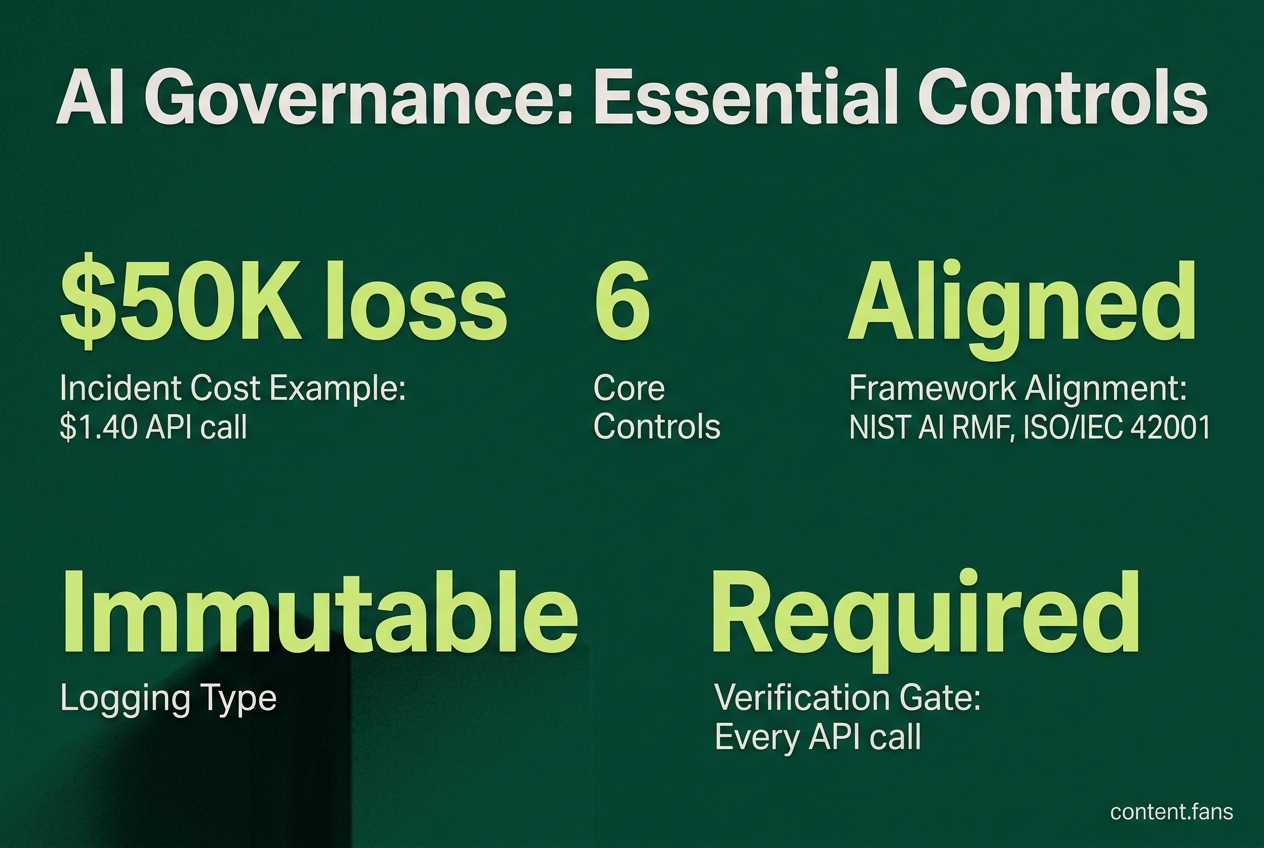
Agent governance checklist core controls
This checklist provides a set of essential controls for managing autonomous AI agents within an enterprise. It focuses on establishing clear identity and ownership, classifying agents by risk, verifying actions before execution, maintaining immutable logs, setting budget caps, and defining a formal retirement process for security.
- Identity Registry - Establish a unique identity for each agent with a designated owner and scoped credentials, a practice recommended by industry experts for enterprise AI deployments.
- Policy Classification - Classify agents into risk and autonomy tiers, linking each level to specific requirements for human review and rollback capabilities.
- Verification Gate - Implement a gate to intercept every tool or API call, evaluating it against defined policies to block or escalate high-risk actions before they execute.
- Immutable Logging - Maintain an append-only log that captures the agent's intent, reasoning, tool calls, outcomes, and identity, streaming this data to your SIEM for analysis.
- Rate Limits and Budget Caps - Enforce per-agent spending ceilings and rate limits. Because runaway workflows can start with small costs, low limits are crucial for early anomaly detection.
- Retirement Workflow - Create a formal retirement process to revoke credentials and archive logs when an agent is decommissioned, preventing lingering permissions.
Aligning with existing frameworks
The checklist's controls align directly with major governance frameworks, allowing teams to leverage existing policies. It maps to the NIST AI Risk Management Framework (RMF) functions (Govern, Map, Measure, Manage) and supports the certifiable management system outlined in ISO/IEC 42001:2023. This approach enables security teams to build on established risk language instead of creating new taxonomies from scratch.
A more faithful mapping would treat Identity registry and policy classification as governance/inventory activities, verification gates as part of Manage, and logging/evidence as part of Measure and Manage; NIST does not publish this exact checklist-to-function table.
Implementation tips for 2025 rollouts
- Integrate the registry with CI/CD to automatically assign an owner to every deployed agent.
- Position the verification gate at the tool invocation layer, which industry experts identify as the most effective point for enforcing least-privilege access.
- Stream structured JSON logs to your existing SIEM. Industry guidance suggests that schema-aligned logs can significantly reduce incident triage time.
- Connect spending alerts to your telemetry. Industry reports indicate that a significant portion of agentic AI projects may face challenges due to unclear value and escalating costs, making budget controls essential (Search Engine Land analysis).
- Develop a simple retirement checklist to empower product managers to securely decommission agents without operational delays.
By embedding these AI governance controls into existing DevSecOps pipelines, organizations can mitigate unexpected costs, strengthen their security posture, and proactively generate the compliance evidence required by emerging regulations like the EU AI Act.
What major risks does the new AI governance checklist protect against?
Recent incident reports highlight three primary risks: runaway costs, unauthorized actions, and data leakage. Industry studies have documented various incidents including support agents mistakenly sending collection emails, low-cost API calls that caused production database issues, and significant fraud resulting from compromised agent credentials. The checklist addresses these threats by layering identity management, policy enforcement, and immutable logging to prevent minor expenses from causing catastrophic damage.
How does the checklist integrate with existing DevSecOps pipelines?
It integrates as a runtime layer within your existing infrastructure, not as a separate, siloed workflow. A lightweight gateway intercepts every agent tool call to:
1. Evaluate policy in real-time
2. Block or escalate risky actions
3. Stream structured logs into your existing SIEM
This approach lets enterprises implement robust AI controls by reusing existing CI/CD secrets stores, Kubernetes RBAC, and on-call rotations without building a new silo.
What must every agent audit trail contain to satisfy auditors and incident teams?
Immutable, end-to-end execution traces are the minimum standard. To satisfy auditors and accelerate incident response, each log entry must capture:
- Agent ID & version, the associated human user, and the trigger prompt
- The agent's decision path and reasoning steps
- Tool and policy context, including the exact API called and the policy decision
- The resulting outcome, such as records changed or external side effects
Industry playbooks confirm this level of detail meets both ISO/IEC 42001 evidence requirements and forensic analysis needs.
Which verification gates stop agents before they act?
Runtime policy gates are essential for preventing harmful actions. They intercept every tool invocation and categorize it for disposition:
- Auto-approve for low-risk, pre-authorized actions
- Human review for financially significant operations or access to sensitive data
- Immediate block for requests violating cost, security, or compliance policies
Open-source gateway templates show how to implement these gates without modifying agent code.
How can teams budget and monitor agent spend in real time?
The checklist recommends enforcing per-agent cost controls at the token and action level. Key mechanisms include:
- Daily spend caps that trigger on-call alerts
- Rate limits on API calls to prevent system overloads
- Cost anomaly detection that pauses agents exceeding their typical burn rate
Early adopters find that integrating these alerts with existing infrastructure monitoring rotations contains the financial blast radius of errant agents to single-digit dollars.