
New AI Agent Governance Checklist Updates Security, Cost Controls for CTOs
Serge Bulaev
The updated AI Agent Governance Checklist gives CTOs and security teams new ways to control security and costs as they use more autonomous coding agents. It suggests using strong tracking, clear agent identities, and real-time controls instead of only static policies. Studies point out that spending problems may happen quickly, so teams should set strict spending limits and alerts. The checklist also recommends regular reviews, strict data privacy measures, and careful management of agent permissions to prevent risks. Some risks, like personal data leaks or shared accounts, may still happen but can be reduced with these steps.

An effective AI Agent Governance Checklist provides a crucial framework for CTOs, security leads, and compliance officers scaling autonomous coding agents. This updated guidance emphasizes a shift from static policies to dynamic, real-time guardrails. According to the AI Agent Governance Checklist, every agent requires a unique identity and a complete, auditable action trail to manage risk without sacrificing development velocity. Furthermore, studies show runaway costs can manifest in minutes, highlighting the need for agent gateways to connect directly with financial alerting systems.
Governance Checklist for Agentic Coding Deployments: core pillars
A strong AI agent governance checklist is built on five core pillars: maintaining a full inventory of agents and their permissions, enforcing unique identities, implementing real-time security guardrails, ensuring comprehensive monitoring for auditability, and establishing clear incident response plans with kill switches and rollback procedures.
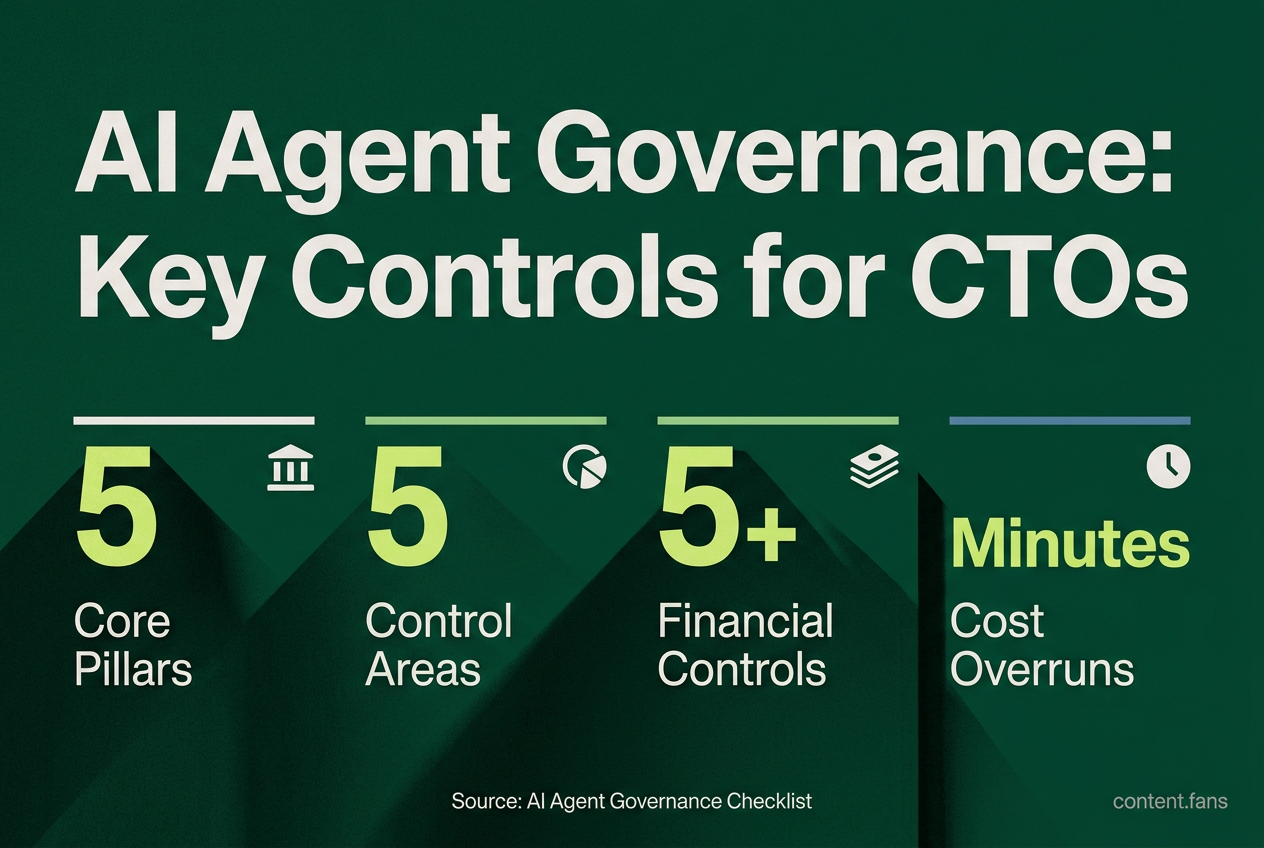
Enterprise checklists converge on five control areas:
- Discovery and Inventory: Maintain a comprehensive, live registry of all agents, their owners, assigned tools, and autonomy levels.
- Identity and Access Management (IAM): Assign unique, scoped service accounts to each agent, conduct frequent permission reviews, and strictly segregate read, write, and deploy privileges.
- Runtime Guardrails: Implement automated policy gates for code merges, production deployments, and secrets access. Include circuit breakers to instantly halt suspected prompt injection or tool misuse.
- Monitoring and Provenance: Log all prompts, tool interactions, file changes, and human approvals to create an immutable audit trail that can fully reconstruct any code modification.
- Incident Response: Develop pre-defined incident response plans that include immediate kill switches, automated rollback capabilities, and clear escalation paths for any detected unsafe agent behavior.
Implementing Financial Guardrails to Prevent Budget Overruns
As AI agents begin to chain complex tasks across multiple models, the financial risk multiplies. Hard budget ceilings can help control cost overruns, but effective cost management also typically includes monitoring usage, tightening permissions, and governance controls. A robust financial control stack should combine:
- Per-Agent Daily Caps: Set hard dollar limits that trigger auto-termination.
- Rate Limiting: Implement token or request quotas to throttle excessively long conversations.
- Execution Timeouts: Use per-minute limits to prevent resource spikes.
- Model Tiering: Route routine, low-value tasks to cheaper, more efficient models.
- Loop Detection: Automatically stop recursive tool calls to prevent infinite loops.
These controls can be unified within the same orchestration gateway that manages security policies, creating a single enforcement point for both engineering and finance. A mature throttling strategy will incorporate both soft throttles (delaying requests) and hard throttles (rejecting requests) for excessive API calls.
A 90-Day Implementation Plan for Engineering Leaders
A phased rollout ensures a smooth transition to full agent governance. Field reports indicate that teams following this cadence can achieve audit readiness within a single quarter.
- Days 0-30 (Foundation): Build the agent registry, classify all use cases by risk level, and conduct a thorough audit to uncover shadow AI agents.
- Days 31-60 (Control): Issue unique identities for every agent, tighten access permissions based on the principle of least privilege, and activate comprehensive logging for all prompts, code diffs, and API calls.
- Days 61-90 (Maturity): Deploy automated anomaly detection alerts, test kill switch and rollback procedures, run tabletop exercises for threats like prompt injection, and establish a quarterly governance review cadence.
Mapping Governance Controls to Key Compliance Risks
Data Residency: A primary compliance concern is data residency, as prompts, vector embeddings, and logs can inadvertently cross geographic borders. To mitigate this risk, teams must pin model endpoints and storage resources to approved regions and configure the orchestration gateway to block any unauthorized cross-border data processing.
PII Leakage: The risk of Personally Identifiable Information (PII) leakage increases significantly when agents are given access to broad datasets. Training models on personal data can trigger GDPR obligations. Implementing PII redaction tools before data ingestion and enforcing strict retention limits on logs are essential controls.
RBAC Failures: Role-Based Access Control (RBAC) often fails due to the use of shared service accounts. The recommended best practice is to issue per-agent identities and use just-in-time (JIT) privilege elevation for high-risk actions. This means agent identity governance must mirror human access reviews but operate on a much faster, automated cycle.
What must be in my first agent governance checklist before we scale beyond pilot?
Start with inventory, identity, and guardrails. Industry reports show that teams who skip these three items run into significant budget overruns within ninety days. The minimal checklist therefore looks like this:
- Agent registry - name, owner, data sources, autonomy level
- Unique non-human identity with scoped credentials
- Hard budget ceiling (per agent / day) that automatically stops spend when hit
- Least-privilege allow-list for repos, APIs, and secrets
- Human approval gate for any change that reaches staging or prod
These five lines prevent the two most common early failures: runaway cost and over-privileged code changes.
How do I stop an agent from burning through the cloud budget in a single night?
Use three concurrent controls:
- Per-agent daily dollar cap enforced at the gateway layer - when the cap is reached, the agent is terminated or downgraded to a free model tier Clarifai.
- Request-per-minute throttle to smooth out retry storms that can rack up thousands of dollars in minutes.
- Loop-detection circuit breaker that kills jobs stuck in recursive tool calls; many early adopters have encountered infinite loops that resulted in significant unexpected costs.
Layering all three reduces the chance of any single control failing and gives finance a real-time meter they can query the next morning.
Which security controls actually matter when the agent touches both source code and customer PII?
Focus on data minimization at ingest and immutable provenance logs:
- PII scanner/redactor runs on every prompt and context chunk before the agent sees it, significantly reducing PII leakage incidents according to industry reports.
- Unique agent identity so every git push, API call, or database read is tied to a non-reusable credential - this prevents privilege inheritance from the developer who deployed the agent.
- Log stream that captures prompt, retrieved docs, diffs, and approval events and is append-only for 90 days to satisfy audit requests without manual snapshots.
When these three are in place, traditional RBAC gaps (escalation through chained agents, accidental exposure of PII in code comments, etc.) drop sharply.
Who should own the agent governance policy - Engineering, Security, Finance, or Legal?
Split the ownership by risk layer:
| Risk Layer | Primary Owner | Secondary Owner |
|---|---|---|
| Daily spend & throttling | Finance | Engineering |
| Tool & data access permissions | Security | Engineering |
| PII, residency, retention | Legal / Compliance | Security |
| Code change approvals & rollbacks | Engineering | Security |
A lightweight Agent Governance Council - one representative from each group - meets bi-weekly to review budget burn, incident logs, and pending policy exceptions. This prevents the common trap where Security writes rules that Finance cannot measure or Legal imposes retention windows that break CI/CD.
What metrics should I show the board to prove our agent program is still "safe to scale"?
Present a quarterly Agent Governance Scorecard with four numbers:
- % of agents with unique identity + scoped permissions (target ≥ 95 %)
- Budget variance per agent (actual vs projected, target within ± 10 %)
- Mean time to detect policy violation via automated alerts (target < 5 minutes)
- % of code commits with tamper-proof provenance log (target 100 %)
Boards respond well to this format because each metric ties cost, security, and auditability to a single traffic-light status, allowing a quick go / no-go decision on expanding the program.