
NanoClaw Pivots to Enterprise AI 'Second Brain,' Secures Agents
Serge Bulaev
NanoClaw has changed from a small project to a platform focused on security and compliance for large companies. It uses containers to keep each AI agent separated, which may help reduce risks if something goes wrong. A special Rust gateway makes sure sensitive information stays secure, only giving out secrets after human approval. Some reports say that several regulated companies are testing NanoClaw for tasks like email sorting and report writing. It appears that enterprises may choose NanoClaw for its security features, but still compare it to bigger platforms from companies like Nvidia and Google.

The NanoClaw Enterprise AI platform has rapidly evolved from a side-project into a compliance-focused solution for large organizations. As a secure, open-source agent harness for employees, it enables security teams to audit the system as quickly as they can deploy it. This report details NanoClaw's architecture and explores why regulated industries are initiating pilot programs.
Security by Architecture, Not by Prompt
NanoClaw is an enterprise AI agent platform prioritizing security through architectural design rather than prompt filtering. It isolates each AI agent in a dedicated container, using the operating system as the security boundary. This approach, combined with a minimal codebase, significantly reduces the attack surface for enterprise deployments.
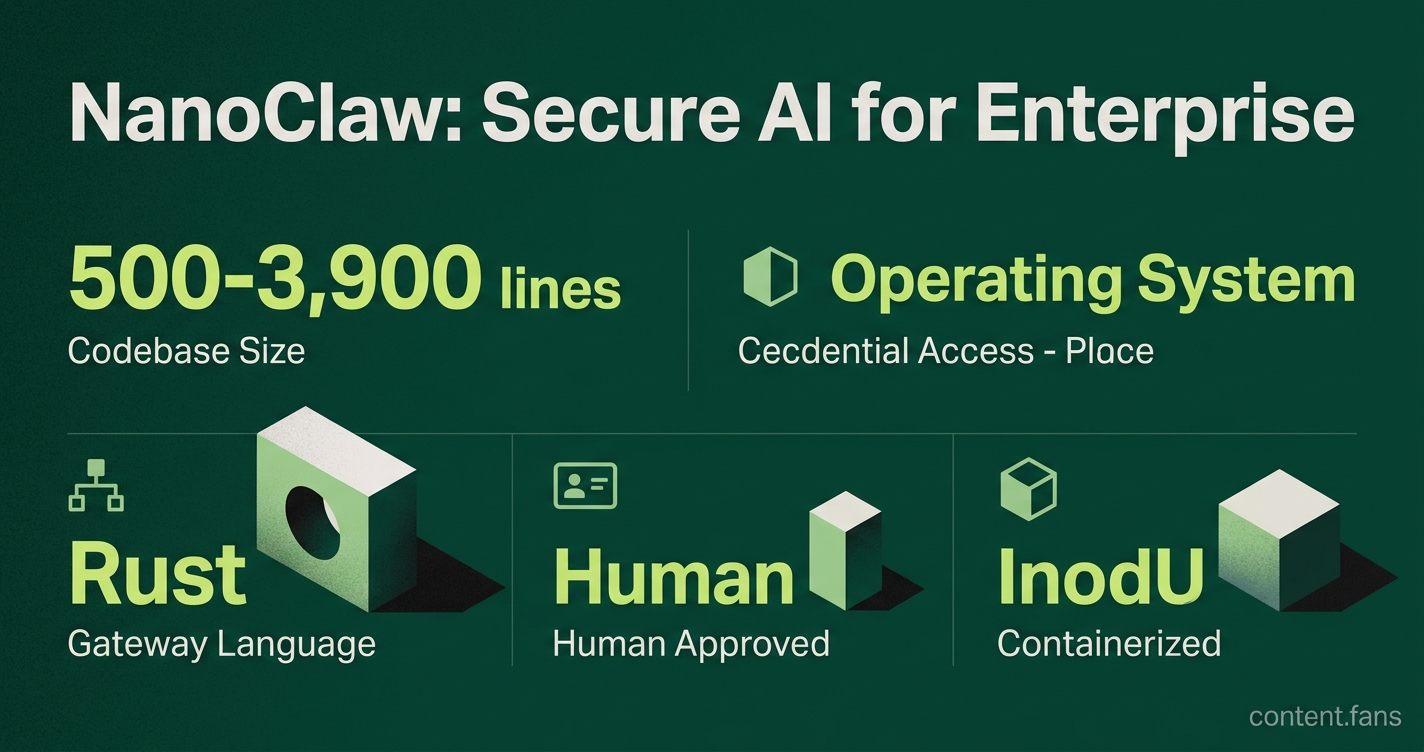
Public analysis highlights NanoClaw's remarkably small codebase, estimated between 500 and 3,900 lines of code, which allows for a full security review in minutes. Every agent instance launches within a dedicated container (Docker on Linux or Apple Containers on macOS). This mandatory isolation makes the operating system - not the application - the primary security boundary, removing the risks associated with optional security configurations.
Key security pillars include:
- Containerized isolation limits the blast radius of a compromised agent.
- A minimal code surface reduces unintended attack vectors.
- A central Rust gateway mediates all outbound actions.
- Sensitive credentials remain in a vault until a human approves their use.
Rust Gateway Keeps Credentials Outside the Agent
A core security feature is that raw API keys never reach the agent itself. According to VentureBeat, when an agent needs to access an external service, it sends a signed request to a Rust-based gateway. This gateway verifies the request against company policy, logs the intent, and sends an approval request to the user via Slack, Teams, or WhatsApp. Only after human approval does the gateway inject a temporary, scoped token and forward the call, creating a clear audit trail without exposing long-lived secrets.
Enterprise Adoption and Competitive Landscape
NanoClaw is positioned as a managed personal assistant that integrates with existing enterprise identity systems. Initial pilots in security-sensitive sectors like healthcare and finance are reportedly focused on email triage, report generation, and ticket routing where credential containment is mandatory.
In the broader market, NanoClaw offers a security-first alternative to comprehensive ecosystems from tech giants. This positions NanoClaw for enterprises that prioritize auditability and granular control over the all-in-one convenience of larger vendor platforms.
How does NanoClaw keep credentials safe from the agents themselves?
Raw API credentials never reach the agent.
Every outbound request is forced through a Rust-based OneCLI gateway that holds the secrets outside the container. When an agent wants to perform a sensitive action, the gateway blocks the call, pushes an interactive approval card to Slack/Teams/WhatsApp, and only injects the credential after the user taps "Approve." This design means a compromised agent cannot leak what it never possesses, a pattern that many enterprises still get wrong by sharing API keys across agents.
Why does the eight-minute audit claim matter for regulated teams?
The entire harness is ~3,900 lines across 15 files, small enough that a human security squad can finish a full manual review in about eight minutes. In healthcare or finance, where regulators expect documented evidence of control, this micro-footprint turns a week-long code audit into a coffee-break task and shrinks the unintended attack surface that compliance teams must sign off on.
How is NanoClaw different from other agent platforms?
NanoClaw carves out a distinct position as security-first, on-prem-friendly middleware that enterprises can drop into existing clouds or bare metal without committing to a full silicon-plus-software stack from larger vendors.
What isolation model does NanoClaw use inside employee laptops?
Each agent is locked into its own Linux or Apple container before it can start. The security boundary is the OS kernel, not an application-layer sandbox, so a rogue skill cannot read a co-worker's files or scan the corporate network. This per-group isolation also satisfies agent registry recommendations that many firms still lack.
Can NanoClaw stop prompt-injection attacks?
The framework does not rely on prompt filters; instead it enforces gateway-mediated policy. Even if an attacker tricks the LLM into generating a malicious tool call, the Rust gateway evaluates the action against company rules and withholds credentials until a human confirms it. This human-in-the-loop step creates an instant audit log, closing the attribution gap that shared service accounts usually leave open.