
Amca Closes $300M Series B for Industrial Scale, Valued at $1B+
Serge Bulaev
Amca recently closed a $300 million Series B funding round at a reported valuation above $1 billion. This round may signal that investors are willing to fund growth when manufacturing processes and product quality appear stable. Industrial hardware startups often face unique challenges, such as long certification cycles and higher costs from tariffs, which may require careful planning and capital use. Investors seem to want proof of consistent production and clear financials, and many companies structure funding in phases tied to specific goals. Experts suggest keeping extra capital on hand for surprises and using a mix of funding sources to limit ownership loss.

Amca's recent $300 million Series B funding round highlights a critical lesson for industrial startups: scaling requires more than momentum. For hardware founders, structuring a Series B means proving the factory, supply chain, and go-to-market strategy are repeatable, tying capital deployment directly to operational milestones.
Why industrial Series B differs from SaaS
Structuring a Series B for industrial scale requires balancing capital-intensive manufacturing needs with investor demands for efficiency. Founders must align the round's size, dilution, and deployment schedule with specific operational milestones, focusing on production stability and clear financials to de-risk the investment and secure funding.
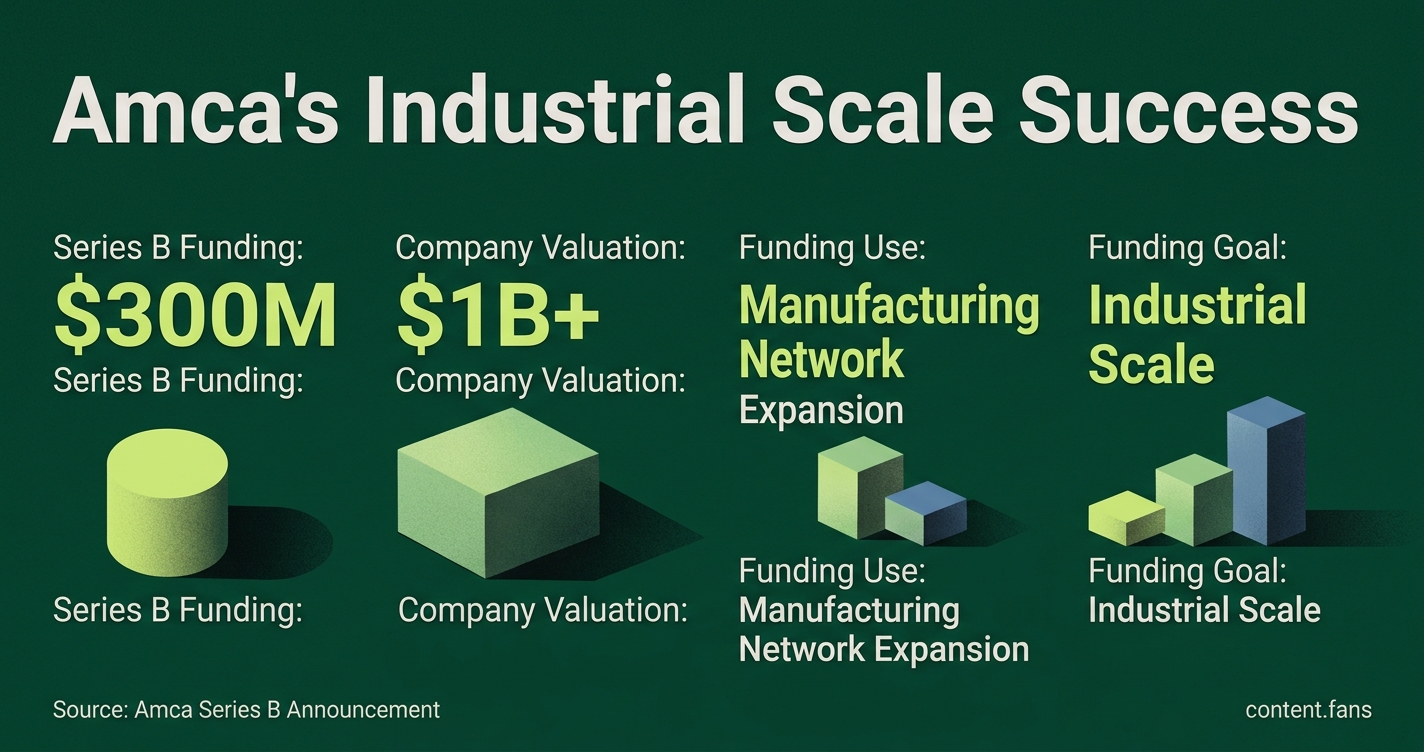
Unlike software, industrial hardware companies navigate longer certification cycles, physical supply shortages, and tariffs that inflate costs. With LP liquidity tight, investors increasingly demand clearer paths to exit, according to industry reports. This forces hardware founders to show cleaner financials and better burn multiples than their SaaS peers. A prime example is aerospace/defense advanced manufacturing company Amca, which recently closed a $300 million Series B at a valuation over $1 billion. Amca designated the funds for expanding its manufacturing network, signaling strong investor appetite for scale-ups that have already achieved stable production yields.
Linking capital to de-risked milestones
Global Venturing notes that tariffs can "raise materials costs and create investment uncertainty," making disciplined capital allocation essential. A milestone-based budget is crucial. Some hardware CFOs structure their Series B into internal tranches to de-risk the path to scale:
- Tranche 1: supplier redundancy, yield improvement, and QA automation.
- Tranche 2: channel sales expansion once first-pass yield holds above target for sustained periods.
- Tranche 3: capacity additions tied to booked, prepaid orders.
Dilution management and alternative funds
To manage dilution, founders should layer in non-dilutive capital before raising an equity round. The Onshape funding guide identifies the SBIR program as an "entry point" for dual-use hardware, providing grants without equity loss. Venture debt and customer prepayments can also finance near-term inventory needs. Before outreach, Spectup advises founders to "clean the cap table," as hidden SAFEs and side letters can complicate negotiations and increase dilution. A robust cap-table model should also include an option pool expansion to cover future hiring cycles.
Key metrics investors scrutinize before wiring funds
For late-stage hardware investors, operational reliability trumps top-line bookings. Data rooms should therefore lead with metrics that prove manufacturing and financial stability:
- First-pass yield trend and scrap rate.
- Gross margin by product line over the last three quarters.
- Inventory turns and cash conversion cycle.
- CAC and payback period where hardware carries a service plan.
- Warranty return rates and field failure incidents.
Embedding flexibility for macro shocks
Given that input prices and geopolitical landscapes are volatile, building flexibility into the budget is non-negotiable. Many hardware boards recommend holding significant uncommitted runway after the round closes. This buffer enables rapid adjustments - like re-tooling or multi-sourcing - without needing an emergency bridge round. As investors told Global Venturing, the ability to shift production regionally "might actually work in your favour" in turbulent times.
Ultimately, a successful industrial Series B is built on a foundation of operational proof. By staging capital deployment against clear milestones, strategically layering alternative funding sources, and maintaining rigorous transparency with key metrics, an industrial startup can achieve rapid scale while protecting future ownership.