
Apple unveils new AI features for VoiceOver, Magnifier, Vision Pro
Serge Bulaev
Apple announced new AI-powered accessibility features coming later this year for devices like iPhone, iPad, Mac, and Vision Pro. VoiceOver may give better scene descriptions, Magnifier appears to answer questions about nearby objects, and Voice Control might let users speak more naturally. The updates only work on newer Apple devices that support Apple Intelligence, so some older devices may not get them. Apple also says devices will soon create subtitles for any video in English, and Vision Pro may help control certain wheelchairs with eye-tracking. The release timing is uncertain, and not all details are final.

Apple is set to enhance accessibility across its ecosystem, unveiling new AI features for VoiceOver, Magnifier, and Vision Pro powered by Apple Intelligence. First previewed on May 13, 2026, these updates for iPhone, iPad, Mac, and Vision Pro are scheduled to arrive "later this year," according to the official Apple Newsroom post. This move highlights Apple's strategy of integrating on-device machine learning with established assistive tools, likely aligning the rollout with its next major OS updates, although a specific release date remains unconfirmed.
What changes inside VoiceOver, Magnifier and Voice Control
Apple's AI-powered accessibility updates introduce more descriptive scene analysis in VoiceOver, allow Magnifier to identify and answer questions about objects, and enable Voice Control to understand natural language commands. These enhancements leverage on-device intelligence to provide a more intuitive and context-aware user experience.
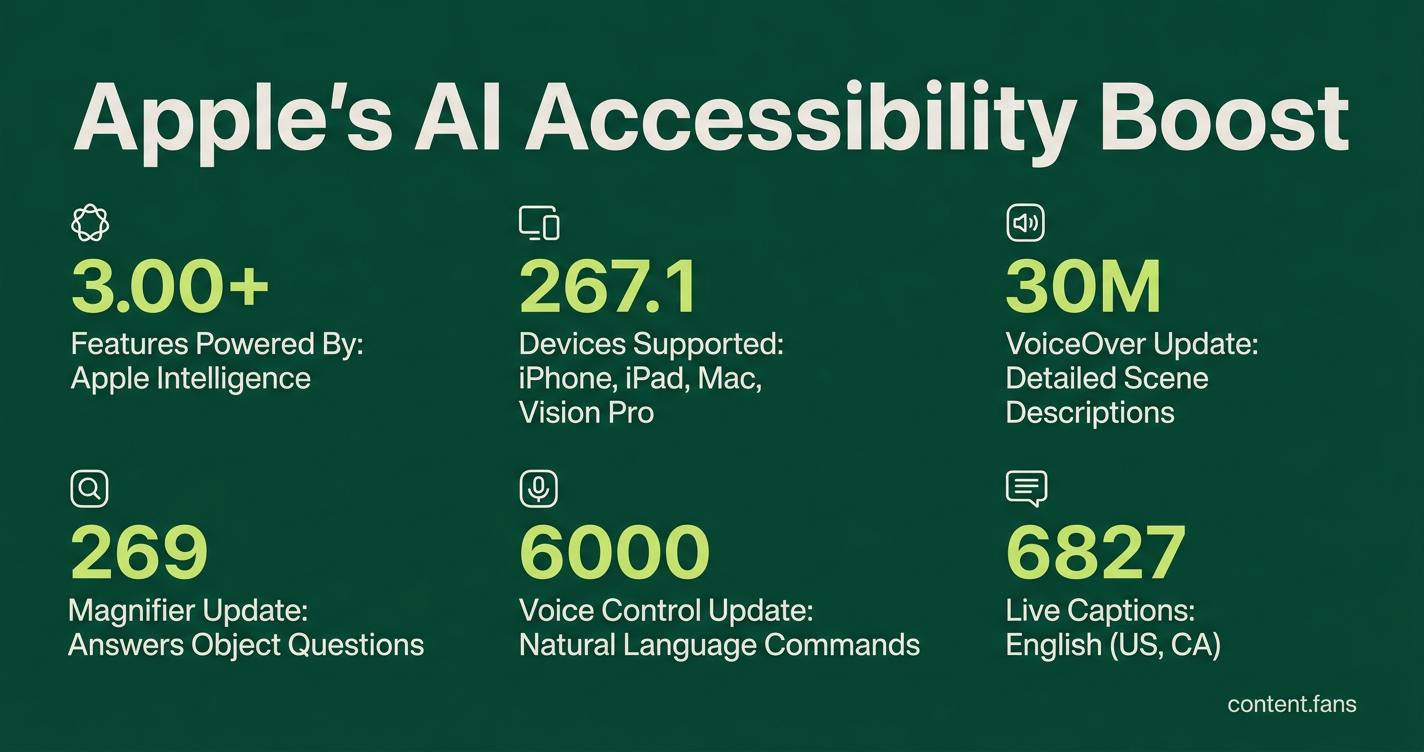
Powered by Apple Intelligence, VoiceOver will provide richer and more detailed scene descriptions. Magnifier will gain a new mode that can answer spoken questions about physical objects in the user's environment. Meanwhile, Voice Control will be upgraded to understand natural language, freeing users from memorizing specific commands. As noted by TechCrunch, the underlying image analysis can now "understand the image better and describe it in greater detail," bringing powerful on-device processing that rivals previous cloud-based solutions.
Device compatibility follows Apple Intelligence support
Access to these new accessibility features is dependent on hardware capable of running Apple Intelligence. Apple has indicated that a significant portion of recent devices will receive the updates, including newer iPhone Pro models, recent iPad models with advanced chips, modern Mac systems, and compatible Apple Vision Pro units. Notably, this excludes older Intel-based Macs and standard iPhone 15 models, indicating the AI-driven enhancements will not be available on that hardware.
Generated subtitles aim at everyday video gaps
Another key update is Live Captions for any video content. This feature will automatically generate subtitles for uncaptioned clips, including personal videos, directly on the device to ensure user privacy. Initially launching for English in the United States and Canada, users can customize subtitle appearance in Settings. The feature aims to close the accessibility gap for casual video content where captions are often missing, although its real-world performance is yet to be seen.
Vision Pro gains eye-tracked wheelchair control
For Apple Vision Pro, a groundbreaking feature will enable users to control compatible power wheelchairs using only their eyes. Leveraging the headset's precision eye-tracking technology, this function connects to wheelchair systems via Bluetooth or a wired interface. Apple has confirmed initial support for Tolt and LUCI drive systems in the U.S. A key benefit is its reported reliability across different lighting conditions without needing frequent recalibration, simplifying daily use.
Release window and remaining unknowns
Apple has consistently stated all new accessibility features are "coming later this year," but has not provided specific release dates or software version numbers. This lack of detail in the official announcement suggests a phased rollout rather than a simultaneous launch. Industry observers anticipate more technical information and potential beta timelines will be revealed at the upcoming Worldwide Developers Conference (WWDC), including details on expanded language support for Live Captions.