
Nadella Urges Companies: Build Your Own AI Models by 2026
Serge Bulaev
Satya Nadella, Microsoft's CEO, suggests that companies should build their own AI models by 2026 instead of relying on rented ones. He warns that using outside providers could risk losing a company's competitive advantage. Nadella says owning models and using unique company data may help businesses stand out, while outsourcing might make firms too dependent on vendors. Some examples appear to show that custom AI models can bring big benefits and savings. However, fully renting AI could lead to legal, operational, and skill loss risks, according to several analysts.

Microsoft CEO Satya Nadella is urging companies to build their own AI models by 2026, arguing that proprietary intelligence is crucial for maintaining a competitive edge. He warned that relying on third-party providers amounts to outsourcing institutional learning, which could hand a firm's strategic advantages to outsiders. This guidance comes as Microsoft itself balances its high-profile OpenAI partnership with new tools designed to help customers develop and govern their own in-house AI capabilities.
Why Did Satya Nadella Warn Against Relying on External AI Models?
Microsoft's CEO Satya Nadella cautions against relying on external AI because shared access to generic models offers no lasting competitive advantage. He argues that outsourcing core AI functions leads to "cognitive outsourcing," preventing companies from building valuable, proprietary institutional knowledge captured within their own custom-trained systems.
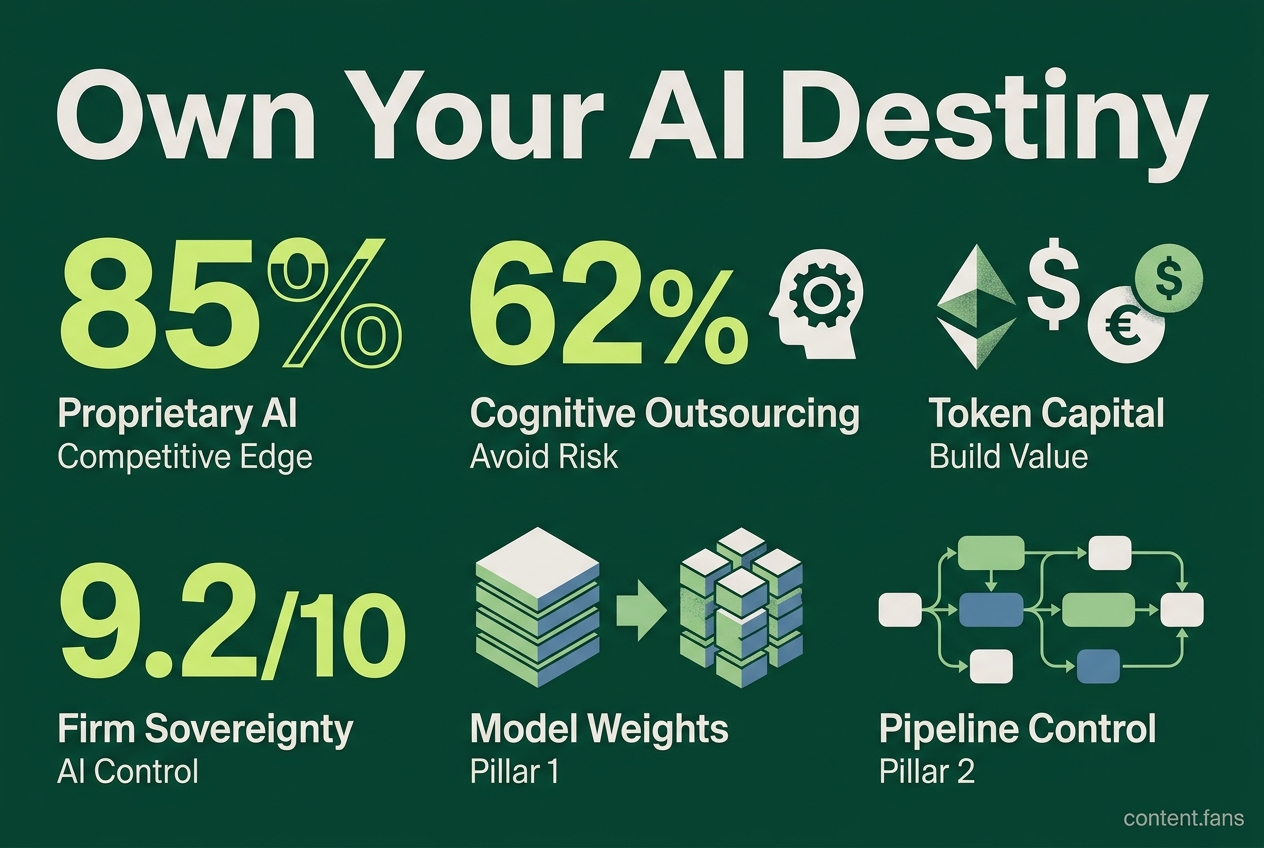
Nadella's warning centers on a critical insight: access to powerful, general-purpose AI is becoming a commodity. When every competitor can rent the same tools, the models themselves cease to be a differentiator. He argues that relying solely on these services engages in "cognitive outsourcing," a practice that hollows out a company's internal expertise and institutional memory.
The deeper risk involves what Nadella calls "token capital" - the compounding value of AI capabilities an organization develops internally. By renting AI, companies feed their unique data and user interactions into a vendor's system, improving an external asset instead of their own. As Nadella emphasized, he doesn't want to be locked into any one model and wants to be able to use his own context, noting that the model you choose is not your competitive advantage. This trend risks having frontier models commoditize professional knowledge across industries by absorbing expert insights and reselling them at scale.
What Is "Firm Sovereignty" and Why Does It Matter?
Nadella has discussed the concept of "Firm Sovereignty" as a framework for measuring a company's control over its AI destiny. It assesses how effectively an organization captures and protects its unique institutional knowledge within its own AI systems.
Nadella outlined three technical pillars for achieving genuine AI sovereignty:
- Control of Model Weights: Owning the neural network state that results from fine-tuning models on internal data.
- Pipeline Control: Maintaining end-to-end management of data provenance, training cycles, and feedback loops.
- Deployment Control: Running models in secure, sovereign environments where infrastructure providers cannot scrape interactions.
Nadella emphasizes that firms must control AI, specifically learned weights and isolated environments, to maintain sovereignty. The concept of 'context moats' describes this sovereignty approach, where companies build defensible advantages through proprietary AI capabilities rather than relying on generic external models.
Which Companies Have Successfully Built Proprietary AI Models?
Several leading organizations have demonstrated competitive advantages from developing proprietary AI models. These case studies show a clear pattern: combining unique data assets with deep workflow integration creates a durable moat that competitors relying on generic models cannot easily cross.
| Company | Approach | Outcome |
|---|---|---|
| Bloomberg | Built BloombergGPT on proprietary financial data | Defensible moat in financial analysis competitors cannot replicate |
| Chegg | Created personalized learning assistant trained on proprietary educational content | Unique capability generic models cannot match |
| Various enterprises | Developed custom AI platforms on proprietary datasets | Significant productivity gains and cost savings reported |
Many organizations across industries are piloting custom AI solutions, with growing numbers reporting substantial improvements in efficiency and competitive positioning through proprietary model development.
What Are the Risks of Outsourcing Core AI Capabilities?
A strategy of pure AI rental exposes companies to significant legal, operational, and strategic risks. Analysts and legal experts warn that full outsourcing can lead to several critical failure modes:
Erosion of Institutional Learning
Analysts call this "cognitive outsourcing." When external teams handle model tuning and monitoring, internal engineers fail to build the skills needed to interpret data, retrain systems, or audit outputs. This creates knowledge gaps that leave the organization unable to maintain or evolve its AI capabilities long-term.
De Facto Vendor Lock-In
While seemingly flexible, a rental strategy can lead to what experts call "digital dependency." As architectural choices become deeply tied to a single vendor's proprietary engine, organizations lose negotiating leverage and become exposed to service disruptions or unfavorable term changes.
Regulatory Liability
Enterprises cannot outsource legal responsibility for AI outcomes. Legal experts note that the data controller remains fully liable for privacy breaches, algorithmic bias, or harmful hallucinations under regulations like GDPR. Contract language cannot transfer this fundamental accountability to a vendor.
Unmaintainable Systems
A common outsourcing failure occurs when vendors deliver a "black box" system built to specification but not for real-world needs. These subscriptions often become unmaintainable without constant vendor support, as internal teams lack the experience to manage prompt drift and complex agent orchestration.
How Can Companies Test Whether They Truly Own Their AI Capability?
To cut through the hype, Nadella proposed a practical, three-question test for enterprises to assess whether they have achieved genuine AI sovereignty or are merely renting a capability. Answering "no" to these questions may signal a significant strategic vulnerability.
-
Does your AI deployment generate proprietary training signals?
An authentic AI asset learns and improves from your unique data and user interactions. If your system only consumes a vendor's model without creating its own feedback loop, you are not building a durable advantage. -
Can you swap the underlying model without losing your learned capabilities?
If your organization's institutional knowledge is locked inside a vendor's proprietary system and cannot be extracted, you do not own your learning loop. True ownership means the intelligence you've built is portable. -
Are your success metrics tied to business outcomes?
The ultimate measure of AI success is its impact on your specific business goals, not its performance on generic public benchmarks. Aligning AI evaluation with key performance indicators ensures you are building real value.