
N-able Unveils Shadow AI Visibility for Unapproved AI Tools
Serge Bulaev
N-able has released a Shadow AI Visibility feature that helps companies see how employees use AI tools without needing extra software agents. The tool may help track which AI tools, machines, users, and processes are involved, and shows this information on a live map for audits. Many workers reportedly use AI without approval, which appears to create risks for data security. N-able's tool might help companies manage these risks by making it easier to spot unapproved AI use. It is not yet clear how effective the tool is, as adoption numbers and results are still unknown.

N-able has launched its Shadow AI Visibility capability, a new security tool designed to address the growing risks of unapproved AI use in the workplace. The agentless software provides IT teams with crucial insight by mapping how employees interact with generative AI tools across company networks and endpoints, plugging a significant security blind spot.
The rise of "Shadow AI" has become a major security concern. According to the Microsoft and LinkedIn 2024 Work Trend Index, 75% of knowledge workers use AI, and 78% of them adopt Bring Your Own AI (BYOAI) practices, often without guidance or clearance from leadership. This unmanaged usage creates significant data exposure risks, with security risks being significant as organizations struggle to maintain visibility into unauthorized AI tool usage.
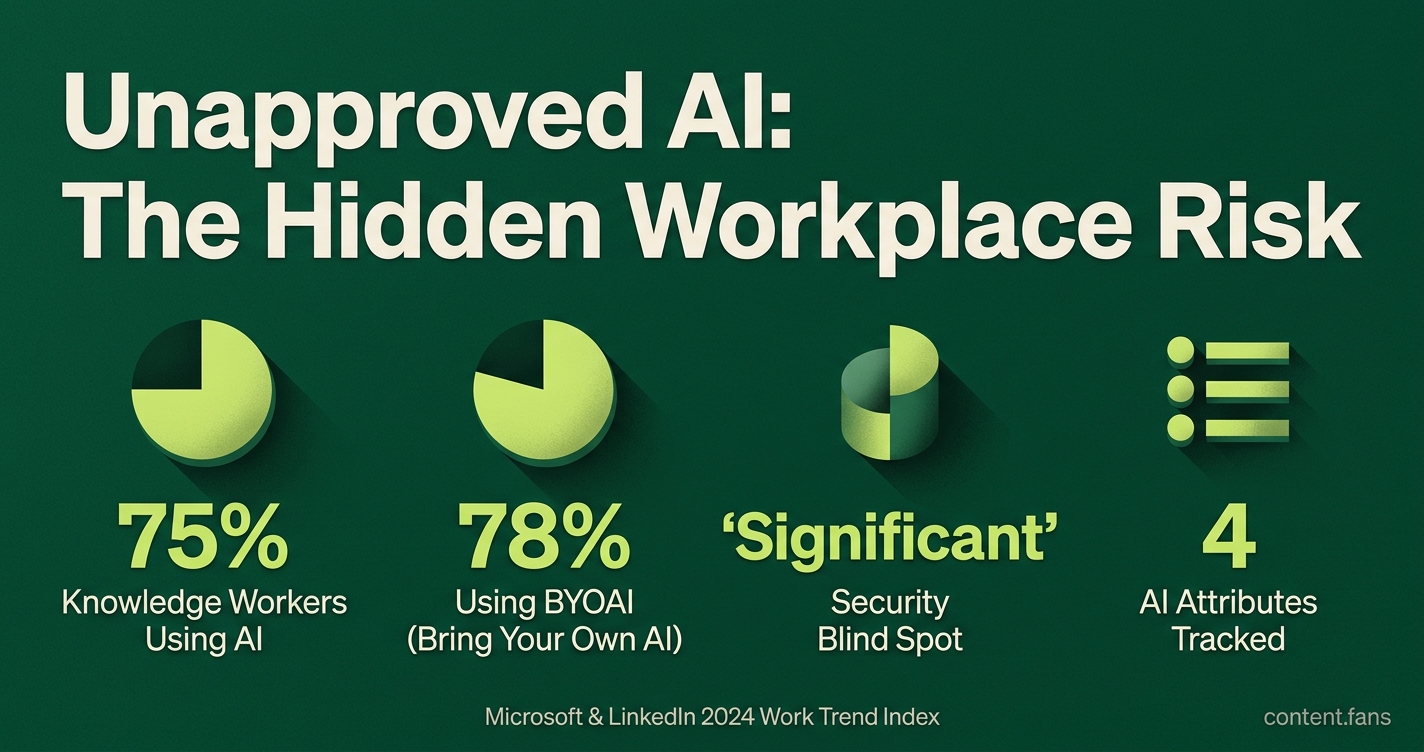
The feature inventories four key attributes for each detected AI interaction: the specific tools, machines, users, and processes involved. This data is aggregated into a continuously refreshing live map within existing N-central, N-sight, and Adlumin dashboards. As noted in international coverage by [Investing.com], a primary benefit is that no additional software agents are required.
How Shadow AI Visibility Works
N-able's Shadow AI Visibility tool gives IT administrators a real-time inventory of unapproved AI applications used by employees. It works without agents by inspecting network and endpoint traffic to identify, classify, and map AI tool usage, linking every interaction to a specific user, machine, and process.
The module functions by inspecting traffic at both the endpoint and network layers. According to the [official status page], it classifies every interaction by category, vendor, and approval status, allowing administrators to query data and create reports directly from their existing dashboards. The inventory focuses on four core attributes:
- Which Tools
- Which Machines
- Which Users
- Which Processes
This level of visibility is critical in a landscape where a significant number of organizations lack comprehensive AI governance policies. By providing precise user attribution, N-able empowers governance teams to enforce acceptable-use rules and prevent sensitive data exfiltration. This evidence can also help other departments, like marketing, verify that customer data remains within sanctioned AI models.
Managing Rapidly Changing AI Risks
Just as market conditions can change rapidly, unmanaged AI tools can proliferate within an organization at high speed, introducing significant risks before security teams are aware. N-able's inventory acts as an early warning system in this scenario. This real-time visibility allows operations staff to guide users toward approved, secure AI alternatives and mitigate risk proactively.
While N-able positions its agentless discovery as an efficient solution for managed service providers (MSPs), the market features competing approaches. Alternatives include [LayerX] for browser-level discovery and [Nightfall Security] for data loss prevention (DLP), indicating a maturing market for AI governance.
The urgency for such tools is clear. Cyberhaven has published reports identifying Shadow AI as a critical and rapidly growing unmanaged privacy risk for enterprises. The tool appears to address key CIO concerns, with Microsoft/LinkedIn surveys indicating that a significant majority of leaders cite unapproved AI as a top data worry. By embedding governance directly into existing infrastructure, the feature represents a strategic shift. Its ultimate success will depend on whether its capabilities translate into a measurable reduction in security incidents.
What is N-able's new Shadow AI Visibility tool and why was it introduced now?
N-able has been testing Shadow AI Visibility capabilities across its Adlumin, N-central and N-sight platforms. The add-on builds a four-dimensional live inventory of every AI tool touching the network - mapping which tool is used, which machine runs it, which user triggered it and which process initiated the call - without installing extra agents. The release targets a concrete gap: according to the Microsoft and LinkedIn 2024 Work Trend Index, many knowledge workers already rely on AI at work, yet a significant majority adopt BYOAI practices without proper organizational guidance.
How does the capability spot "shadow" apps that fly under traditional radar?
The engine inspects traffic at the endpoint and network layer, fingerprinting browser extensions, APIs, SaaS log-ins and even locally installed copilots. Anything that matches known generative-AI signatures is auto-classified by vendor, model family and risk level and added to a continuously updated map security teams can query inside the same dashboards they use for patch or asset management.
Does the module block risky tools or only report on them?
Pure visibility is the design philosophy: dashboards flag un-approved instances in real time, but enforcement is left to existing policy engines already baked into N-central or Adlumin. This approach lets auditors produce user-level, machine-level evidence regulators demand while allowing each firm to decide whether to isolate, quarantine or simply guide users toward approved alternatives.
Which departments outside security could benefit from this data?
Marketing, legal and product teams regularly feed customer data or proprietary copy into chatbots. Because shadow AI visibility tools can link interactions to timestamped identities, compliance officers can better track whether personal information may have left the organization via unsanctioned models, a growing concern as organizations struggle to maintain visibility into shadow data practices.
Who else competes in this space if an MSP or internal IT group wants to compare options?
Pure-play specialists include LayerX for browser-level discovery, Reco for SaaS-identity cross-referencing, Nightfall for DLP around generative models and Teramind for user-behavior analytics. Among RMM-centric suites ConnectWise Automate and Atera have added their own AI-governance dashboards, giving shops that already standardize on N-central or NinjaOne additional leverage when negotiating feature parity or per-seat pricing.