
Microsoft Unveils Scout AI Agents for Microsoft 365, IQ APIs
Serge Bulaev
Microsoft introduced Scout AI agents for Microsoft 365, which may help teams automate tasks through APIs like Context, Tools, and Workspaces. Scout appears to run in Teams and uses Azure for orchestration, connecting securely to company tools and protecting data with Microsoft's security features. Reports suggest Scout records every action and uses policy checks to make sure it follows company rules. Enterprises may use agents for meeting prep, reporting, and bug triage, with KPIs to measure time saved and process efficiency. The system seems to help companies use AI agents while keeping strong security and governance.

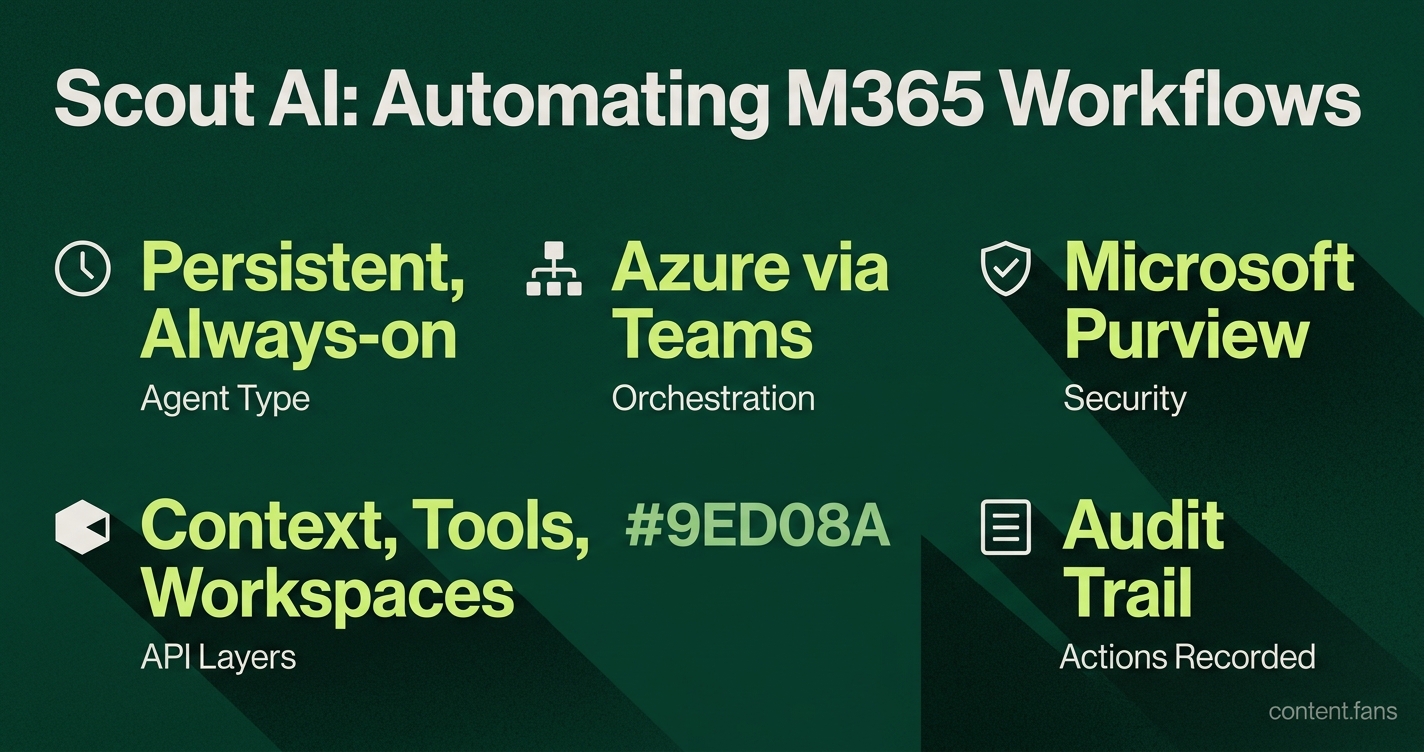
Microsoft has unveiled Scout AI agents for Microsoft 365, a new class of persistent agents designed to automate enterprise workflows. Scout is described by Microsoft as an always-on Autopilot agent with its own identity that acts on your behalf. Operating through Microsoft Teams with Azure orchestration, Scout ensures robust security and governance through enterprise-grade controls.
Core Architecture for Scout and Work IQ
The core architecture places Scout within the user's Teams client, with an Azure-based orchestration plane managing its operations. Work IQ APIs were announced as an intelligence layer for agents to access Microsoft 365 context and data, providing secure, permission-aware access to documents, calendars, and external systems.
A typical Work IQ API deployment utilizes the following domains:
1. Context API: Retrieves permission-filtered work artifacts, such as recent documents or chat threads, to provide relevant context for tasks.
2. Tools API: Executes actions on the user's behalf, like scheduling meetings or sending emails, within a governed framework.
3. Workspaces API: Persists the intermediate state for long-running, multi-step tasks such as generating monthly business reviews.
Architects can extend agent capabilities by publishing reusable connector functions in Azure Functions or Logic Apps, enabling integration with external ITSM or CRM tools. Data traffic is securely handled via A2A for intra-tenant calls or the Model Context Protocol for local Office data access.
Robust Security and Governance Guardrails
Scout is engineered with enterprise security at its core, inheriting all Microsoft Purview policies, including sensitivity labels and data loss prevention (DLP). Every action is meticulously recorded in an audit trail, and a policy conformance system performs continuous checks to ensure compliance with company rules.
For enhanced security, organizations should implement the following hardening steps:
- Register every agent instance in Agent 365 for comprehensive identity observability.
- Limit Work IQ permissions to the minimal tool endpoints required for agent functions.
- Mandate human approval for any Tools API calls that could modify production systems.
- Store all workspace data in an encrypted Cosmos DB account with soft delete enabled.
Example Agent Flows and Prompt Engineering
Scout agents can be configured to handle a variety of automated processes. The following examples demonstrate common use cases:
- Meeting Preparation Agent: Triggers automatically before a scheduled meeting, uses the Context API to gather past notes and open action items, and then generates a draft agenda delivered via the Tools API.
- Automated Reporting Agent: Runs on a recurring schedule, such as the first weekday of the month, to query financial data through a custom connector and generate a PowerPoint summary.
- Bug Triage Agent: Listens to Azure Boards webhooks to automatically suggest priority, assign ownership, and create follow-up tasks in Microsoft Teams for new bugs.
Pro Tip for Prompt Engineering: Maintain stable role instructions for the agent and pass volatile information through the Context API rather than injecting it into the system prompt. This strategy improves reproducibility and reduces prompt length.
Measuring Success: KPIs and Enterprise Readiness
Measuring the impact of Scout deployment relies on tracking key performance indicators (KPIs) that demonstrate value and efficiency gains:
- Average hours returned to employees per week: As reported by Scout's internal logs.
- Policy Conformance Rate: The percentage of agent actions that pass policy checks on the first attempt.
- Mean Time to Resolution (MTTR): The average time taken to resolve automated bug tickets.
Before deploying to a production environment, complete this enterprise readiness checklist:
* Confirm all Work IQ scopes are mapped to documented data flows.
* Ensure the audit trail has been successfully ingested into your SIEM for at least one pilot week.
* Document a fail-safe human handoff process for every critical tool action.
This structured approach enables enterprises to confidently adopt persistent AI agents while leveraging and preserving their existing governance frameworks.
What exactly is Microsoft Scout and how does it differ from Copilot?
Microsoft Scout is an always-on "Autopilot" AI agent that keeps working even when you are away from your keyboard.
Unlike request-based Copilot, Scout maintains persistent background operation: it reads Teams threads, scans Outlook inboxes, monitors calendars, and proactively drafts agendas, books meeting rooms, or nudges owners about stalled decisions without waiting for a prompt.
The agent runs under its own Microsoft Entra identity, giving every instance a governed, scoped credential that inherits your organization's existing sensitivity labels, DLP rules, and Purview controls.
Microsoft positions Scout as the evolution from "assistant you ask" to "colleague that acts."
How does Work IQ fit into the Scout story?
Work IQ is the set of enterprise intelligence APIs that feed Scout (and any custom agent) with Microsoft 365 context while honoring existing permissions.
For architects, the four Work IQ domains matter most:
- Chat - return Copilot-style synthesized answers with citations
- Context - fetch raw emails, files, and threads for custom reasoning
- Tools - perform actions like send mail or schedule meeting via scoped tokens
- Workspaces - store intermediate state for long-running, multi-step workflows
The endpoints support A2A, MCP, and REST so you can plug Scout into ticketing systems, ITSM platforms, or business-process engines without breaking the security model.
Work IQ is expected to become generally available under a consumption-based license that is independent of Microsoft 365 Copilot seats.
Which Microsoft 365 surfaces can Scout touch today?
Scout integrates natively with:
- Teams - interactive bot and side-panel for task approval
- Outlook - reads threads, drafts replies, blocks calendar time
- OneDrive & SharePoint - surfaces relevant files and tracks version comments
- Desktop & browsers - via a lightweight host that can reach local files and MCP servers
Every connector respects conditional-access policies, and sensitive actions (e.g., external mail) can be forced into a human-in-the-loop approval step that is logged to Purview.
What governance controls are baked in?
Governance is not an afterthought; it is the product.
- Identity: Each Scout instance holds its own Entra ID with certificate-bound tokens.
- Policy: Real-time conformance checker halts any action that violates DLP, retention, or compliance labels.
- Audit: Full end-to-end audit trail per action - who approved, what changed, which policy was evoked - exported to Sentinel or your SIEM of choice.
- Data residency: Runs in the same geopolitical boundary as your Microsoft 365 tenant; cross-region calls can be disabled by policy.
How does Scout compare with Salesforce Einstein Copilot or Snowflake Cortex?
| Dimension | Microsoft Scout | Salesforce Einstein Copilot* | Snowflake Cortex AI Agents |
|---|---|---|---|
| Primary Value | Work-context automation inside Microsoft 365 | CRM-native assistance inside Salesforce | Governed data access over Snowflake warehouse |
| Best Fit | Microsoft-first enterprises | Sales & service teams in Salesforce | Data-heavy analytics & regulated industries |
| Lock-in Risk | Tightly coupled to Microsoft Graph & Entra | Locked to Salesforce metadata & permissions | Portable, supports multiple LLM providers |
| Open Source | Extends OpenClaw runtime under MIT-style license | Closed source | Open-source agent orchestration SDKs |
Note: Salesforce also offers Agentforce* for broader orchestration, but Einstein Copilot is the embedded layer comparable to Scout's daily-work focus.