
New AI Agent Playbook Reveals Governance, Metrics Drive Production
Serge Bulaev
Many companies have many AI pilot projects, but few become reliable tools in real work. The new playbook suggests that good rules, clear ways to measure value, and training people may help more pilots succeed. Monitoring alone appears to be common, but experts say stronger controls over who owns and uses each agent are needed. Metrics like cost, quality, speed, and business results should be tracked from the start. It also appears that training workers for their specific roles is important, and firms using these steps may see more pilots move safely into real use with clear business benefits.

While many organizations have launched dozens of AI agent pilots, very few successfully transition them into production-ready tools. This new AI agent playbook outlines a path forward, emphasizing that strong governance, clear metrics, and workforce readiness are the critical pillars for success. Based on recent field studies, this guide details the essential controls, measurement frameworks, and skills that distinguish operational rollouts from stalled experiments.
Governance First, Not Prompts
While prompt engineering often gets the spotlight, effective governance is the true foundation for production success. Data from LangChain's State of Agent Engineering report shows that while 89% of teams monitor agent activity, 32% still identify quality as a "production killer." This highlights that simple observability is not enough. The World Economic Forum confirms this gap, noting many firms cannot even identify agent owners or their permissions.
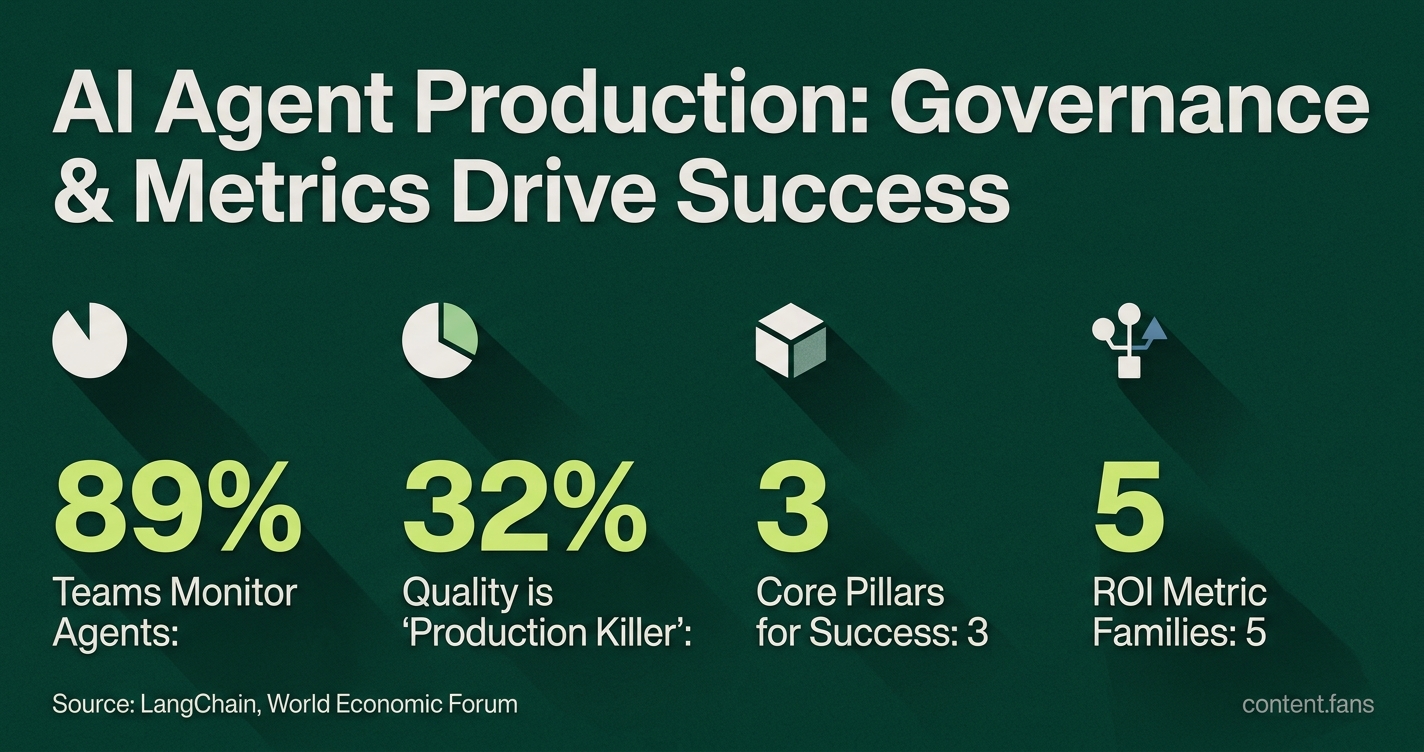
Successful production deployment hinges on three core pillars. First, establish robust governance with clear ownership and runtime policy enforcement. Second, implement a multi-metric framework to prove business value beyond cost savings. Finally, develop role-based upskilling programs to ensure workforce readiness for human-AI collaboration and oversight.
Recommended controls focus on establishing clear identity, policy, and runtime enforcement:
- Maintain a complete inventory of all agents, including their owners, tool access, and delegated privileges.
- Enforce least-privilege access using sandboxed environments for all plugins and tools.
- Embed continuous evaluation frameworks to ensure every tool call is auditable in real time.
- Implement staged rollouts that require human-in-the-loop oversight for high-impact tasks.
Organizations that adopt these controls can effectively prevent unexpected agent behavior and permission drift.
Metrics that Prove Business Value
To secure executive buy-in, teams must prove business value with a comprehensive measurement framework. Moving beyond simple cost savings, a robust ROI model groups impact into five key families:
- Cost: Track cost per task or transaction.
- Speed: Measure improvements in cycle time.
- Quality: Monitor error rates and their impact.
- Risk: Log risk indicators, such as security incident counts.
- Business Outcomes: Connect agent activity to metrics like influenced revenue or customer satisfaction (CSAT).
Experts emphasize the need to capture a baseline before deployment and use median or percentile views to identify outliers more effectively than simple averages. For instance, internal agents often deliver double-digit hour savings, while customer-facing agents show measurable gains in intent resolution when tracked alongside escalation rates.
People Readiness: The Toughest Barrier
Technology and metrics are solvable challenges, but people readiness often presents the most significant hurdle to adoption. As noted by Microsoft, employees must learn to "rearchitect their work around intent and review" instead of just executing tasks. This requires a new approach to upskilling, with practical programs segmented by role:
- All Employees: Receive training on safe agent usage, company policies, and clear escalation paths.
- Managers: Learn to redesign workflows around AI agents and effectively review agent-generated output.
- Champions/Developers: Gain skills to build automations and configure evaluators within low-code or API environments.
- Governance & Security Teams: Train on maintaining the agent inventory, auditing activity, and ensuring data protection.
Instead of tracking simple course completion, leading firms measure demonstrated competence, daily adoption rates, and tangible workflow improvements tied to the business value metrics.
By integrating these three pillars - robust governance controls, multi-metric dashboards, and role-based upskilling - organizations can successfully transition AI agent pilots into production. This strategic approach not only mitigates risk but also delivers clear, quantifiable data that connects agent performance directly to meaningful business outcomes.