
Meta unveils Enterprise Solutions unit, embeds staff in large corporate customers
Serge Bulaev
Meta is planning to create an Enterprise Solutions unit that may place its engineers and product managers inside large companies to help set up Meta's AI tools.

Meta is launching a new Enterprise Solutions unit to embed its technical staff within large corporate customers, a significant strategic shift toward hands-on enterprise services. The initiative, first reported by The Information, will involve placing Meta engineers and product managers on-site to help companies deploy its AI tools link. This model moves Meta from a platform vendor to a services-oriented partner, similar to a strategy previously adopted by major cloud providers.
Why Meta is taking the embedded approach
Meta's embedded approach places its technical experts directly within a client's organization. This hands-on model is designed to accelerate the integration of Meta's AI tools, like Llama models, into the customer's existing workflows and systems, shortening the path from proof-of-concept to full-scale deployment.
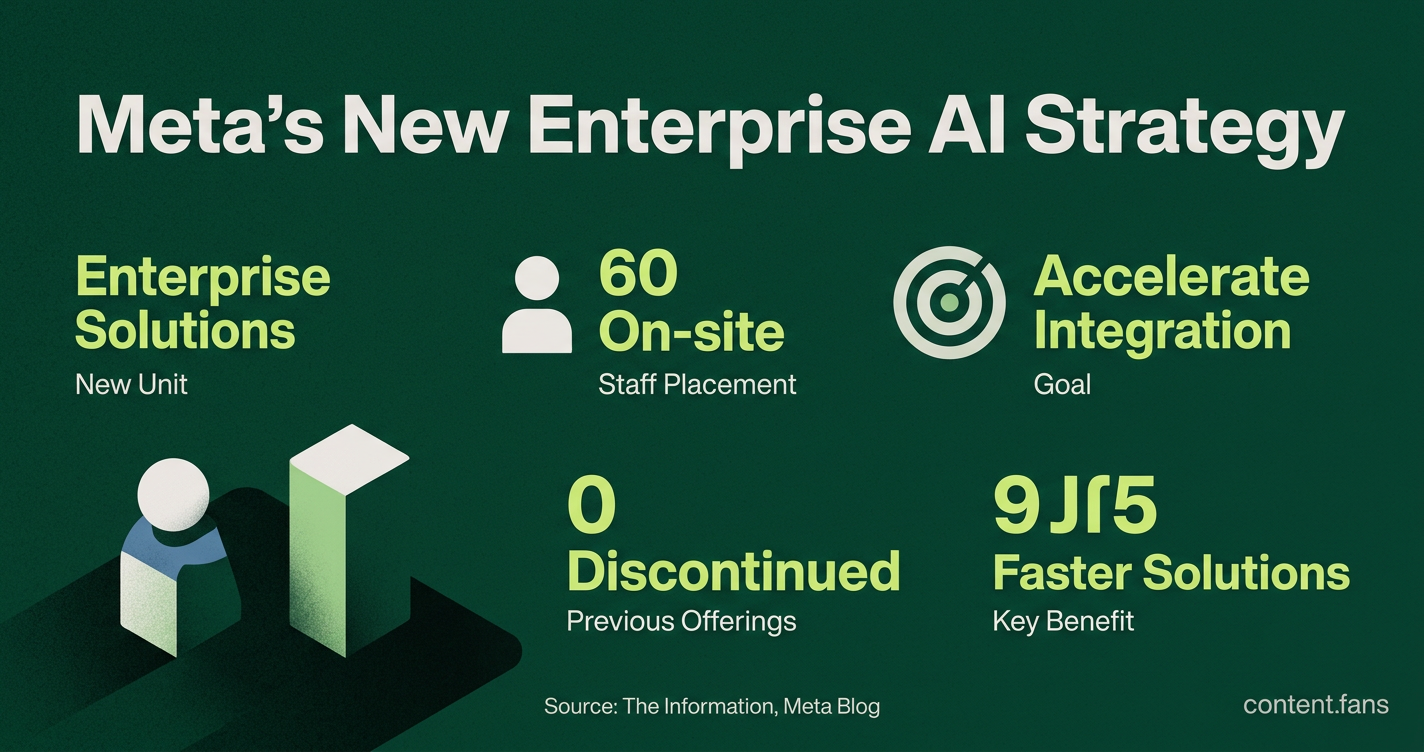
This strategy follows a period of change in Meta's business offerings. The company recently discontinued sales of its Horizon managed services and commercial Quest SKUs, a move analysts believe frees up resources for more intensive AI client engagements Meta blog. The new Enterprise Solutions unit is designed to drive adoption of Meta's AI models, like the Llama family, within complex corporate IT environments. By embedding engineers directly, Meta can overcome common adoption hurdles by tailoring integrations to legacy systems and collaborating with internal security teams.
How the embedded teams may operate
According to industry reports, vendor-client collaboration can accelerate AI rollouts. Meta's embedded teams are expected to focus on key integration tasks:
• mapping data flows between on-premise systems and Meta-hosted inference endpoints.
• creating custom prompts or fine-tunes that respect industry compliance rules.
• training in-house employees to extend and monitor the tooling after Meta exits.
While this model can significantly shorten proof-of-concept timelines, industry research suggests that over-reliance on a small external team risks creating a bottleneck if project demands outpace resources.
Benefits and trade-offs for customers
Customers stand to gain significant advantages:
- Faster workflow integration: Embedded engineers can adapt APIs and data pipelines without long hand-offs.
- Improved governance: On-site product managers can apply enterprise policies before AI features go live.
- Higher trust: Direct collaboration may ease concerns over data leakage or hallucination risk.
However, this approach introduces important trade-offs. Companies must account for the added cost of hosting on-site vendor personnel and establish clear terms for solution ownership and maintenance after the Meta team's engagement ends. Furthermore, governance complexity can increase as more departments seek customized AI support.
Competitive context
This hands-on tactic sets Meta apart from competitors like Microsoft and Google, which primarily generate enterprise AI revenue through cloud services and software subscriptions. While Meta's core business remains focused on consumers and advertising, the Enterprise Solutions unit signals a strategic, targeted move into the enterprise space. This initiative could help justify the company's massive AI infrastructure investment.
Currently, there is no public information regarding the official launch date for Enterprise Solutions or its initial customers. The original report indicates the unit is in the planning stages, and definitive timelines will likely remain unclear pending a formal announcement from Meta.
What is Meta Enterprise Solutions and how does it work?
Meta has quietly formed Meta Enterprise Solutions, a new unit that places its own engineers and product managers inside large corporate customers to speed up deployment of Meta-built AI tools. Instead of selling software licenses and walking away, Meta now keeps staff on-site (or virtually embedded) to configure models, integrate them with legacy systems, and train customer teams.
Why is Meta switching to this hands-on model now?
The move mirrors a wider industry trend: many large enterprises struggle to move AI pilots into production, with a significant portion converting only a small fraction of experiments into live workflows. By embedding experts, Meta shrinks the time between proof-of-concept and company-wide rollout, helping justify its substantial AI infrastructure investments.
How does Meta's approach compare with Microsoft and Google?
Microsoft sells enterprise AI primarily through Azure cloud and Office Copilots, targeting CIOs and IT procurement. Google blends search, cloud, and workspace AI. Meta is the outlier: it keeps the consumer-first DNA, so its embedded teams focus on advertising optimization, creator tools, and customer engagement rather than back-office productivity. In short, Microsoft wants to run your spreadsheets; Meta wants to sharpen your ad targeting.
What are the concrete benefits for customers?
- Faster integration: embedded staff can tweak Llama models to work with fragmented data stacks, cutting integration time by weeks.
- Higher adoption rates: proximity to business teams translates technical jargon into task-level wins, reducing the "shadow AI" risk where employees use unapproved tools.
- Governance guardrails: on-site experts help set compliance rules, audit trails, and explainability frameworks, addressing the trust gaps that stall many AI projects.
What risks should enterprises watch?
Embedding vendor staff can create bottlenecks if all AI requests must flow through a small Meta team. Role confusion may arise over who owns data, models, and downtime. Finally, legacy integration remains hard - embedded engineers speed things up but do not erase technical debt. Enterprises should insist on clear exit criteria so knowledge and model ownership revert in-house once deployment is stable.