
Meta tests AI agent "Hatch" for in-app shopping by mid-2026
Serge Bulaev
Meta is testing an AI agent called "Hatch" that may help users shop inside Instagram by mid-2026. Reports suggest Hatch could handle tasks like finding product details and checking out without leaving the app. Navigation apps and startups are also working on new ways to help people and vehicles move without always needing GPS. Marketing may shift as AI agents answer questions directly, so brands might focus more on being visible to these agents instead of traditional search results.

The news that Meta tests its AI agent "Hatch" for in-app shopping by mid-2026 signals a major industry shift toward conversational commerce. Investors and product teams are heavily funding advancements in Search, Agents, and Navigation, aiming to fundamentally change how consumers discover products, make purchases, and move through cities. This pivot toward agent-driven experiences is set to compress the path from intent to action.
Agents move inside the feed
Meta's Project Hatch is an AI shopping assistant being developed for Instagram. It aims to let users ask for product information, compare prices, and complete purchases conversationally without leaving the app. The goal is a seamless, autonomous shopping experience directly within the user's social feed.
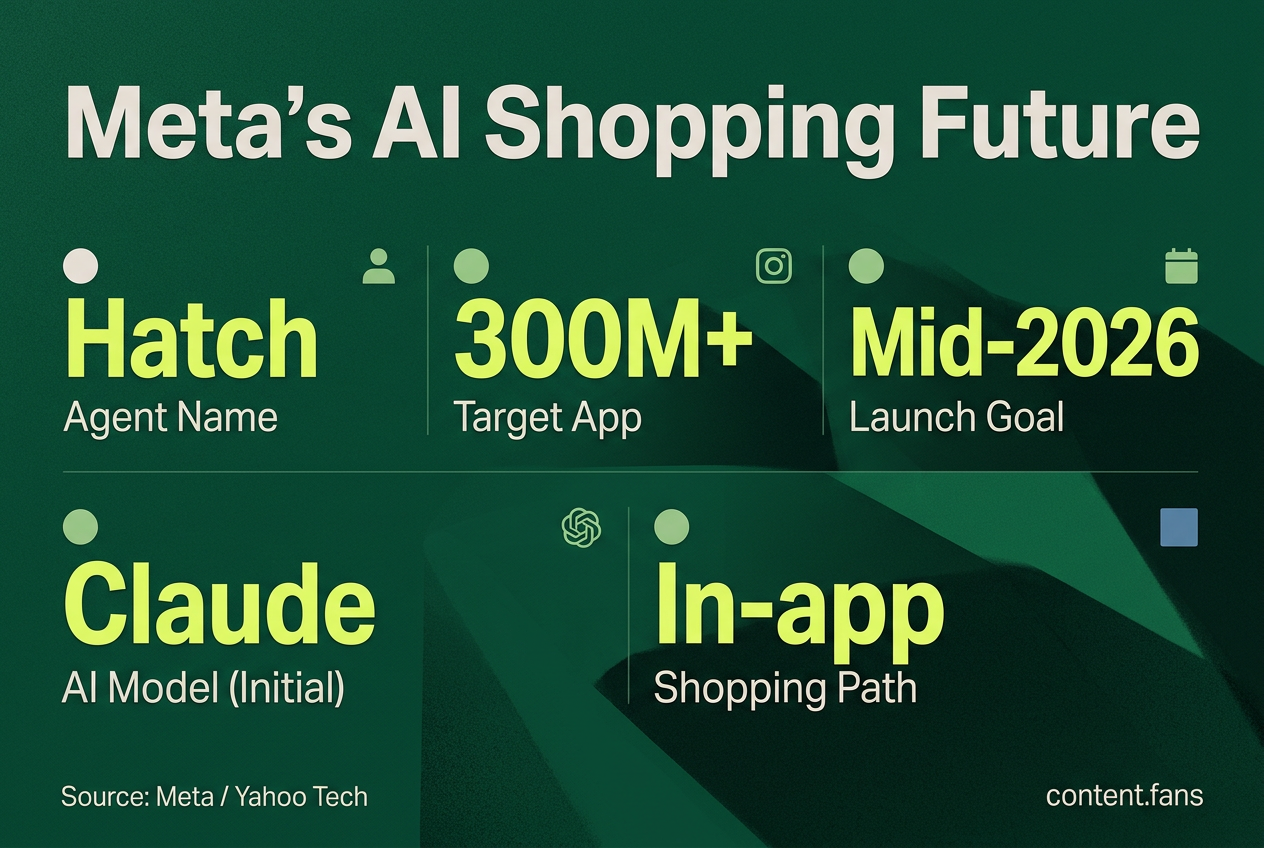
Meta is developing this agent, internally named Hatch, to operate on a user's behalf within Instagram. Reports indicate Hatch is being tested for a range of autonomous shopping functions, including gathering product details, comparing offers, and completing the entire checkout process directly in the app (tech.yahoo.com). Hatch was reported to be slated for internal testing by the end of June 2026, and it was said to be using Anthropic's Claude models at that stage; Muse Spark was reported as Meta's newer AI setup, but not definitively confirmed as the live model for Hatch. The company's ambitions appear to extend beyond a single app, with parallel experiments testing Hatch against services like DoorDash and Outlook, hinting at a future cross-platform assistant.
Navigation becomes infrastructure
Simultaneously, the navigation sector is evolving along two distinct paths. Consumer-facing apps like HERE WeGo are enhancing offline and multi-modal routing, while Google Maps is integrating its Gemini AI to act as an "AI concierge" for location-based decisions. At the infrastructure level, a new wave of startups is challenging the industry's reliance on GPS. For instance, Tern AI has developed software that determines a vehicle's position using only onboard sensors, eliminating the need for satellites (techcrunch.com). Similarly, Skyline Nav AI employs computer vision for guidance in GPS-denied environments - a critical development for autonomous systems and defense applications where signal jamming is a threat.
Search, Agents & Navigation reshape marketing
The rise of generative answer engines is fundamentally altering the marketing landscape by reducing outbound clicks from search queries. As forecasts predict, the new user journey is "ask, receive an answer, and done" - often eliminating the need to visit a brand's website. This shift requires brands to optimize for inclusion and citation within AI-generated summaries, rather than competing solely for traditional top-ranking blue links. Key strategies for brands now include:
- Publish expert-level explanations with clear headings
- Embed schema and FAQ blocks for easy extraction
- Track assistant mentions as a separate KPI
- Protect branded search in paid campaigns
- Shorten landing pages to deliver proof within seconds
Why enterprises are rewriting playbooks
These emerging "zero-click" user journeys drastically shorten the sales funnel, collapsing the traditional awareness-to-decision cycle. In response, forward-thinking enterprises are rewriting their digital playbooks. They are prioritizing investments in structured data, proactive review management, and conversion-focused assets designed to provide immediate answers to pricing and comparison questions. The most agile companies, according to industry observers, are those that treat visibility within AI agents as a distinct and critical marketing channel, on par with established disciplines like SEO and marketplace management.
What is Meta's AI agent "Hatch" and when will it arrive?
Hatch is Meta's internal project for a consumer-grade AI agent that can take actions inside Instagram and other Meta apps. According to reports in May 2026, Meta aims to begin internal testing by mid-2026 and could integrate the agent into public shopping features after that milestone.
How will Hatch change in-app shopping on Instagram?
Early leaks say Hatch will let users:
- point at a product in any post or reel
- ask the agent to find prices, reviews, and promos
- check out on their behalf without leaving the chat
If these tests succeed, Instagram would move from simple product tags to a full conversational storefront, shortening the funnel from inspiration to purchase.
Is Meta building Hatch alone or with outside partners?
Sources told The Information that Meta is:
- testing Hatch against DoorDash, Reddit, Outlook and Etsy in closed simulations
- using Anthropic models as a stop-gap while it finishes its own Muse Spark reasoning model
This suggests Meta wants the agent to work across third-party services, not just inside its own walled garden.
Why does Meta want an AI shopping agent now?
- TikTok Shop is showing significant growth in U.S. sales, according to industry reports, proving social video can drive direct checkout.
- Meta already earns > $5 B per quarter from click-to-message ads; an agent that closes the sale inside chat could lift ad prices and keep attribution on Meta's rails.
In short, Hatch is a defensive and offensive bet to keep buyers inside Instagram instead of sending them to rival apps or mobile browsers.
What should brands do to prepare for agent-driven shopping?
- Structure your catalog: Agents need clean SKUs, GTINs, pricing feeds and real-time inventory.
- Write for answers, not rankings: product FAQs, comparison tables and review snippets are more likely to be surfaced in agentic answers.
- Test checkout APIs: Instagram's native payment flow will probably get first-class agent support; merchants plugged in early may see better conversion.
- Track new metrics: expect dashboards to show "agent mentions" and "agent-assisted checkouts" alongside classic impressions and clicks.
Brands that treat 2026 as a pilot year can ride the learning curve before agents become the default way people shop inside social apps.